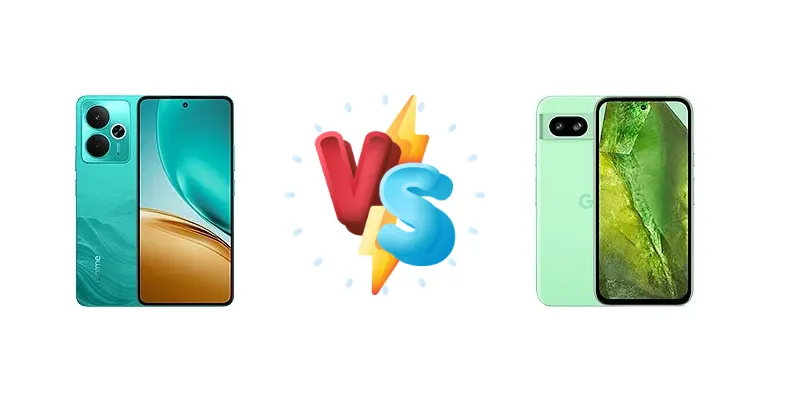
The Realme 14T and Google Pixel 8a represent distinct approaches to the mid-range smartphone market. The Realme 14T prioritizes longevity and rapid charging, while the Pixel 8a focuses on a refined software experience and Google’s Tensor G3 chipset. This comparison dissects their key differences to help you determine which device best suits your priorities.
🏆 Quick Verdict
For users prioritizing all-day battery life and fast charging, the Realme 14T is the clear winner, boasting a 72:49h endurance rating. However, the Google Pixel 8a’s Tensor G3 chip and superior display brightness make it the better choice for those valuing performance and a premium visual experience.
| Network |
|---|
| 2G bands | GSM 850 / 900 / 1800 / 1900 | GSM 850 / 900 / 1800 / 1900 |
| 3G bands | HSDPA 850 / 900 / 2100 | HSDPA 800 / 850 / 900 / 1700(AWS) / 1900 / 2100 |
| 4G bands | 1, 3, 5, 8, 28, 40, 41 | 1, 2, 3, 4, 5, 7, 8, 12, 17, 18, 19, 20, 26, 28, 32, 38, 40, 41, 42, 66 - G6GPR (International) |
| 5G bands | 1, 3, 5, 8, 28, 40, 41, 77, 78 SA/NSA | 1, 2, 3, 5, 7, 8, 12, 20, 26, 28, 38, 40, 41, 66, 75, 76, 77, 78 SA/NSA/Sub6 - G6GPR (International) |
| Speed | HSPA, LTE, 5G | HSPA, LTE, 5G |
| Technology | GSM / HSPA / LTE / 5G | GSM / HSPA / LTE / 5G |
| Launch |
|---|
| Announced | 2025, April 25 | 2024, May 07 |
| Status | Available. Released 2025, April 25 | Available. Released 2024, May 14 |
| Body |
|---|
| Build | Glass front, plastic back | Glass front (Gorilla Glass 3), aluminum frame, plastic back |
| Dimensions | 163.2 x 75.7 x 8 mm (6.43 x 2.98 x 0.31 in) | 152.1 x 72.7 x 8.9 mm (5.99 x 2.86 x 0.35 in) |
| SIM | Nano-SIM + Nano-SIM | Nano-SIM + eSIM |
| Weight | 196 g (6.91 oz) | 188 g (6.63 oz) |
| Display |
|---|
| Protection | Mohs level 5 | Corning Gorilla Glass 3, Mohs level 5 |
| Resolution | 1080 x 2400 pixels, 20:9 ratio (~386 ppi density) | 1080 x 2400 pixels, 20:9 ratio (~430 ppi density) |
| Size | 6.67 inches, 112.5 cm2 (~91.0% screen-to-body ratio) | 6.1 inches, 90.3 cm2 (~81.6% screen-to-body ratio) |
| Type | AMOLED, 120Hz, 2100 nits (peak) | OLED, HDR, 120Hz, 2000 nits (peak) |
| Platform |
|---|
| CPU | Octa-core (2x2.4 GHz Cortex-A76 & 6x2.0 GHz Cortex-A55) | Nona-core (1x3.0 GHz Cortex-X3 & 4x2.45 GHz Cortex-A715 & 4x2.15 GHz Cortex-A510) |
| Chipset | Mediatek Dimensity 6300 (6 nm) | Google Tensor G3 (4 nm) |
| GPU | Mali-G57 MC2 | Immortalis-G715s MC10 |
| OS | Android 15, up to 3 major Android upgrades, Realme UI 6.0 | Android 14, upgradable to Android 16, up to 7 major Android upgrades |
| Memory |
|---|
| Card slot | No | No |
| Internal | 128GB 8GB RAM, 256GB 8GB RAM, 256GB 12GB RAM | 128GB 8GB RAM, 256GB 8GB RAM |
| Main Camera |
|---|
| Dual | 50 MP, f/1.8, 27mm (wide), 1/2.88", PDAF
2 MP, f/2.4 | 64 MP (16 MP eff.), f/1.9, 26mm (wide), 1/1.73", 0.8µm, dual pixel PDAF, OIS
13 MP, f/2.2, 120˚ (ultrawide), 1.12µm |
| Features | LED flash, HDR, panorama | Dual-LED flash, Pixel Shift, Ultra HDR, panorama, Best Take |
| Video | 1080p@30/60, gyro-EIS | 4K@30/60fps, 1080p@30/60/120/240fps, OIS |
| Selfie camera |
|---|
| Features | - | HDR, panorama |
| Single | 16 MP, f/2.4, 23mm (wide), 1/3.09" | 13 MP, f/2.2, 20mm (ultrawide), 1.12µm |
| Video | 1080p@30fps | 4K@30fps, 1080p@30/60fps |
| Sound |
|---|
| 35mm jack | No | No |
| Loudspeaker | Yes, with stereo speakers | Yes, with stereo speakers |
| Comms |
|---|
| Bluetooth | 5.3, A2DP, LE | 5.3, A2DP, LE |
| NFC | Yes (market/region dependent) | Yes |
| Positioning | GPS, GLONASS, GALILEO, BDS, QZSS | GPS, GLONASS, GALILEO, BDS, QZSS, NavIC |
| Radio | No | No |
| USB | USB Type-C | USB Type-C 3.2 |
| WLAN | Wi-Fi 802.11 a/b/g/n/ac, dual-band | Wi-Fi 802.11 a/b/g/n/ac/6e, dual/tri-band (market/region dependent) |
| Features |
|---|
| Sensors | Fingerprint (under display, optical), accelerometer, gyro, proximity, compass | Fingerprint (under display, optical), accelerometer, gyro, proximity, compass, barometer |
| Battery |
|---|
| Charging | 45W wired, 50% in 30 min | 18W wired, PD3.0
7.5W wireless
Bypass charging |
| Type | 6000 mAh | Li-Po 4492 mAh |
| Misc |
|---|
| Colors | Surf Green, Obsidian Black, Lightning Purple | Obsidian, Porcelain, Bay, Aloe |
| Models | RMX5078 | GKV4X, G6GPR, G8HHN, G576D |
| Price | $ 219.23 / € 223.80 / ₹ 16,499 | $ 229.98 / C$ 417.99 / £ 279.00 / € 299.99 / ₹ 33,300 |
| EU LABEL |
|---|
| Battery | 72:49h endurance, 1600 cycles | 40:06h endurance, 1000 cycles |
| Energy | Class A | Class B |
| Free fall | Class C (90 falls) | Class A (270 falls) |
| Repairability | Class B | Class B |
Realme 14T
- Exceptional battery life (72:49h endurance)
- Ultra-fast 45W charging
- Long battery lifespan (1600 cycles)
- Performance may lag behind Pixel 8a in demanding tasks
- Display brightness and quality likely inferior to Pixel 8a
Google Pixel 8a
- Powerful Google Tensor G3 chipset
- Bright and vibrant display (1508 nits)
- Superior camera image processing
- Significantly shorter battery life (40:06h endurance)
- Slower 18W charging
Display Comparison
The Google Pixel 8a boasts a significantly brighter display, reaching a measured 1508 nits, compared to the Realme 14T (brightness data unavailable). This higher peak brightness translates to improved visibility in direct sunlight. While the Realme 14T’s panel specifics are unknown, the Pixel 8a’s OLED panel delivers vibrant colors and deep blacks. The Pixel 8a’s display is likely to offer a more immersive viewing experience, particularly for media consumption. The absence of LTPO technology in either device suggests neither offers adaptive refresh rates for power saving.
Camera Comparison
Without detailed camera specifications for the Realme 14T, a direct comparison is limited. However, the Pixel 8a benefits from Google’s renowned computational photography capabilities, leveraging the Tensor G3’s image signal processor. While sensor size and aperture data are missing for the Realme 14T, the Pixel 8a’s image processing excels in dynamic range and low-light performance. The Pixel 8a’s focus on software optimization likely provides a more consistent and user-friendly camera experience.
Performance
The Google Pixel 8a’s Tensor G3, built on a 4nm process, offers a more complex CPU configuration – a nona-core setup with a Cortex-X3 prime core – compared to the Realme 14T’s octa-core Dimensity 6300 (6nm). This architectural difference suggests the Tensor G3 will deliver superior performance in demanding tasks like video editing and gaming. The Dimensity 6300, while efficient, is geared towards smooth everyday performance. The Pixel 8a’s CPU configuration (1x3.0 GHz Cortex-X3, 4x2.45 GHz Cortex-A715, 4x2.15 GHz Cortex-A510) provides a wider range of processing power, while the Realme 14T relies on (2x2.4 GHz Cortex-A76 & 6x2.0 GHz Cortex-A55).
Battery Life
The Realme 14T dominates in battery endurance, achieving a remarkable 72:49h rating, significantly exceeding the Pixel 8a’s 40:06h. This difference is substantial, indicating the Realme 14T can last nearly two full days on a single charge for typical users. The Realme 14T also supports 45W wired charging, achieving 50% charge in just 30 minutes, while the Pixel 8a is limited to 18W wired charging with PD3.0 and 7.5W wireless charging. The Realme 14T’s 1600 charge cycles also suggest a longer lifespan for the battery itself, compared to the Pixel 8a’s 1000 cycles.
Buying Guide
Buy the Realme 14T if you need exceptional battery life, consistently fast charging, and a dependable processor for everyday tasks. It’s ideal for users who frequently travel or rely heavily on their phone throughout the day. Buy the Google Pixel 8a if you prefer a smoother, more responsive user experience powered by Google’s Tensor G3, a brighter and more vibrant display, and a focus on computational photography.
Frequently Asked Questions
❓ How much faster is the Realme 14T's charging compared to the Pixel 8a in real-world use?
The Realme 14T's 45W charging can deliver a 50% charge in 30 minutes, while the Pixel 8a's 18W charging will take considerably longer – likely over an hour to reach 50%. This makes the Realme 14T ideal for users who need a quick power boost before leaving the house.
❓ Will the Google Tensor G3 in the Pixel 8a handle graphically intensive games like Genshin Impact smoothly?
The Tensor G3 is capable of running Genshin Impact, but you may need to lower graphics settings for a consistently smooth experience. The Realme 14T’s Dimensity 6300 may struggle with the same game at higher settings, but its efficiency could lead to less thermal throttling during extended gaming sessions.
❓ Does the Pixel 8a support wireless charging, and is it practical?
Yes, the Pixel 8a supports 7.5W wireless charging. However, this is significantly slower than the Realme 14T’s wired charging and even slower than many other wireless charging solutions. It’s best suited for overnight or occasional top-ups rather than rapid charging.
❓ How does the Realme 14T's battery hold up over several years of use, considering its 1600 charge cycle rating?
The 1600 charge cycle rating suggests the Realme 14T’s battery is designed for longevity. It indicates the battery should retain a significant portion of its capacity even after multiple years of daily charging and discharging, exceeding the Pixel 8a's 1000 cycle rating.