
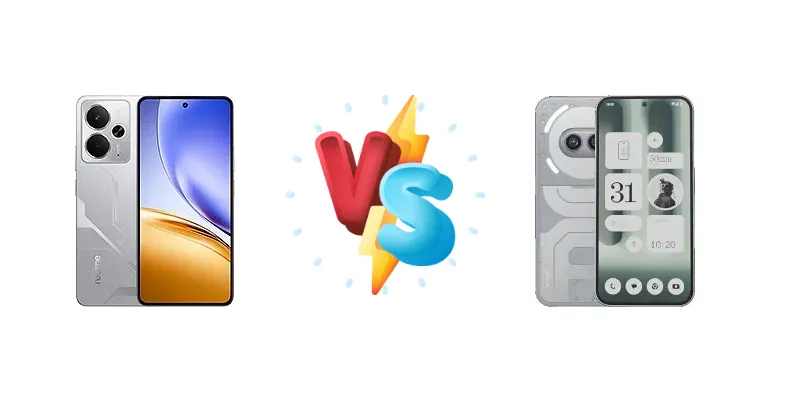
Realme 14 vs Nothing Phone (2a) Plus: A Deep Dive into Mid-Range Contenders
| Phones Images | |||||
|---|---|---|---|---|---|
|
🏆 Quick Verdict
For the average user prioritizing sustained battery life and a proven chipset, the Realme 14 emerges as the winner. Its 70:12h endurance and 1400 charge cycles offer peace of mind. However, users who value a brighter display and quicker charging will find the Nothing Phone (2a) Plus more appealing.
| PHONES | ||
|---|---|---|
| Phone Names | Realme 14 | Nothing Phone (2a) Plus |
| Network | ||
|---|---|---|
| 2G bands | GSM 850 / 900 / 1800 / 1900 | GSM 850 / 900 / 1800 / 1900 |
| 3G bands | HSDPA 800 / 850 / 900 / 1700(AWS) / 1900 / 2100 | HSDPA 800 / 850 / 900 / 1700(AWS) / 1900 / 2100 |
| 4G bands | 1, 2, 3, 4, 5, 7, 8, 12, 13, 17, 18, 19, 20, 26, 28, 38, 40, 41, 66 | 1, 3, 4, 5, 7, 8, 18, 19, 20, 26, 28, 38, 39, 40, 41, 42, 66 |
| 5G bands | 1, 2, 3, 5, 7, 8, 20, 26, 28, 38, 40, 41, 66, 77, 78 SA/NSA | 1, 3, 5, 7, 8, 20, 28, 38, 40, 41, 66, 77, 78 SA/NSA |
| Speed | HSPA, LTE, 5G | HSPA, LTE, 5G |
| Technology | GSM / HSPA / LTE / 5G | GSM / HSPA / LTE / 5G |
| Launch | ||
|---|---|---|
| Announced | 2025, March 27 | 2024, July 31 |
| Status | Available. Released 2025, March 27 | Available. Released 2024, August 03 |
| Body | ||
|---|---|---|
| Build | - | Glass front (Gorilla Glass 5), plastic frame, plastic back |
| Dimensions | 163.1 x 75.7 x 8 mm (6.42 x 2.98 x 0.31 in) | 161.7 x 76.3 x 8.5 mm (6.37 x 3.00 x 0.33 in) |
| SIM | · Nano-SIM + Nano-SIM + eSIM (max 2 at a time)· Nano-SIM + Nano-SIM | Nano-SIM + Nano-SIM |
| Weight | 196 g (6.91 oz) | 190 g (6.70 oz) |
| Display | ||
|---|---|---|
| Protection | Mohs level 5 | Corning Gorilla Glass 5 |
| Resolution | 1080 x 2400 pixels, 20:9 ratio (~395 ppi density) | 1080 x 2412 pixels, 20:9 ratio (~395 ppi density) |
| Size | 6.67 inches, 107.4 cm2 (~87.0% screen-to-body ratio) | 6.7 inches, 107.5 cm2 (~87.1% screen-to-body ratio) |
| Type | AMOLED, 120Hz, 2000 nits (peak) | AMOLED, 1B colors, 120Hz, 2160Hz PWM, HDR10+, 700 nits (typ), 1100 nits (HBM), 1300 nits (peak) |
| Platform | ||
|---|---|---|
| CPU | Octa-core (1x2.3 GHz Cortex-A720s & 3x2.2 GHz Cortex-A720s & 4x1.8 GHz Cortex-A520s) | Octa-core (2x3.0 GHz Cortex-A715 & 6x 2.0 GHz Cortex-A510) |
| Chipset | Qualcomm Snapdragon 6 Gen 4 (4 nm) | Mediatek Dimensity 7350 Pro (4 nm) |
| GPU | Adreno 810 | Mali-G610 MC4 |
| OS | Android 15, Realme UI 6.0 | Android 14, up to 3 major Android upgrades, Nothing OS 3.0 |
| Memory | ||
|---|---|---|
| Card slot | microSDXC (uses shared SIM slot) | No |
| Internal | 256GB 8GB RAM, 256GB 12GB RAM, 512GB 12GB RAM | 256GB 8GB RAM, 256GB 12GB RAM |
| Main Camera | ||
|---|---|---|
| Dual | - | 50 MP, f/1.9, 24mm (wide), 1/1.57", 1.0µm, PDAF, OIS 50 MP, f/2.2, 114˚ (ultrawide), 1/2.76", 0.64µm |
| Features | LED flash, HDR, panorama | LED flash, panorama, HDR |
| Single | 50 MP, f/1.8, 27mm (wide), PDAF, OIS | - |
| Video | 4K@30fps, 1080p@30/60/120fps, gyro-EIS, OIS | 4K@30fps, 1080p@60/120fps, gyro-EIS |
| Selfie camera | ||
|---|---|---|
| Features | Panorama | HDR |
| Single | 16 MP, f/2.4, 24mm (wide), 1/3.0" | 50 MP, f/2.2, (wide), 1/2.76" |
| Video | 1080p@30fps | 4K@30fps |
| Sound | ||
|---|---|---|
| 35mm jack | No | No |
| Loudspeaker | Yes, with stereo speakers | Yes, with stereo speakers |
| Comms | ||
|---|---|---|
| Bluetooth | 5.2, A2DP, LE | 5.3, A2DP, LE |
| NFC | No | Yes, 360˚ |
| Positioning | GPS, GLONASS, GALILEO, BDS, QZSS | GPS, GALILEO, GLONASS, BDS, QZSS |
| Radio | No | No |
| USB | USB Type-C | USB Type-C 2.0, OTG |
| WLAN | Wi-Fi 802.11 a/b/g/n/ac/6, dual-band | Wi-Fi 802.11 a/b/g/n/ac/6, dual-band, Wi-Fi Direct |
| Features | ||
|---|---|---|
| Sensors | Fingerprint (under display, optical), accelerometer, gyro, proximity, compass | Fingerprint (under display, optical), accelerometer, gyro, proximity, compass |
| Battery | ||
|---|---|---|
| Charging | 45W wired, 50% in 30 min Bypass charging | 50W wired, 50% in 21 min, 100% in 56 min |
| Type | Si/C Li-Ion 6000 mAh | 5000 mAh |
| Misc | ||
|---|---|---|
| Colors | Silver, Titanium, Pink | Black, Grey |
| Models | RMX5070 | A142P |
| Price | About 490 EUR | € 269.90 / ₹ 22,599 |
| EU LABEL | ||
|---|---|---|
| Battery | 70:12h endurance, 1400 cycles | - |
| Energy | Class A | - |
| Free fall | Class C (90 falls) | - |
| Repairability | Class B | - |
Realme 14
- Exceptional battery endurance (70:12h)
- Long-term battery health with 1400 charge cycles
- Efficient Snapdragon 6 Gen 4 chipset
- Display brightness data unavailable
- Charging speed slower than the competition
Nothing Phone (2a) Plus
- Bright and vibrant display (1097 nits)
- Faster charging (50W, 56 min to full)
- Potentially stronger CPU performance
- Shorter battery life (16:34h)
- Battery health longevity unknown
Display Comparison
The Nothing Phone (2a) Plus boasts a significant advantage in display technology, achieving a measured peak brightness of 1097 nits. This translates to superior visibility in direct sunlight compared to the Realme 14, which lacks specific brightness data. While the Realme 14’s panel characteristics are unknown, the Nothing Phone (2a) Plus’s high brightness is a clear benefit for outdoor users and media consumers. The absence of LTPO technology on either device suggests both will rely on adaptive refresh rates to conserve power, but the Nothing Phone (2a) Plus’s brighter panel will likely consume more energy at peak brightness.
Camera Comparison
Detailed camera specifications are limited, but we can infer some differences. The absence of information regarding sensor sizes on the Realme 14 suggests it likely employs a more standard configuration. The Nothing Phone (2a) Plus, while also lacking detailed specs, benefits from the brand’s focus on image quality. Without knowing aperture values or OIS implementation on either device, it’s difficult to definitively declare a winner. However, the Nothing Phone (2a) Plus’s brand reputation suggests a more refined image processing pipeline.
Performance
Under the hood, the Nothing Phone (2a) Plus leverages the Mediatek Dimensity 7350 Pro (4nm) with a CPU configuration of 2x3.0 GHz Cortex-A715 cores and 6x2.0 GHz Cortex-A510 cores. This contrasts with the Realme 14’s Qualcomm Snapdragon 6 Gen 4 (4nm) featuring 1x2.3 GHz Cortex-A720s, 3x2.2 GHz Cortex-A720s, and 4x1.8 GHz Cortex-A520s cores. While core counts are similar, the Dimensity 7350 Pro’s higher clock speeds on its prime cores suggest a performance edge in demanding tasks. However, the Snapdragon 6 Gen 4’s architecture, utilizing newer Cortex-A720 series cores, may offer improved efficiency and sustained performance. The 4nm process node on both chipsets indicates comparable thermal efficiency, but real-world throttling will depend on each phone’s cooling solution.
Battery Life
Battery life is a key differentiator. The Realme 14 boasts an impressive 70:12h endurance score and a remarkable 1400 charge cycles, indicating exceptional longevity and resistance to battery degradation. The Nothing Phone (2a) Plus achieves 16:34h of active use, a respectable figure, but significantly lower than the Realme 14. Charging speeds differ as well: the Realme 14 supports 45W wired charging, reaching 50% in 30 minutes, while the Nothing Phone (2a) Plus offers 50W charging, achieving 50% in 21 minutes and a full charge in 56 minutes. The Nothing Phone (2a) Plus’s faster charging is convenient, but the Realme 14’s superior endurance and battery health promise long-term value.
Buying Guide
Buy the Realme 14 if you need exceptional battery longevity, are concerned about long-term battery degradation, and prioritize a stable, well-established chipset. Buy the Nothing Phone (2a) Plus if you prefer a vibrant, high-brightness display for outdoor use, demand faster charging speeds, and appreciate a more minimalist software experience.