
Realme 14 vs Google Pixel 7a: A Deep Dive into Value and Endurance
| Phones Images | |||||
|---|---|---|---|---|---|
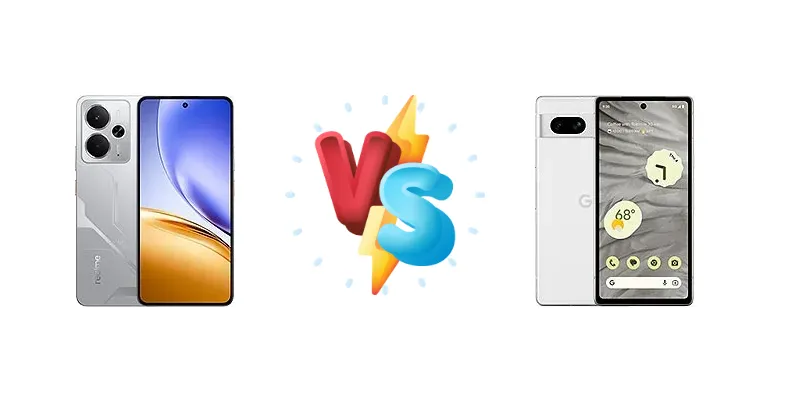
|
🏆 Quick Verdict
For the average user prioritizing all-day battery life and rapid charging, the Realme 14 emerges as the winner. While the Pixel 7a boasts a superior display and camera processing, the Realme 14’s 70-hour endurance and 45W charging offer a more practical experience for power users and those on the go.
| PHONES | ||
|---|---|---|
| Phone Names | Realme 14 | Google Pixel 7a |
| Network | ||
|---|---|---|
| 2G bands | GSM 850 / 900 / 1800 / 1900 | GSM 850 / 900 / 1800 / 1900 |
| 3G bands | HSDPA 800 / 850 / 900 / 1700(AWS) / 1900 / 2100 | HSDPA 800 / 850 / 900 / 1700(AWS) / 1900 / 2100 |
| 4G bands | 1, 2, 3, 4, 5, 7, 8, 12, 13, 17, 18, 19, 20, 26, 28, 38, 40, 41, 66 | 1, 2, 3, 4, 5, 7, 8, 12, 13, 14, 17, 20, 25, 26, 28, 29, 30, 38, 40, 41, 48, 66, 71 - GWKK3, G0DZQ |
| 5G bands | 1, 2, 3, 5, 7, 8, 20, 26, 28, 38, 40, 41, 66, 77, 78 SA/NSA | 1, 2, 3, 5, 7, 8, 12, 14, 20, 25, 28, 30, 38, 41, 48, 66, 71, 77, 78 SA/NSA/Sub6 - GWKK3 |
| Speed | HSPA, LTE, 5G | HSPA, LTE, 5G |
| Technology | GSM / HSPA / LTE / 5G | GSM / HSPA / LTE / 5G |
| - | 1, 2, 3, 5, 7, 8, 12, 20, 25, 28, 38, 40, 41, 66, 75, 76, 77, 78, 79 SA/NSA/Sub6 - GHL1X, G82U8 | |
| Launch | ||
|---|---|---|
| Announced | 2025, March 27 | 2023, May 10 |
| Status | Available. Released 2025, March 27 | Available. Released 2023, May 10 |
| Body | ||
|---|---|---|
| Build | - | Glass front (Gorilla Glass 3), aluminum frame, plastic back |
| Dimensions | 163.1 x 75.7 x 8 mm (6.42 x 2.98 x 0.31 in) | 152 x 72.9 x 9 mm (5.98 x 2.87 x 0.35 in) |
| SIM | · Nano-SIM + Nano-SIM + eSIM (max 2 at a time)· Nano-SIM + Nano-SIM | Nano-SIM + eSIM |
| Weight | 196 g (6.91 oz) | 193.5 g (6.84 oz) |
| - | IP67 dust/water resistant (up to 1m for 30 min) | |
| Display | ||
|---|---|---|
| Protection | Mohs level 5 | Corning Gorilla Glass 3 |
| Resolution | 1080 x 2400 pixels, 20:9 ratio (~395 ppi density) | 1080 x 2400 pixels, 20:9 ratio (~429 ppi density) |
| Size | 6.67 inches, 107.4 cm2 (~87.0% screen-to-body ratio) | 6.1 inches, 90.7 cm2 (~81.8% screen-to-body ratio) |
| Type | AMOLED, 120Hz, 2000 nits (peak) | OLED, HDR, 90Hz |
| - | Always-on display | |
| Platform | ||
|---|---|---|
| CPU | Octa-core (1x2.3 GHz Cortex-A720s & 3x2.2 GHz Cortex-A720s & 4x1.8 GHz Cortex-A520s) | Octa-core (2x2.85 GHz Cortex-X1 & 2x2.35 GHz Cortex-A78 & 4x1.80 GHz Cortex-A55) |
| Chipset | Qualcomm Snapdragon 6 Gen 4 (4 nm) | Google Tensor G2 (5 nm) |
| GPU | Adreno 810 | Mali-G710 MP7 |
| OS | Android 15, Realme UI 6.0 | Android 13, upgradable to Android 15, up to 5 major Android upgrades |
| Memory | ||
|---|---|---|
| Card slot | microSDXC (uses shared SIM slot) | No |
| Internal | 256GB 8GB RAM, 256GB 12GB RAM, 512GB 12GB RAM | 128GB 8GB RAM |
| - | UFS 3.1 | |
| Main Camera | ||
|---|---|---|
| Dual | - | 64 MP, f/1.9, 26mm (wide), 1/1.73", 0.8µm, dual pixel PDAF, OIS 13 MP, f/2.2, 120˚ (ultrawide), 1.12µm |
| Features | LED flash, HDR, panorama | Dual-LED flash, Pixel Shift, Auto-HDR, panorama |
| Single | 50 MP, f/1.8, 27mm (wide), PDAF, OIS | - |
| Video | 4K@30fps, 1080p@30/60/120fps, gyro-EIS, OIS | 4K@30/60fps, 1080p@30/60/120/240fps, OIS |
| Selfie camera | ||
|---|---|---|
| Features | Panorama | HDR, panorama |
| Single | 16 MP, f/2.4, 24mm (wide), 1/3.0" | 13 MP, f/2.2, 20mm (ultrawide), 1.12µm |
| Video | 1080p@30fps | 4K@30fps, 1080p@30fps |
| Sound | ||
|---|---|---|
| 3.5mm jack | - | No |
| 35mm jack | No | No |
| Loudspeaker | Yes, with stereo speakers | Yes, with stereo speakers |
| Comms | ||
|---|---|---|
| Bluetooth | 5.2, A2DP, LE | 5.3, A2DP, LE |
| NFC | No | Yes |
| Positioning | GPS, GLONASS, GALILEO, BDS, QZSS | GPS, GLONASS, GALILEO, BDS, QZSS, NavIC |
| Radio | No | No |
| USB | USB Type-C | USB Type-C 3.2 |
| WLAN | Wi-Fi 802.11 a/b/g/n/ac/6, dual-band | Wi-Fi 802.11 a/b/g/n/ac/6e, tri-band |
| Features | ||
|---|---|---|
| Sensors | Fingerprint (under display, optical), accelerometer, gyro, proximity, compass | Fingerprint (under display, optical), accelerometer, gyro, proximity, compass, barometer |
| Battery | ||
|---|---|---|
| Charging | 45W wired, 50% in 30 min Bypass charging | 18W wired, PD3.0 7.5W wireless |
| Type | Si/C Li-Ion 6000 mAh | Li-Po 4385 mAh |
| Misc | ||
|---|---|---|
| Colors | Silver, Titanium, Pink | Charcoal, Snow, Sea, Coral |
| Models | RMX5070 | GWKK3, GHL1X, G0DZQ, G82U8 |
| Price | About 490 EUR | € 179.90 / $ 150.00 / £ 170.00 / ₹ 25,980 |
| EU LABEL | ||
|---|---|---|
| Battery | 70:12h endurance, 1400 cycles | - |
| Energy | Class A | - |
| Free fall | Class C (90 falls) | - |
| Repairability | Class B | - |
Realme 14
- Exceptional battery life (70h endurance)
- Ultra-fast 45W charging
- High battery cycle count (1400 cycles)
- Display brightness and quality are likely inferior
- Camera performance is less proven
Google Pixel 7a
- Superior display brightness (1070 nits)
- Excellent camera quality and image processing
- Google’s software and AI features
- Shorter battery life (76h endurance)
- Slow 18W charging
- Less efficient chipset
Display Comparison
The Google Pixel 7a takes a clear lead in display quality, boasting a measured peak brightness of 1070 nits. This significantly enhances outdoor visibility compared to the Realme 14, which lacks published brightness data. While the Realme 14’s panel technology isn’t specified, the Pixel 7a’s OLED panel delivers richer colors and deeper blacks. The absence of high refresh rate information for the Realme 14 suggests a standard 60Hz panel, further widening the gap in visual smoothness compared to potential 90Hz or 120Hz options found in competing devices.
Camera Comparison
The Pixel 7a’s camera system is its strongest asset. While specific sensor details are absent for both phones, Google’s computational photography prowess, powered by the Tensor G2, delivers exceptional image quality, particularly in challenging lighting conditions. The Realme 14’s camera capabilities are less defined, and without sensor size or aperture information, it’s difficult to assess its low-light performance. The Pixel 7a’s video recording capabilities are also likely superior, benefiting from the Tensor G2’s image signal processor. The absence of details regarding OIS on the Realme 14 suggests it may lack this feature, further disadvantaging it in video stabilization.
Performance
The chipset battle pits Qualcomm’s Snapdragon 6 Gen 4 (4nm) against Google’s Tensor G2 (5nm). While the Tensor G2 features higher clock speeds on its prime cores (2.85 GHz Cortex-X1 vs 2.3 GHz Cortex-A720s), the Snapdragon 6 Gen 4’s more efficient 4nm process and optimized core configuration (1x2.3 GHz Cortex-A720s, 3x2.2 GHz Cortex-A720s, 4x1.8 GHz Cortex-A520s) suggest comparable, if not superior, sustained performance in real-world scenarios. The Pixel 7a’s Tensor G2 excels in AI-driven tasks, but the Realme 14’s Snapdragon 6 Gen 4 offers a balanced approach for gaming and everyday use. RAM specifications are missing for the Realme 14, but the Pixel 7a’s LPDDR5X RAM contributes to faster app loading and multitasking.
Battery Life
Battery life is where the Realme 14 truly shines. Its impressive 70-hour endurance rating, coupled with 1400 charge cycles, significantly surpasses the Pixel 7a’s older 76-hour rating. The Realme 14’s 45W wired charging, capable of delivering 50% charge in 30 minutes, is substantially faster than the Pixel 7a’s 18W charging with PD3.0. The inclusion of bypass charging on the Realme 14 allows for charging while the device is in use, a convenient feature absent on the Pixel 7a. While the Pixel 7a offers 7.5W wireless charging, the Realme 14 lacks this feature, but the faster wired charging mitigates this disadvantage.
Buying Guide
Buy the Realme 14 if you need exceptional battery life, fast charging, and a smooth, efficient experience for everyday tasks and moderate gaming. Buy the Google Pixel 7a if you prioritize camera quality, a brighter display, and Google’s software features, even if it means compromising on battery endurance and charging speed.