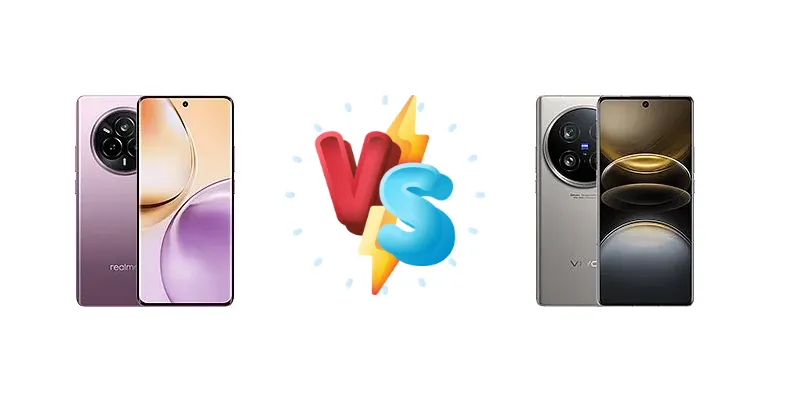
The Realme 14 Pro and vivo X100 Ultra represent distinct approaches to the flagship smartphone market. The Realme focuses on efficient performance and longevity, while the vivo X100 Ultra aims for uncompromising power and cutting-edge features. This comparison dissects their key differences to determine which device best suits your needs.
🏆 Quick Verdict
For most users, the vivo X100 Ultra is the superior choice. Its Snapdragon 8 Gen 3 chipset delivers significantly faster performance, complemented by an exceptionally bright display and versatile charging options. While the Realme 14 Pro offers impressive battery endurance, it can't match the X100 Ultra's overall capabilities.
| Network |
|---|
| 2G bands | GSM 850 / 900 / 1800 / 1900 | GSM 850 / 900 / 1800 / 1900 |
| 3G bands | HSDPA 850 / 900 / 2100 | HSDPA 800 / 850 / 900 / 1700(AWS) / 1900 / 2100 |
| 4G bands | 1, 3, 5, 8, 28, 40, 41 | 1, 2, 3, 4, 5, 7, 8, 12, 17, 18, 19, 20, 25, 26, 28, 34, 38, 39, 40, 41, 42, 66 |
| 5G bands | 1, 3, 5, 8, 28, 40, 41, 77, 78 SA/NSA | 1, 2, 3, 5, 7, 8, 12, 20, 25, 26, 28, 38, 40, 41, 66, 77, 78, 79 SA/NSA |
| Speed | HSPA, LTE, 5G | HSPA, LTE, 5G |
| Technology | GSM / HSPA / LTE / 5G | GSM / CDMA / HSPA / LTE / 5G |
| Launch |
|---|
| Announced | 2025, January 16 | 2024, May 13 |
| Status | Available. Released 2025, January 23 | Available. Released 2024, May 28 |
| Body |
|---|
| Build | - | Glass front, glass back, aluminum frame |
| Dimensions | 162.8 x 74.9 x 7.6 mm or 7.8 mm | 164.1 x 75.6 x 9.2 mm (6.46 x 2.98 x 0.36 in) |
| SIM | Nano-SIM + Nano-SIM | Nano-SIM + Nano-SIM |
| Weight | 179 g or 182 g (6.31 oz) | 229 g (8.08 oz) |
| Display |
|---|
| Protection | Mohs level 6 | - |
| Resolution | 1080 x 2392 pixels (~388 ppi density) | 1440 x 3200 pixels, 20:9 ratio (~517 ppi density) |
| Size | 6.77 inches, 110.9 cm2 (~90.9% screen-to-body ratio) | 6.78 inches, 111.4 cm2 (~89.8% screen-to-body ratio) |
| Type | OLED, 1B colors, 120Hz, 3840Hz PWM, 1400 nits (HBM), 4500 nits (peak) | LTPO AMOLED, 1B colors, 120Hz, Dolby Vision, HDR, 3000 nits (peak) |
| Platform |
|---|
| CPU | Octa-core (4x2.5 GHz Cortex-A78 & 4x2.0 GHz Cortex-A55) | Octa-core (1x3.3 GHz Cortex-X4 & 3x3.2 GHz Cortex-A720 & 2x3.0 GHz Cortex-A720 & 2x2.3 GHz Cortex-A520) |
| Chipset | Mediatek Dimensity 7300 Energy (4 nm) | Qualcomm SM8650-AB Snapdragon 8 Gen 3 (4 nm) |
| GPU | Mali-G615 MC2 | Adreno 750 |
| OS | Android 15, up to 3 major Android upgrades, Realme UI 6.0 | Android 14, upgradable to Android 15, OriginOS 5 |
| Memory |
|---|
| Card slot | No | No |
| Internal | 128GB 8GB RAM, 256GB 8GB RAM, 256GB 12GB RAM, 512GB 12GB RAM | 256GB 12GB RAM, 512GB 16GB RAM, 1TB 16GB RAM |
| Main Camera |
|---|
| Dual | 50 MP, f/1.8, 26mm (wide), 1/1.95", 0.8µm, multi-directional PDAF, OIS
Auxiliary lens | - |
| Features | LED flash, HDR, panorama | Laser AF, color spectrum sensor, Zeiss optics, Zeiss T* lens coating, LED flash, panorama, HDR, 3D LUT import |
| Triple | - | 50 MP, f/1.8, 23mm (wide), 1/0.98", 1.6µm, dual pixel PDAF, gimbal OIS
200 MP, f/2.7, 85mm (periscope telephoto), 1/1.4", 0.56µm, multi-directional PDAF, OIS, 3.7x optical zoom, macro 3.4:1
50 MP, f/2.2, 14mm, 116˚ (ultrawide), 1/2.0", 0.8µm, AF |
| Video | 4K@30fps, 1080p@30/60/120fps, gyro-EIS, OIS | 8K@30fps, 4K@30/60/120fps, 1080p@30/60/120/240fps, gyro-EIS, Dolby Vision HDR |
| Selfie camera |
|---|
| Features | Panorama | HDR |
| Single | 16 MP, f/2.4, 24mm (wide), 1/3.09", 1.0µm | 50 MP, f/2.5, 24mm (wide), 1/2.76", 0.64µm, AF |
| Video | 1080p@30fps | 4K@30/60fps, 1080p@30/60fps |
| Sound |
|---|
| 35mm jack | No | No |
| Loudspeaker | Yes, with stereo speakers | Yes, with stereo speakers |
| Comms |
|---|
| Bluetooth | 5.4, A2DP, LE | 5.4, A2DP, LE, aptX HD, aptX Adaptive, aptX Lossless, LHDC |
| Infrared port | - | Yes |
| NFC | Yes (market/region dependent) | Yes |
| Positioning | GPS, GLONASS, GALILEO, BDS | GPS (L1+L5), BDS (B1I+B1c+B2a), GALILEO (E1+E5a), QZSS (L1+L5), GLONASS |
| Radio | No | No |
| USB | USB Type-C 2.0 | USB Type-C 3.2, OTG, DisplayPort |
| WLAN | Wi-Fi 802.11 a/b/g/n/ac/6, dual-band | Wi-Fi 802.11 a/b/g/n/ac/6/7, dual-band |
| Features |
|---|
| Sensors | Fingerprint (under display, optical), accelerometer, gyro, proximity, compass | Fingerprint (under display, ultrasonic), accelerometer, gyro, proximity, compass |
| Battery |
|---|
| Charging | 45W wired, 50% in 36 min | 80W wired, PD, PPS, QC, UFCS
30W wireless
Reverse wired
Reverse wireless |
| Type | Si/C Li-Ion 6000 mAh | Si/C Li-Ion 5500 mAh |
| Misc |
|---|
| Colors | Pearl White, Jaipur Pink, Suede Grey | Titanium, White, Grey |
| Models | RMX5056 | V2366GA, V2366HA |
| Price | $ 275.51 / € 229.00 / ₹ 23,990 | About 980 EUR |
| EU LABEL |
|---|
| Battery | 84:25h endurance, 1000 cycles | - |
| Energy | Class A | - |
| Free fall | Class A (270 falls) | - |
| Repairability | Class B | - |
Realme 14 Pro
- Exceptional battery endurance (84:25h)
- Long battery lifespan (1000 cycles)
- More affordable price point (likely)
- Less powerful processor
- Slower charging speeds
- Potentially less vibrant display
vivo X100 Ultra
- Significantly faster performance (Snapdragon 8 Gen 3)
- Brighter, higher-quality display (1801 nits)
- Versatile and incredibly fast charging (80W wired, 30W wireless)
- Shorter battery endurance (12:55h)
- Higher price point
- Potential for thermal throttling under sustained load
Display Comparison
The vivo X100 Ultra boasts a significantly brighter display, reaching a measured peak of 1801 nits, compared to an unspecified brightness for the Realme 14 Pro. This translates to superior visibility in direct sunlight. While the Realme 14 Pro’s panel technology isn’t detailed, the X100 Ultra’s brightness suggests a high-end AMOLED panel, likely with LTPO technology for adaptive refresh rates, maximizing efficiency. The absence of detailed display specs for the Realme 14 Pro suggests a more standard offering, potentially prioritizing cost savings over peak visual performance.
Camera Comparison
Without detailed camera specifications for either device, a direct comparison is limited. However, the X100 Ultra’s positioning as an ‘Ultra’ model suggests a more advanced camera system. The Realme 14 Pro likely features a competent camera setup, but the X100 Ultra is expected to offer larger sensors, wider apertures, and more sophisticated image processing algorithms. The Snapdragon 8 Gen 3’s ISP (Image Signal Processor) is also significantly more capable, enabling features like improved low-light performance and faster image capture. We can assume the X100 Ultra will offer a more versatile and higher-quality camera experience.
Performance
The core difference lies in the chipsets. The vivo X100 Ultra’s Qualcomm Snapdragon 8 Gen 3 (4nm) is a powerhouse, featuring a 1x3.3 GHz Cortex-X4 prime core and a sophisticated multi-core architecture. This contrasts with the Realme 14 Pro’s Mediatek Dimensity 7300 Energy (4nm), which utilizes a Cortex-A78 based core configuration. The Snapdragon 8 Gen 3’s architectural advantages, particularly the X4 core, will result in noticeably faster CPU and GPU performance, especially in demanding tasks like gaming and video editing. The X100 Ultra’s LPDDR5x RAM further enhances performance, while the Realme 14 Pro’s RAM specification is unknown. Thermal management will be crucial for the X100 Ultra to sustain peak performance, but the Snapdragon’s efficiency improvements mitigate throttling concerns.
Battery Life
The Realme 14 Pro claims an impressive 84:25h endurance score, indicating exceptional battery life, and a 1000 cycle lifespan. However, the vivo X100 Ultra, despite a shorter endurance score of 12:55h in active use, compensates with significantly faster charging. The X100 Ultra supports 80W wired charging (with PD, PPS, QC, and UFCS standards), reaching 50% charge in a rapid timeframe, alongside 30W wireless and reverse charging capabilities. The Realme 14 Pro’s 45W charging, while respectable, is considerably slower. The X100 Ultra’s charging versatility and speed offer a more convenient user experience, even if its raw battery capacity isn’t as high.
Buying Guide
Buy the Realme 14 Pro if you prioritize exceptional battery life and a more conservative price point, and don't require the absolute fastest processing speeds. You'll benefit from a phone that reliably lasts through a full day and beyond. Buy the vivo X100 Ultra if you demand top-tier performance for gaming, content creation, or demanding applications, and value a brighter, more vibrant display alongside incredibly fast charging capabilities.
Frequently Asked Questions
❓ Does the Mediatek Dimensity 7300 Energy in the Realme 14 Pro struggle with graphically intensive games like Genshin Impact?
While the Dimensity 7300 Energy is a capable chip, it won't deliver the same level of performance as the Snapdragon 8 Gen 3 in the vivo X100 Ultra. Genshin Impact will likely be playable on the Realme 14 Pro, but you may need to lower graphics settings to maintain a smooth frame rate. The X100 Ultra will provide a consistently smoother and more visually rich gaming experience.
❓ How much faster is the 80W charging on the vivo X100 Ultra compared to the 45W charging on the Realme 14 Pro in real-world use?
The 80W charging on the X100 Ultra will significantly reduce charging times. While the Realme 14 Pro takes 36 minutes to reach 50%, the X100 Ultra will likely achieve that in around 20-25 minutes. This difference is particularly noticeable when you need a quick top-up before leaving the house.
❓ Given the battery endurance difference, is the faster charging of the vivo X100 Ultra enough to offset the Realme 14 Pro's longer battery life for a typical user?
For many users, yes. The convenience of quickly topping up the X100 Ultra's battery outweighs the slightly shorter overall endurance. The X100 Ultra's charging speed minimizes downtime, ensuring you're rarely tethered to a wall for extended periods. However, if you frequently find yourself away from power sources for extended periods, the Realme 14 Pro's endurance is a significant advantage.