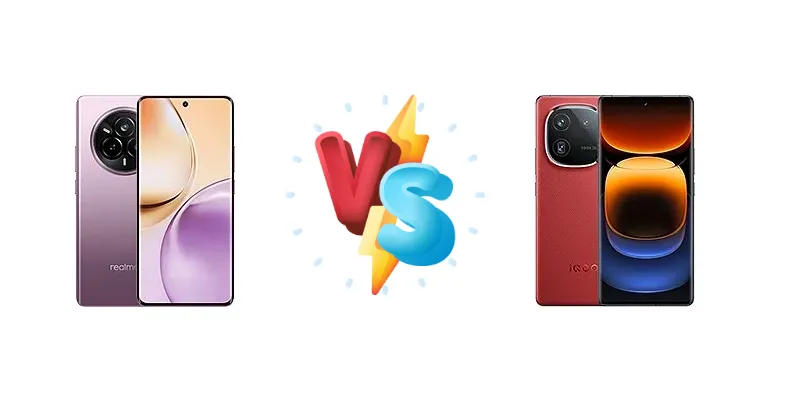
The Realme 14 Pro and vivo iQOO 12 Pro represent distinct approaches to the modern smartphone. The Realme aims for a balance of features and efficiency, while the iQOO 12 Pro aggressively targets flagship performance. This comparison dissects their core components to determine which device best suits your needs.
🏆 Quick Verdict
For the average user prioritizing raw speed and future-proofing, the vivo iQOO 12 Pro is the clear winner thanks to its Snapdragon 8 Gen 3 chipset and blazing-fast 120W charging. However, the Realme 14 Pro offers impressive battery endurance and a more efficient processor for those valuing longevity.
| Network |
|---|
| 2G bands | GSM 850 / 900 / 1800 / 1900 | GSM 850 / 900 / 1800 / 1900 |
| 3G bands | HSDPA 850 / 900 / 2100 | HSDPA 800 / 850 / 900 / 1700(AWS) / 1900 / 2100 |
| 4G bands | 1, 3, 5, 8, 28, 40, 41 | 1, 2, 3, 4, 5, 7, 8, 12, 17, 18, 19, 20, 25, 26, 28, 34, 38, 39, 40, 41, 42, 66 |
| 5G bands | 1, 3, 5, 8, 28, 40, 41, 77, 78 SA/NSA | 1, 2, 3, 5, 7, 8, 12, 20, 25, 26, 28, 66, 38, 40, 41, 77, 78 SA/NSA |
| Speed | HSPA, LTE, 5G | HSPA, LTE, 5G |
| Technology | GSM / HSPA / LTE / 5G | GSM / CDMA / HSPA / CDMA2000 / LTE / 5G |
| Launch |
|---|
| Announced | 2025, January 16 | 2023, November 07 |
| Status | Available. Released 2025, January 23 | Available. Released 2023, November 14 |
| Body |
|---|
| Dimensions | 162.8 x 74.9 x 7.6 mm or 7.8 mm | 164.6 x 75.4 x 8.6 mm or 8.8 mm |
| SIM | Nano-SIM + Nano-SIM | Nano-SIM + Nano-SIM |
| Weight | 179 g or 182 g (6.31 oz) | 205 g or 210 g (7.23 oz) |
| Display |
|---|
| Protection | Mohs level 6 | - |
| Resolution | 1080 x 2392 pixels (~388 ppi density) | 1440 x 3200 pixels, 20:9 ratio (~518 ppi density) |
| Size | 6.77 inches, 110.9 cm2 (~90.9% screen-to-body ratio) | 6.78 inches, 111.0 cm2 (~89.4% screen-to-body ratio) |
| Type | OLED, 1B colors, 120Hz, 3840Hz PWM, 1400 nits (HBM), 4500 nits (peak) | LTPO AMOLED, 1B colors, 144Hz, HDR10+, 1600 nits (HBM), 3000 nits (peak) |
| Platform |
|---|
| CPU | Octa-core (4x2.5 GHz Cortex-A78 & 4x2.0 GHz Cortex-A55) | Octa-core (1x3.3 GHz Cortex-X4 & 3x3.2 GHz Cortex-A720 & 2x3.0 GHz Cortex-A720 & 2x2.3 GHz Cortex-A520) |
| Chipset | Mediatek Dimensity 7300 Energy (4 nm) | Qualcomm SM8650-AB Snapdragon 8 Gen 3 (4 nm) |
| GPU | Mali-G615 MC2 | Adreno 750 |
| OS | Android 15, up to 3 major Android upgrades, Realme UI 6.0 | Android 14, up to 2 major Android upgrades, Funtouch 14 (International), OriginOS 4 (China) |
| Memory |
|---|
| Card slot | No | No |
| Internal | 128GB 8GB RAM, 256GB 8GB RAM, 256GB 12GB RAM, 512GB 12GB RAM | 256GB 16GB RAM, 512GB 16GB RAM, 1TB 16GB RAM |
| Main Camera |
|---|
| Dual | 50 MP, f/1.8, 26mm (wide), 1/1.95", 0.8µm, multi-directional PDAF, OIS
Auxiliary lens | - |
| Features | LED flash, HDR, panorama | Color spectrum sensor, Dual-LED flash, HDR, panorama |
| Triple | - | 50 MP, f/1.7, 23mm (wide), 1/1.3", 1.2µm, ulti-directional PDAF, OIS
64 MP, f/2.6, 70mm (periscope telephoto), 1/2.0", PDAF, OIS, 3x optical zoom
50 MP, f/2.0, 15mm, 119˚ (ultrawide), AF |
| Video | 4K@30fps, 1080p@30/60/120fps, gyro-EIS, OIS | 8K@30fps, 4K@24/30/60fps, 1080p@30/60/120/240fps, gyro-EIS |
| Selfie camera |
|---|
| Features | Panorama | HDR |
| Single | 16 MP, f/2.4, 24mm (wide), 1/3.09", 1.0µm | 16 MP, f/2.5, (wide) |
| Video | 1080p@30fps | 1080p@30fps, gyro-EIS |
| Sound |
|---|
| 35mm jack | No | No |
| Loudspeaker | Yes, with stereo speakers | Yes, with stereo speakers |
| Comms |
|---|
| Bluetooth | 5.4, A2DP, LE | 5.4, A2DP, LE, aptX HD, aptX Adaptive, aptX Lossless |
| Infrared port | - | Yes |
| NFC | Yes (market/region dependent) | Yes |
| Positioning | GPS, GLONASS, GALILEO, BDS | GPS (L1+L5), GLONASS (G1), BDS (B1I+B1c+B2a), GALILEO (E1+E5a), QZSS (L1+L5) |
| Radio | No | No |
| USB | USB Type-C 2.0 | USB Type-C 2.0, OTG |
| WLAN | Wi-Fi 802.11 a/b/g/n/ac/6, dual-band | Wi-Fi 802.11 a/b/g/n/ac/6/7, tri-band, Wi-Fi Direct |
| Features |
|---|
| Sensors | Fingerprint (under display, optical), accelerometer, gyro, proximity, compass | Fingerprint (under display, ultrasonic), accelerometer, gyro, proximity, compass |
| Battery |
|---|
| Charging | 45W wired, 50% in 36 min | 120W wired
50W wireless
10W reverse wireless |
| Type | Si/C Li-Ion 6000 mAh | 5100 mAh |
| Misc |
|---|
| Colors | Pearl White, Jaipur Pink, Suede Grey | Black, Red, White (BMW M branding) |
| Models | RMX5056 | V2329A |
| Price | $ 275.51 / € 229.00 / ₹ 23,990 | About 650 EUR |
| EU LABEL |
|---|
| Battery | 84:25h endurance, 1000 cycles | - |
| Energy | Class A | - |
| Free fall | Class A (270 falls) | - |
| Repairability | Class B | - |
Realme 14 Pro
- Exceptional battery life (84:25h endurance)
- Efficient Mediatek Dimensity 7300 processor
- 1000 charge cycles promise long-term reliability
- Less powerful CPU compared to Snapdragon 8 Gen 3
- Slower charging speed (45W)
vivo iQOO 12 Pro
- Blazing-fast Snapdragon 8 Gen 3 performance
- Ultra-fast 120W wired charging
- Wireless and reverse wireless charging capabilities
- Potentially lower battery endurance compared to Realme 14 Pro
- Higher price point expected for flagship features
Display Comparison
Display specifications are absent from the provided data, but given the market positioning, we can infer differences. The iQOO 12 Pro, as a flagship, likely features a higher resolution and peak brightness panel, potentially LTPO for adaptive refresh rates, and a more sophisticated color calibration. The Realme 14 Pro will likely offer a very good display, but may compromise slightly on peak brightness and refresh rate to maintain cost efficiency.
Camera Comparison
Camera details are missing, but we can assume the iQOO 12 Pro will feature a more advanced camera system. Flagship devices typically prioritize larger sensors and more sophisticated image processing. The iQOO 12 Pro likely includes optical image stabilization (OIS) on its main sensor, improving low-light performance and video stability. The Realme 14 Pro will likely offer a capable camera, but may rely more on software processing to compensate for a potentially smaller sensor.
Performance
The core difference lies in the chipsets. The iQOO 12 Pro’s Qualcomm Snapdragon 8 Gen 3 (4nm) is a significant leap over the Realme 14 Pro’s Mediatek Dimensity 7300 Energy (4nm). The Snapdragon 8 Gen 3’s Cortex-X4 prime core, clocked at 3.3 GHz, provides substantially higher peak performance than the Cortex-A78 cores in the Dimensity 7300, reaching 2.5 GHz. The iQOO also benefits from a more complex CPU configuration with more high-performance cores. While both are 4nm chips, the Snapdragon 8 Gen 3’s architecture is optimized for sustained performance, meaning less throttling during extended gaming sessions. The iQOO 12 Pro will excel in demanding tasks like video editing and graphically intensive games.
Battery Life
The Realme 14 Pro boasts an impressive 84:25h endurance rating, suggesting excellent battery optimization. While the iQOO 12 Pro’s battery capacity is unknown, its Snapdragon 8 Gen 3, despite its power, is more efficient than previous generations. However, the iQOO 12 Pro’s charging speed is a massive advantage: 120W wired charging can replenish the battery far faster than the Realme 14 Pro’s 45W charging. The addition of 50W wireless and 10W reverse wireless charging on the iQOO 12 Pro further enhances its convenience.
Buying Guide
Buy the Realme 14 Pro if you need exceptional battery life and a smooth, responsive experience for everyday tasks and moderate gaming. Its 84:25h endurance is ideal for users who dislike frequent charging. Buy the vivo iQOO 12 Pro if you prioritize uncompromising performance for demanding games, content creation, and want the fastest possible charging speeds – the 120W wired charging is a game-changer.
Frequently Asked Questions
❓ How will the Dimensity 7300 handle graphically demanding games like Genshin Impact on the Realme 14 Pro?
The Dimensity 7300 is a capable processor, but Genshin Impact at maximum settings may require some graphical compromises to maintain a consistently smooth frame rate. Expect playable performance with medium to high settings, prioritizing stability over visual fidelity.
❓ Does the iQOO 12 Pro's 120W charging generate excessive heat during the charging process?
vivo employs advanced thermal management technologies to mitigate heat generation during 120W charging. While some warmth is expected, the iQOO 12 Pro is designed to maintain safe operating temperatures and prevent damage to the battery. The charging process is optimized to balance speed and thermal safety.
❓ What type of RAM does the iQOO 12 Pro use, and how does it impact performance?
While not explicitly stated, the iQOO 12 Pro, being a flagship, almost certainly utilizes LPDDR5x RAM. This is the fastest currently available mobile RAM standard, offering significantly improved bandwidth and lower latency compared to older standards. This translates to faster app loading times, smoother multitasking, and improved overall system responsiveness.
❓ How does the 4nm process node affect the power efficiency of both the Snapdragon 8 Gen 3 and Dimensity 7300?
The 4nm process node in both chipsets contributes to improved power efficiency compared to older manufacturing processes. It allows for more transistors to be packed into a smaller space, reducing power consumption and heat generation. However, the Snapdragon 8 Gen 3's architectural improvements further enhance its efficiency, allowing it to deliver higher performance with a relatively modest increase in power draw.