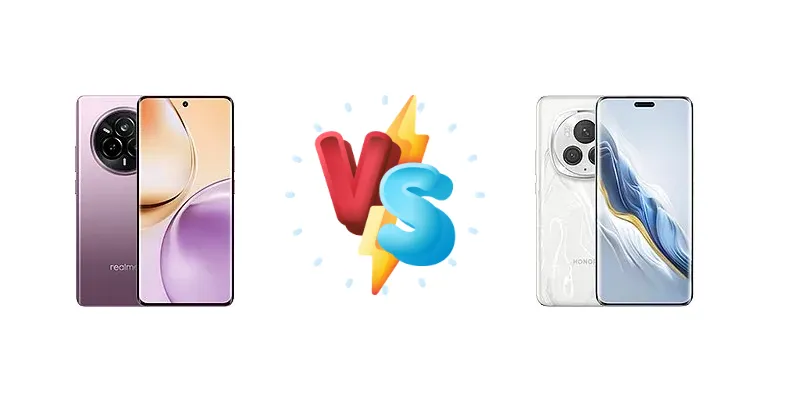
The Realme 14 Pro aims to deliver a balanced experience with a focus on long-lasting battery life, while the Honor Magic6 Pro throws down the gauntlet with top-tier processing power and incredibly fast charging. This comparison dissects the key differences between these two 4nm-based Android contenders, helping you determine which aligns best with your needs.
🏆 Quick Verdict
For the average user prioritizing raw performance and future-proofing, the Honor Magic6 Pro is the clear winner. Its Snapdragon 8 Gen 3 chipset and 80W charging significantly outperform the Realme 14 Pro’s Dimensity 7300 Energy and 45W charging. However, the Realme 14 Pro’s exceptional 84:25h battery endurance makes it a compelling choice for those who prioritize longevity above all else.
| Network |
|---|
| 2G bands | GSM 850 / 900 / 1800 / 1900 | GSM 850 / 900 / 1800 / 1900 |
| 3G bands | HSDPA 850 / 900 / 2100 | HSDPA 800 / 850 / 900 / 1700(AWS) / 1900 / 2100 |
| 4G bands | 1, 3, 5, 8, 28, 40, 41 | LTE |
| 5G bands | 1, 3, 5, 8, 28, 40, 41, 77, 78 SA/NSA | SA/NSA |
| Speed | HSPA, LTE, 5G | HSPA, LTE, 5G |
| Technology | GSM / HSPA / LTE / 5G | GSM / CDMA / HSPA / CDMA2000 / LTE / 5G |
| Launch |
|---|
| Announced | 2025, January 16 | 2024, January 11 |
| Status | Available. Released 2025, January 23 | Available. Released 2024, January 18 |
| Body |
|---|
| Build | - | Glass front (NanoCrystal Shield), glass back or silicone polymer back (eco leather) |
| Dimensions | 162.8 x 74.9 x 7.6 mm or 7.8 mm | 162.5 x 75.8 x 8.9 mm (6.40 x 2.98 x 0.35 in) |
| SIM | Nano-SIM + Nano-SIM | · Nano-SIM + eSIM· Nano-SIM + Nano-SIM |
| Weight | 179 g or 182 g (6.31 oz) | 225 g or 229 g (7.94 oz) |
| Display |
|---|
| Protection | Mohs level 6 | NanoCrystal Shield |
| Resolution | 1080 x 2392 pixels (~388 ppi density) | 1280 x 2800 pixels, 19.5:9 ratio (~453 ppi density) |
| Size | 6.77 inches, 110.9 cm2 (~90.9% screen-to-body ratio) | 6.8 inches, 112.8 cm2 (~91.6% screen-to-body ratio) |
| Type | OLED, 1B colors, 120Hz, 3840Hz PWM, 1400 nits (HBM), 4500 nits (peak) | LTPO OLED, 1B colors, 120Hz, Dolby Vision, HDR, 1600 nits (HBM), 5000 nits (peak) |
| Platform |
|---|
| CPU | Octa-core (4x2.5 GHz Cortex-A78 & 4x2.0 GHz Cortex-A55) | Octa-core (1x3.3 GHz Cortex-X4 & 3x3.2 GHz Cortex-A720 & 2x3.0 GHz Cortex-A720 & 2x2.3 GHz Cortex-A520) |
| Chipset | Mediatek Dimensity 7300 Energy (4 nm) | Qualcomm SM8650-AB Snapdragon 8 Gen 3 (4 nm) |
| GPU | Mali-G615 MC2 | Adreno 750 |
| OS | Android 15, up to 3 major Android upgrades, Realme UI 6.0 | Android 14, up to 4 major Android upgrades, MagicOS 8 |
| Memory |
|---|
| Card slot | No | No |
| Internal | 128GB 8GB RAM, 256GB 8GB RAM, 256GB 12GB RAM, 512GB 12GB RAM | 256GB 12GB RAM, 256GB 16GB RAM, 512GB 12GB RAM, 512GB 16GB RAM, 1TB 16GB RAM |
| Main Camera |
|---|
| Dual | 50 MP, f/1.8, 26mm (wide), 1/1.95", 0.8µm, multi-directional PDAF, OIS
Auxiliary lens | - |
| Features | LED flash, HDR, panorama | Laser AF, color spectrum sensor, LED flash, HDR, panorama |
| Triple | - | 50 MP, f/1.4-2.0, 23mm (wide), 1/1.3", 1.2µm, PDAF, OIS
180 MP, f/2.6, (periscope telephoto), 1/1.49", 0.56µm, PDAF, OIS, 2.5x optical zoom
50 MP, f/2.0, 13mm, 122˚ (ultrawide), 1/2.88", 0.61µm, AF |
| Video | 4K@30fps, 1080p@30/60/120fps, gyro-EIS, OIS | 4K@24/30/60fps, 1080p@30/60/120/240fps, gyro-EIS, OIS, HDR, 10-bit video |
| Selfie camera |
|---|
| Features | Panorama | - |
| Single | 16 MP, f/2.4, 24mm (wide), 1/3.09", 1.0µm | 50 MP, f/2.0, 22mm (wide), 1/2.93", 0.6µm, AF
TOF 3D, (depth/biometrics sensor) |
| Video | 1080p@30fps | 4K@30fps, 1080p@30/60fps, gyro-EIS |
| Sound |
|---|
| 35mm jack | No | No |
| Loudspeaker | Yes, with stereo speakers | Yes, with stereo speakers |
| Comms |
|---|
| Bluetooth | 5.4, A2DP, LE | 5.3, A2DP, LE, aptX HD |
| Infrared port | - | Yes |
| NFC | Yes (market/region dependent) | Yes |
| Positioning | GPS, GLONASS, GALILEO, BDS | GPS (L1+L5), GLONASS, BDS (B1I+B1c+B2a), GALILEO (E1+E5a) |
| Radio | No | No |
| USB | USB Type-C 2.0 | USB Type-C 3.2, DisplayPort 1.2, OTG |
| WLAN | Wi-Fi 802.11 a/b/g/n/ac/6, dual-band | Wi-Fi 802.11 a/b/g/n/ac/6/7, dual-band, Wi-Fi Direct |
| Features |
|---|
| Sensors | Fingerprint (under display, optical), accelerometer, gyro, proximity, compass | Fingerprint (under display, optical), Face ID, accelerometer, gyro, proximity, compass |
| Battery |
|---|
| Charging | 45W wired, 50% in 36 min | 80W wired
66W wireless
Reverse wireless
5W reverse wired |
| Type | Si/C Li-Ion 6000 mAh | Si/C Li-Ion 5600 mAh |
| Misc |
|---|
| Colors | Pearl White, Jaipur Pink, Suede Grey | Black, Green, Blue, Purple, White |
| Models | RMX5056 | BVL-AN16, BVL-N49 |
| Price | $ 275.51 / € 229.00 / ₹ 23,990 | € 455.54 / $ 899.00 / £ 598.99 |
| EU LABEL |
|---|
| Battery | 84:25h endurance, 1000 cycles | - |
| Energy | Class A | - |
| Free fall | Class A (270 falls) | - |
| Repairability | Class B | - |
Realme 14 Pro
- Exceptional battery life (84:25h endurance)
- Efficient Mediatek Dimensity 7300 Energy chipset
- 1000 charge cycles promise long-term battery health
- Slower charging speed (45W)
- Less powerful CPU/GPU compared to Snapdragon 8 Gen 3
Honor Magic6 Pro
- Blazing-fast Snapdragon 8 Gen 3 performance
- Ultra-fast 80W wired and 66W wireless charging
- High peak display brightness (1578 nits)
- Shorter battery endurance (14:06h active use)
- Potentially higher price point
Display Comparison
The Honor Magic6 Pro boasts a significantly brighter display, reaching a measured peak of 1578 nits, crucial for outdoor visibility. While the Realme 14 Pro’s display specs are not provided, the Magic6 Pro’s brightness advantage is substantial. The Magic6 Pro likely utilizes an LTPO panel for adaptive refresh rates, further enhancing efficiency, a feature not confirmed for the Realme 14 Pro. The higher brightness of the Magic6 Pro benefits users frequently exposed to direct sunlight.
Camera Comparison
Without detailed camera specifications for the Realme 14 Pro, a direct comparison is limited. However, the Honor Magic6 Pro is expected to feature a high-end camera system leveraging the Snapdragon 8 Gen 3’s ISP capabilities. The focus should be on the main sensor size and aperture, and the quality of optical image stabilization (OIS). The Magic6 Pro’s image processing will likely prioritize detail and dynamic range, appealing to photography enthusiasts. The Realme 14 Pro will likely offer a competent camera experience, but the Magic6 Pro is positioned to deliver superior image quality.
Performance
The core difference lies in the chipsets. The Honor Magic6 Pro’s Qualcomm Snapdragon 8 Gen 3 (4nm) is a flagship powerhouse, featuring a 1x3.3 GHz Cortex-X4 prime core, alongside 3x3.2 GHz Cortex-A720 and 2x3.0 GHz Cortex-A720 cores, and 2x2.3 GHz Cortex-A520 cores. This configuration delivers significantly higher CPU and GPU performance compared to the Realme 14 Pro’s Mediatek Dimensity 7300 Energy (4nm) with its 4x2.5 GHz Cortex-A78 and 4x2.0 GHz Cortex-A55 cores. The Snapdragon 8 Gen 3’s architectural advantages translate to smoother multitasking, faster app loading, and superior gaming performance. The Realme 14 Pro will handle everyday tasks well, but the Magic6 Pro offers a more future-proof experience.
Battery Life
The Realme 14 Pro shines in battery endurance, achieving an impressive 84:25h score. While the Honor Magic6 Pro offers a respectable 14:06h of active use, the Realme 14 Pro’s longevity is significantly greater. However, the Magic6 Pro compensates with drastically faster charging: 80W wired, 66W wireless, and even reverse wireless charging at 5W. The Realme 14 Pro’s 45W wired charging, while respectable, pales in comparison. The Magic6 Pro can reach 50% charge in a significantly shorter time (estimated under 30 minutes) than the Realme 14 Pro’s 36 minutes. This difference benefits users who need a quick power boost.
Buying Guide
Buy the Realme 14 Pro if you need a phone that can reliably last through two full days of moderate use and value exceptional battery endurance over peak performance. Buy the Honor Magic6 Pro if you prioritize a fluid, responsive experience for demanding tasks like gaming and video editing, and want the convenience of incredibly fast wired and wireless charging. The Magic6 Pro is for power users, while the Realme 14 Pro is for efficiency-focused users.
Frequently Asked Questions
❓ Does the Mediatek Dimensity 7300 Energy in the Realme 14 Pro struggle with graphically intensive games like Genshin Impact?
While the Dimensity 7300 Energy is a capable chipset, it won't deliver the same level of sustained performance as the Snapdragon 8 Gen 3 in the Honor Magic6 Pro. Genshin Impact will be playable on the Realme 14 Pro, but you may need to lower graphics settings to maintain a stable frame rate, especially during prolonged gaming sessions. The Magic6 Pro will offer a smoother, more consistent experience at higher settings.
❓ How much faster is the 80W charging on the Honor Magic6 Pro compared to the 45W charging on the Realme 14 Pro in real-world use?
The 80W charging on the Honor Magic6 Pro will significantly reduce charging times. While the Realme 14 Pro takes 36 minutes to reach 50%, the Magic6 Pro is expected to achieve 50% charge in under 30 minutes. A full 0-100% charge on the Magic6 Pro will likely take around 30-40 minutes, compared to over an hour on the Realme 14 Pro. This is a substantial difference for users who frequently need to top up their battery quickly.
❓ Is the battery health of the Realme 14 Pro guaranteed to last longer due to the 1000 charge cycle claim?
The 1000 charge cycle claim suggests the Realme 14 Pro’s battery is designed to retain a higher percentage of its original capacity after a significant number of charge/discharge cycles. However, battery degradation is also affected by charging habits (e.g., avoiding overnight charging) and temperature. While the 1000 cycle claim is a positive indicator, it doesn’t guarantee indefinite battery health.