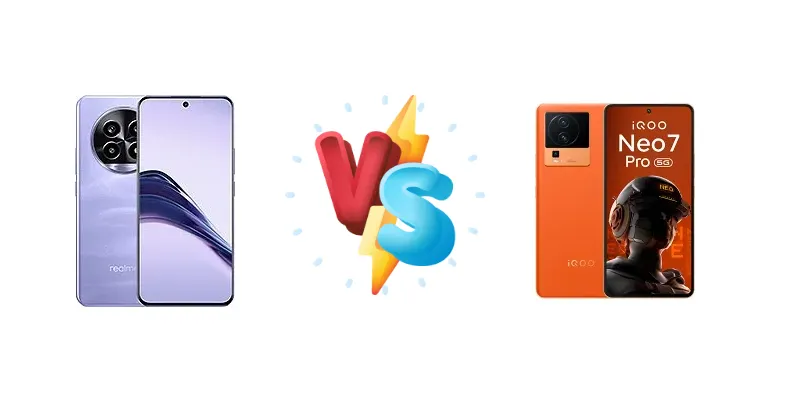
The Realme 14 Pro Lite and vivo iQOO Neo 7 Pro represent distinct approaches to the mid-range smartphone market. The Realme focuses on a balance of efficiency and affordability, powered by the Snapdragon 7s Gen 2. Conversely, the iQOO Neo 7 Pro aims for near-flagship performance with the older, but still potent, Snapdragon 8+ Gen 1. This comparison dissects their strengths and weaknesses to determine which device delivers the best experience for your needs.
🏆 Quick Verdict
For the average user prioritizing sustained performance and rapid charging, the vivo iQOO Neo 7 Pro is the clear winner. Its Snapdragon 8+ Gen 1 offers a significant performance leap over the 7s Gen 2, and the 120W charging is dramatically faster. However, the Realme 14 Pro Lite provides a compelling value proposition for those seeking efficiency and a more budget-friendly option.
| Network |
|---|
| 2G bands | GSM 850 / 900 / 1800 / 1900 | GSM 850 / 900 / 1800 / 1900 |
| 3G bands | HSDPA 850 / 900 / 2100 | HSDPA 800 / 850 / 900 / 1700(AWS) / 1900 / 2100 |
| 4G bands | 1, 3, 5, 8, 28, 40, 41 | 1, 2, 3, 4, 5, 8, 28, 34, 38, 39, 40, 41 |
| 5G bands | 1, 3, 5, 8, 28, 40, 41, 77, 78 SA/NSA | 1, 3, 5, 8, 28, 40, 77, 78 SA/NSA |
| Speed | HSPA, LTE, 5G | HSPA, LTE, 5G |
| Technology | GSM / HSPA / LTE / 5G | GSM / HSPA / LTE / 5G |
| Launch |
|---|
| Announced | 2025, March 05 | 2023, July 04 |
| Status | Available. Released 2025, March 05 | Available. Released 2023, July 15 |
| Body |
|---|
| Build | - | Glass front, plastic frame, glass or leather back |
| Dimensions | 161.3 x 73.9 x 8.2 mm (6.35 x 2.91 x 0.32 in) | 164.8 x 76.9 x 8.5 mm or 8.9 mm |
| SIM | Nano-SIM + Nano-SIM | Nano-SIM + Nano-SIM |
| Weight | 188 g (6.63 oz) | 197 g or 202 g (6.95 oz) |
| Display |
|---|
| Protection | Corning Gorilla Glass 7i | - |
| Resolution | 1080 x 2412 pixels, 20:9 ratio (~394 ppi density) | 1080 x 2400 pixels, 20:9 ratio (~388 ppi density) |
| Size | 6.7 inches, 108.0 cm2 (~90.6% screen-to-body ratio) | 6.78 inches, 111.0 cm2 (~87.6% screen-to-body ratio) |
| Type | AMOLED, 1B colors, 120Hz, 600 nits (typ), 1200 nits (HBM), 2000 nits (peak) | AMOLED, 1B colors, 120Hz, HDR10+, 1300 nits (peak) |
| Platform |
|---|
| CPU | Octa-core (4x2.40 GHz Cortex-A78 & 4x1.95 GHz Cortex-A55) | Octa-core (1x3.19 GHz Cortex-X2 & 3x2.75 GHz Cortex-A710 & 4x2.0 GHz Cortex-A510) |
| Chipset | Qualcomm SM7435-AB Snapdragon 7s Gen 2 (4 nm) | Qualcomm SM8475 Snapdragon 8+ Gen 1 (4 nm) |
| GPU | Adreno 710 | Adreno 730 |
| OS | Android 14, Realme UI 5.0 | Android 13, Funtouch 13 |
| Memory |
|---|
| Card slot | No | No |
| Internal | 128GB 8GB RAM, 256GB 8GB RAM | 128GB 8GB RAM, 256GB 12GB RAM |
| Main Camera |
|---|
| Dual | 50 MP, f/1.9, 26mm (wide), 1/1.95", 0.8µm, multi-directional PDAF, OIS
8 MP, f/2.2, 16mm, 112˚ (ultrawide), 1/4.0", 1.12µm | - |
| Features | LED flash, HDR, panorama | LED flash, HDR, panorama |
| Triple | - | 50 MP, f/1.9, 24mm (wide), 1/1.57", 1.0µm, PDAF, OIS
8 MP, f/2.2, 16mm (ultrawide), 1/4.0", 1.12µm
2 MP (macro) |
| Video | 4K@30fps, 1080p@30/60/120fps, gyro-EIS, OIS | 4K@30fps, 1080p@30fps |
| Selfie camera |
|---|
| Features | - | HDR |
| Single | 32 MP, f/2.5, 22mm (wide) | 16 MP, f/2.5, (wide), 1/3.1", 1.0µm |
| Video | 4K@30fps, 1080p@30fps | 1080p@30fps |
| Sound |
|---|
| 35mm jack | No | No |
| Loudspeaker | Yes, with stereo speakers (Hi-Res audio) | Yes, with stereo speakers |
| Comms |
|---|
| Bluetooth | 5.2, A2DP, LE | 5.3, A2DP, LE, aptX HD, aptX Adaptive |
| Infrared port | - | Yes |
| NFC | No | No |
| Positioning | GPS, GLONASS, GALILEO, BDS, QZSS | GPS, GLONASS, GALILEO, BDS, QZSS, NavIC |
| Radio | No | No |
| USB | USB Type-C 2.0 | USB Type-C 2.0, OTG |
| WLAN | Wi-Fi 802.11 a/b/g/n/ac/6, dual-band | Wi-Fi 802.11 a/b/g/n/ac/6, dual-band, Wi-Fi Direct |
| Features |
|---|
| Sensors | Fingerprint (under display, optical), accelerometer, gyro, proximity, compass | Fingerprint (under display, optical), accelerometer, gyro, proximity, compass |
| Battery |
|---|
| Charging | 45W wired, 50% in 27 min | 120W wired, 50% in 8 min |
| Type | 5200 mAh | 5000 mAh |
| Misc |
|---|
| Colors | Glass Gold, Glass Purple | Fearless Flame, Dark Storm |
| Models | - | I2217 |
| Price | ₹ 18,899 | About 380 EUR |
Realme 14 Pro Lite
- More affordable price point
- Efficient Snapdragon 7s Gen 2 chipset
- Good battery life due to efficient chipset
- Significantly lower performance than the iQOO Neo 7 Pro
- Much slower charging speed (45W)
vivo iQOO Neo 7 Pro
- Powerful Snapdragon 8+ Gen 1 processor
- Ultra-fast 120W charging
- Superior gaming performance
- Higher price tag
- Potentially more thermal throttling under sustained load
Display Comparison
While both devices likely employ AMOLED panels (based on brand trends), specific details like peak brightness and refresh rates are missing. However, the core difference lies in the processing power driving them. The Snapdragon 8+ Gen 1 in the iQOO Neo 7 Pro will handle graphically intensive tasks on the display more smoothly. The Realme 14 Pro Lite’s Snapdragon 7s Gen 2, while capable, will exhibit more frame drops in demanding scenarios. Bezels and color accuracy are assumed to be comparable given the market segment.
Camera Comparison
Without specific camera sensor details, a direct comparison is difficult. However, the iQOO Neo 7 Pro, positioned as a performance-focused device, likely incorporates a more capable primary sensor. The Snapdragon 8+ Gen 1’s image signal processor (ISP) also offers more advanced image processing capabilities. While the Realme 14 Pro Lite will likely produce acceptable photos in good lighting, the iQOO Neo 7 Pro should excel in low-light conditions and offer more dynamic range. We can assume both phones will include standard features like portrait mode and night mode.
Performance
The iQOO Neo 7 Pro’s Snapdragon 8+ Gen 1 (4nm) is the dominant force here. Its Cortex-X2 prime core, clocked at 3.19 GHz, significantly outperforms the Cortex-A78 cores (2.40 GHz) in the Realme 14 Pro Lite’s Snapdragon 7s Gen 2. The 8+ Gen 1’s Adreno 730 GPU also provides a substantial advantage in graphics performance. While both chipsets are built on a 4nm process, the 8+ Gen 1’s architecture is more advanced, leading to better sustained performance and potentially less thermal throttling under heavy load. The iQOO Neo 7 Pro is the clear choice for gamers and power users.
Battery Life
The iQOO Neo 7 Pro’s 120W charging is a game-changer, achieving a 50% charge in just 8 minutes. This is dramatically faster than the Realme 14 Pro Lite’s 45W charging (50% in 27 minutes). While battery capacity isn’t specified, the iQOO Neo 7 Pro’s faster charging mitigates any potential disadvantage from a slightly smaller battery. The Snapdragon 8+ Gen 1, despite its power, is relatively efficient, and the combination of fast charging and efficient power management makes the iQOO Neo 7 Pro the more convenient option for users who frequently need to top up their battery.
Buying Guide
Buy the Realme 14 Pro Lite if you need a reliable daily driver with good battery life and don't demand the absolute highest performance for gaming. It's ideal for users who prioritize efficiency and value. Buy the vivo iQOO Neo 7 Pro if you prefer a phone capable of handling demanding games and applications with ease, and if minimizing charging time is a top priority. This is the choice for power users and mobile gamers.
Frequently Asked Questions
❓ Will the Snapdragon 8+ Gen 1 in the iQOO Neo 7 Pro overheat during prolonged gaming sessions?
While the Snapdragon 8+ Gen 1 is a powerful chip, it can generate heat under sustained load. However, iQOO typically implements robust cooling solutions, such as vapor chamber cooling, to mitigate thermal throttling. Expect some performance reduction after extended gaming, but it should remain playable.
❓ Is the 45W charging on the Realme 14 Pro Lite slow compared to other phones?
45W charging is respectable, but it's significantly slower than the 120W charging on the iQOO Neo 7 Pro. It will take considerably longer to fully charge the Realme 14 Pro Lite, making it less convenient for users who need a quick power boost.
❓ Does the Snapdragon 7s Gen 2 in the Realme 14 Pro Lite handle demanding apps like video editing software?
The Snapdragon 7s Gen 2 is capable of handling everyday tasks and some light video editing, but it will struggle with complex projects or high-resolution footage. The iQOO Neo 7 Pro’s Snapdragon 8+ Gen 1 is much better suited for demanding applications.
❓ What kind of gaming performance can I expect from the iQOO Neo 7 Pro?
The iQOO Neo 7 Pro delivers excellent gaming performance. You can expect to run most popular titles at high settings with smooth frame rates. The Adreno 730 GPU and powerful CPU ensure a fluid and responsive gaming experience.