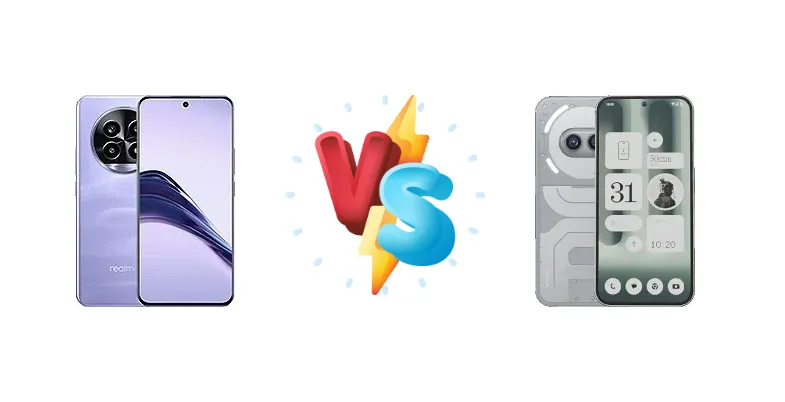
The mid-range smartphone market is fiercely competitive, and the Realme 14 Pro Lite and Nothing Phone (2a) Plus represent compelling options for budget-conscious buyers. The Realme leverages Qualcomm’s Snapdragon 7s Gen 2, while the Nothing Phone (2a) Plus opts for MediaTek’s Dimensity 7350 Pro. This comparison will dissect their key differences, focusing on performance, battery life, and display quality to determine which device delivers the most bang for your buck.
🏆 Quick Verdict
For the average user prioritizing sustained performance and faster charging, the Realme 14 Pro Lite emerges as the winner. Its Snapdragon 7s Gen 2 chipset, coupled with 45W charging, provides a smoother experience for demanding tasks and quicker top-ups. However, the Nothing Phone (2a) Plus excels in battery endurance.
| Network |
|---|
| 2G bands | GSM 850 / 900 / 1800 / 1900 | GSM 850 / 900 / 1800 / 1900 |
| 3G bands | HSDPA 850 / 900 / 2100 | HSDPA 800 / 850 / 900 / 1700(AWS) / 1900 / 2100 |
| 4G bands | 1, 3, 5, 8, 28, 40, 41 | 1, 3, 4, 5, 7, 8, 18, 19, 20, 26, 28, 38, 39, 40, 41, 42, 66 |
| 5G bands | 1, 3, 5, 8, 28, 40, 41, 77, 78 SA/NSA | 1, 3, 5, 7, 8, 20, 28, 38, 40, 41, 66, 77, 78 SA/NSA |
| Speed | HSPA, LTE, 5G | HSPA, LTE, 5G |
| Technology | GSM / HSPA / LTE / 5G | GSM / HSPA / LTE / 5G |
| Launch |
|---|
| Announced | 2025, March 05 | 2024, July 31 |
| Status | Available. Released 2025, March 05 | Available. Released 2024, August 03 |
| Body |
|---|
| Build | - | Glass front (Gorilla Glass 5), plastic frame, plastic back |
| Dimensions | 161.3 x 73.9 x 8.2 mm (6.35 x 2.91 x 0.32 in) | 161.7 x 76.3 x 8.5 mm (6.37 x 3.00 x 0.33 in) |
| SIM | Nano-SIM + Nano-SIM | Nano-SIM + Nano-SIM |
| Weight | 188 g (6.63 oz) | 190 g (6.70 oz) |
| Display |
|---|
| Protection | Corning Gorilla Glass 7i | Corning Gorilla Glass 5 |
| Resolution | 1080 x 2412 pixels, 20:9 ratio (~394 ppi density) | 1080 x 2412 pixels, 20:9 ratio (~395 ppi density) |
| Size | 6.7 inches, 108.0 cm2 (~90.6% screen-to-body ratio) | 6.7 inches, 107.5 cm2 (~87.1% screen-to-body ratio) |
| Type | AMOLED, 1B colors, 120Hz, 600 nits (typ), 1200 nits (HBM), 2000 nits (peak) | AMOLED, 1B colors, 120Hz, 2160Hz PWM, HDR10+, 700 nits (typ), 1100 nits (HBM), 1300 nits (peak) |
| Platform |
|---|
| CPU | Octa-core (4x2.40 GHz Cortex-A78 & 4x1.95 GHz Cortex-A55) | Octa-core (2x3.0 GHz Cortex-A715 & 6x 2.0 GHz Cortex-A510) |
| Chipset | Qualcomm SM7435-AB Snapdragon 7s Gen 2 (4 nm) | Mediatek Dimensity 7350 Pro (4 nm) |
| GPU | Adreno 710 | Mali-G610 MC4 |
| OS | Android 14, Realme UI 5.0 | Android 14, up to 3 major Android upgrades, Nothing OS 3.0 |
| Memory |
|---|
| Card slot | No | No |
| Internal | 128GB 8GB RAM, 256GB 8GB RAM | 256GB 8GB RAM, 256GB 12GB RAM |
| Main Camera |
|---|
| Dual | 50 MP, f/1.9, 26mm (wide), 1/1.95", 0.8µm, multi-directional PDAF, OIS
8 MP, f/2.2, 16mm, 112˚ (ultrawide), 1/4.0", 1.12µm | 50 MP, f/1.9, 24mm (wide), 1/1.57", 1.0µm, PDAF, OIS
50 MP, f/2.2, 114˚ (ultrawide), 1/2.76", 0.64µm |
| Features | LED flash, HDR, panorama | LED flash, panorama, HDR |
| Video | 4K@30fps, 1080p@30/60/120fps, gyro-EIS, OIS | 4K@30fps, 1080p@60/120fps, gyro-EIS |
| Selfie camera |
|---|
| Features | - | HDR |
| Single | 32 MP, f/2.5, 22mm (wide) | 50 MP, f/2.2, (wide), 1/2.76" |
| Video | 4K@30fps, 1080p@30fps | 4K@30fps |
| Sound |
|---|
| 35mm jack | No | No |
| Loudspeaker | Yes, with stereo speakers (Hi-Res audio) | Yes, with stereo speakers |
| Comms |
|---|
| Bluetooth | 5.2, A2DP, LE | 5.3, A2DP, LE |
| NFC | No | Yes, 360˚ |
| Positioning | GPS, GLONASS, GALILEO, BDS, QZSS | GPS, GALILEO, GLONASS, BDS, QZSS |
| Radio | No | No |
| USB | USB Type-C 2.0 | USB Type-C 2.0, OTG |
| WLAN | Wi-Fi 802.11 a/b/g/n/ac/6, dual-band | Wi-Fi 802.11 a/b/g/n/ac/6, dual-band, Wi-Fi Direct |
| Features |
|---|
| Sensors | Fingerprint (under display, optical), accelerometer, gyro, proximity, compass | Fingerprint (under display, optical), accelerometer, gyro, proximity, compass |
| Battery |
|---|
| Charging | 45W wired, 50% in 27 min | 50W wired, 50% in 21 min, 100% in 56 min |
| Type | 5200 mAh | 5000 mAh |
| Misc |
|---|
| Colors | Glass Gold, Glass Purple | Black, Grey |
| Models | - | A142P |
| Price | ₹ 18,899 | € 269.90 / ₹ 22,599 |
Realme 14 Pro Lite
- Faster 50% charging time (27 minutes)
- Potentially stronger GPU performance for gaming
- Snapdragon 7s Gen 2 is a proven performer
- Battery life is likely shorter than the Nothing Phone (2a) Plus
- Display brightness is likely lower
Nothing Phone (2a) Plus
- Exceptional battery life (16:34h active use)
- Brighter display for outdoor visibility (1097 nits)
- More powerful CPU for multitasking
- Slower full charge time (56 minutes)
- Charging speed is slower than Realme
Display Comparison
The Nothing Phone (2a) Plus boasts a significantly brighter display, reaching a measured peak of 1097 nits. This translates to superior visibility outdoors under direct sunlight compared to the Realme 14 Pro Lite, whose brightness is not specified. While the Realme’s display specs are missing, the Nothing Phone (2a) Plus’s brightness advantage is substantial. The Nothing Phone (2a) Plus likely utilizes a standard AMOLED panel, while the Realme’s panel type is unknown. The Nothing Phone (2a) Plus’s brightness is a clear advantage for outdoor usability.
Camera Comparison
Without detailed camera specifications for the Realme 14 Pro Lite, a direct comparison is limited. However, the market positioning suggests both phones will feature similar primary camera setups. The Nothing Phone (2a) Plus is expected to have a 50MP main sensor, while the Realme likely features a similar resolution. The absence of OIS information for either phone suggests image stabilization may rely heavily on software processing. The Realme’s camera performance will likely focus on computational photography, while the Nothing’s will focus on natural color reproduction. The 2MP macro cameras found on many phones in this price range are generally of limited utility on both devices.
Performance
The core of the performance difference lies in the chipsets. The Nothing Phone (2a) Plus’s MediaTek Dimensity 7350 Pro features a more powerful CPU configuration with 2x3.0 GHz Cortex-A715 cores and 6x2.0 GHz Cortex-A510 cores, compared to the Realme 14 Pro Lite’s Snapdragon 7s Gen 2’s 4x2.40 GHz Cortex-A78 and 4x1.95 GHz Cortex-A55. Both are built on a 4nm process, suggesting similar efficiency. However, the Dimensity 7350 Pro’s newer architecture and higher clock speeds should translate to faster processing in CPU-intensive tasks. The Snapdragon 7s Gen 2, however, is known for its strong GPU performance, potentially giving the Realme an edge in some gaming scenarios. The Realme’s chipset is optimized for gaming, while the Nothing’s is optimized for general performance.
Battery Life
The Nothing Phone (2a) Plus demonstrates a clear advantage in battery life, achieving an active use score of 16:34h. While the Realme 14 Pro Lite’s battery capacity is unknown, the Nothing Phone (2a) Plus’s endurance is a significant selling point. Charging speeds differ, with the Nothing Phone (2a) Plus taking 56 minutes for a full charge and 21 minutes for 50%, while the Realme 14 Pro Lite reaches 50% in 27 minutes with its 45W charging. The Realme’s faster initial charging speed is beneficial for quick top-ups, but the Nothing Phone (2a) Plus’s overall battery life is more impactful for all-day use.
Buying Guide
Buy the Realme 14 Pro Lite if you need a phone that can handle demanding apps and games without significant throttling, and if you value faster charging speeds. It’s ideal for users who frequently multitask or enjoy mobile gaming. Buy the Nothing Phone (2a) Plus if you prioritize all-day battery life and a unique, minimalist design. It’s a better fit for users who primarily browse, stream content, and need a phone that will reliably last through a full day of moderate use.
Frequently Asked Questions
❓ Does the MediaTek Dimensity 7350 Pro in the Nothing Phone (2a) Plus tend to overheat during prolonged gaming sessions?
The Dimensity 7350 Pro is a relatively efficient chipset built on a 4nm process. While some heat generation is inevitable during gaming, it's unlikely to experience significant throttling under normal usage. The Nothing Phone (2a) Plus’s thermal management system should be adequate for sustained gaming, but prolonged sessions at maximum settings may lead to some performance reduction.
❓ How does the Snapdragon 7s Gen 2 in the Realme 14 Pro Lite handle graphically demanding games like Genshin Impact or Call of Duty Mobile?
The Snapdragon 7s Gen 2 is a capable performer for mobile gaming. It should be able to run Genshin Impact and Call of Duty Mobile at medium to high settings with playable frame rates. However, achieving consistently high frame rates at maximum settings may require some graphical compromises. The chipset’s Adreno GPU is well-optimized for gaming, providing a smooth experience for most titles.
❓ Is the 50W charging on the Nothing Phone (2a) Plus truly faster in real-world use than the Realme 14 Pro Lite's 45W, considering the longer full charge time?
While the Realme 14 Pro Lite charges to 50% faster (27 minutes vs 21 minutes), the Nothing Phone (2a) Plus’s 50W charging is more efficient overall. The slower initial charge is offset by a more consistent charging curve, resulting in a more manageable heat buildup and potentially preserving long-term battery health. The Realme’s faster initial burst is useful for quick top-ups, but the Nothing’s approach is more balanced.