
Realme 14 Pro Lite vs. Google Pixel 7a: Which Mid-Range Phone Reigns Supreme?
| Phones Images | |||||
|---|---|---|---|---|---|
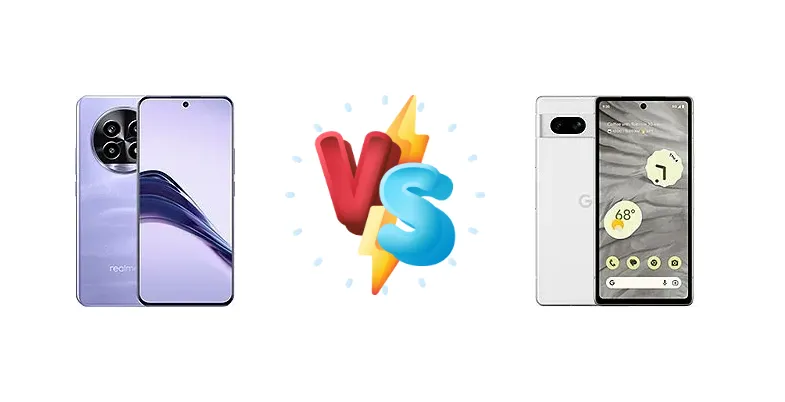
|
🏆 Quick Verdict
For the average user prioritizing camera quality and software experience, the Google Pixel 7a is the clear winner. Its Tensor G2 chip and exceptional image processing provide a superior photographic experience. However, the Realme 14 Pro Lite offers significantly faster 45W charging and a potentially smoother experience for less demanding tasks, making it a strong contender for budget-conscious users.
| PHONES | ||
|---|---|---|
| Phone Names | Realme 14 Pro Lite | Google Pixel 7a |
| Network | ||
|---|---|---|
| 2G bands | GSM 850 / 900 / 1800 / 1900 | GSM 850 / 900 / 1800 / 1900 |
| 3G bands | HSDPA 850 / 900 / 2100 | HSDPA 800 / 850 / 900 / 1700(AWS) / 1900 / 2100 |
| 4G bands | 1, 3, 5, 8, 28, 40, 41 | 1, 2, 3, 4, 5, 7, 8, 12, 13, 14, 17, 20, 25, 26, 28, 29, 30, 38, 40, 41, 48, 66, 71 - GWKK3, G0DZQ |
| 5G bands | 1, 3, 5, 8, 28, 40, 41, 77, 78 SA/NSA | 1, 2, 3, 5, 7, 8, 12, 14, 20, 25, 28, 30, 38, 41, 48, 66, 71, 77, 78 SA/NSA/Sub6 - GWKK3 |
| Speed | HSPA, LTE, 5G | HSPA, LTE, 5G |
| Technology | GSM / HSPA / LTE / 5G | GSM / HSPA / LTE / 5G |
| - | 1, 2, 3, 5, 7, 8, 12, 20, 25, 28, 38, 40, 41, 66, 75, 76, 77, 78, 79 SA/NSA/Sub6 - GHL1X, G82U8 | |
| Launch | ||
|---|---|---|
| Announced | 2025, March 05 | 2023, May 10 |
| Status | Available. Released 2025, March 05 | Available. Released 2023, May 10 |
| Body | ||
|---|---|---|
| Build | - | Glass front (Gorilla Glass 3), aluminum frame, plastic back |
| Dimensions | 161.3 x 73.9 x 8.2 mm (6.35 x 2.91 x 0.32 in) | 152 x 72.9 x 9 mm (5.98 x 2.87 x 0.35 in) |
| SIM | Nano-SIM + Nano-SIM | Nano-SIM + eSIM |
| Weight | 188 g (6.63 oz) | 193.5 g (6.84 oz) |
| - | IP67 dust/water resistant (up to 1m for 30 min) | |
| Display | ||
|---|---|---|
| Protection | Corning Gorilla Glass 7i | Corning Gorilla Glass 3 |
| Resolution | 1080 x 2412 pixels, 20:9 ratio (~394 ppi density) | 1080 x 2400 pixels, 20:9 ratio (~429 ppi density) |
| Size | 6.7 inches, 108.0 cm2 (~90.6% screen-to-body ratio) | 6.1 inches, 90.7 cm2 (~81.8% screen-to-body ratio) |
| Type | AMOLED, 1B colors, 120Hz, 600 nits (typ), 1200 nits (HBM), 2000 nits (peak) | OLED, HDR, 90Hz |
| - | Always-on display | |
| Platform | ||
|---|---|---|
| CPU | Octa-core (4x2.40 GHz Cortex-A78 & 4x1.95 GHz Cortex-A55) | Octa-core (2x2.85 GHz Cortex-X1 & 2x2.35 GHz Cortex-A78 & 4x1.80 GHz Cortex-A55) |
| Chipset | Qualcomm SM7435-AB Snapdragon 7s Gen 2 (4 nm) | Google Tensor G2 (5 nm) |
| GPU | Adreno 710 | Mali-G710 MP7 |
| OS | Android 14, Realme UI 5.0 | Android 13, upgradable to Android 15, up to 5 major Android upgrades |
| Memory | ||
|---|---|---|
| Card slot | No | No |
| Internal | 128GB 8GB RAM, 256GB 8GB RAM | 128GB 8GB RAM |
| - | UFS 3.1 | |
| Main Camera | ||
|---|---|---|
| Dual | 50 MP, f/1.9, 26mm (wide), 1/1.95", 0.8µm, multi-directional PDAF, OIS 8 MP, f/2.2, 16mm, 112˚ (ultrawide), 1/4.0", 1.12µm | 64 MP, f/1.9, 26mm (wide), 1/1.73", 0.8µm, dual pixel PDAF, OIS 13 MP, f/2.2, 120˚ (ultrawide), 1.12µm |
| Features | LED flash, HDR, panorama | Dual-LED flash, Pixel Shift, Auto-HDR, panorama |
| Video | 4K@30fps, 1080p@30/60/120fps, gyro-EIS, OIS | 4K@30/60fps, 1080p@30/60/120/240fps, OIS |
| Selfie camera | ||
|---|---|---|
| Features | - | HDR, panorama |
| Single | 32 MP, f/2.5, 22mm (wide) | 13 MP, f/2.2, 20mm (ultrawide), 1.12µm |
| Video | 4K@30fps, 1080p@30fps | 4K@30fps, 1080p@30fps |
| Sound | ||
|---|---|---|
| 3.5mm jack | - | No |
| 35mm jack | No | No |
| Loudspeaker | Yes, with stereo speakers (Hi-Res audio) | Yes, with stereo speakers |
| Comms | ||
|---|---|---|
| Bluetooth | 5.2, A2DP, LE | 5.3, A2DP, LE |
| NFC | No | Yes |
| Positioning | GPS, GLONASS, GALILEO, BDS, QZSS | GPS, GLONASS, GALILEO, BDS, QZSS, NavIC |
| Radio | No | No |
| USB | USB Type-C 2.0 | USB Type-C 3.2 |
| WLAN | Wi-Fi 802.11 a/b/g/n/ac/6, dual-band | Wi-Fi 802.11 a/b/g/n/ac/6e, tri-band |
| Features | ||
|---|---|---|
| Sensors | Fingerprint (under display, optical), accelerometer, gyro, proximity, compass | Fingerprint (under display, optical), accelerometer, gyro, proximity, compass, barometer |
| Battery | ||
|---|---|---|
| Charging | 45W wired, 50% in 27 min | 18W wired, PD3.0 7.5W wireless |
| Type | 5200 mAh | Li-Po 4385 mAh |
| Misc | ||
|---|---|---|
| Colors | Glass Gold, Glass Purple | Charcoal, Snow, Sea, Coral |
| Models | - | GWKK3, GHL1X, G0DZQ, G82U8 |
| Price | ₹ 18,899 | € 179.90 / $ 150.00 / £ 170.00 / ₹ 25,980 |
Realme 14 Pro Lite
- Significantly faster 45W charging
- Potentially more affordable price point
- Newer Snapdragon 7s Gen 2 chipset
- Camera performance likely inferior to Pixel 7a
- Software updates may be less frequent
Google Pixel 7a
- Exceptional camera quality and image processing
- Clean and consistently updated Android OS
- Powerful Tensor G2 chip for AI tasks
- Slower 18W charging
- Higher price compared to Realme 14 Pro Lite
Display Comparison
The Pixel 7a boasts a measured peak brightness of 1070 nits, ensuring excellent visibility even in direct sunlight. While the Realme 14 Pro Lite’s display specifications are not provided, Realme typically utilizes AMOLED panels in this segment. The Pixel 7a’s brightness advantage is significant, and its color accuracy, a hallmark of Pixel displays, is likely superior. Without knowing the Realme’s panel type or calibration, it’s difficult to assess color gamut coverage or HDR performance, but the Pixel 7a holds a clear advantage in display quality based on measured data.
Camera Comparison
The Pixel 7a’s camera system is its standout feature. While specific sensor details aren’t provided, Google’s computational photography prowess, powered by the Tensor G2, consistently delivers exceptional image quality, particularly in challenging lighting conditions. The Pixel 7a’s image processing excels in dynamic range, detail preservation, and accurate color reproduction. The Realme 14 Pro Lite’s camera capabilities are less defined. Without knowing the sensor size or aperture, it’s difficult to assess its low-light performance. The Pixel 7a’s video capabilities are also likely superior, benefiting from the Tensor G2’s advanced video processing algorithms.
Performance
The Google Pixel 7a’s Tensor G2 (5nm) chipset, featuring a prime Cortex-X1 core clocked at 2.85 GHz, offers a substantial performance advantage over the Realme 14 Pro Lite’s Snapdragon 7s Gen 2 (4nm). The Tensor G2’s architecture, with its focus on AI and machine learning, excels in tasks like image processing and voice recognition. While the Snapdragon 7s Gen 2 is efficient and capable for everyday use, the Tensor G2’s more powerful CPU cores and dedicated AI hardware provide a smoother experience in demanding applications. The 5nm process node of the Tensor G2 also contributes to better thermal management under sustained load compared to the 4nm Snapdragon 7s Gen 2, potentially reducing throttling during extended gaming sessions.
Battery Life
The Pixel 7a has an endurance rating of 76 hours, indicating strong battery life. While the Realme 14 Pro Lite’s battery capacity is unknown, its 45W wired charging is a significant advantage over the Pixel 7a’s 18W charging. The Realme 14 Pro Lite can reach 50% charge in just 27 minutes, while the Pixel 7a takes considerably longer. This difference in charging speed is crucial for users who prioritize quick top-ups. The Pixel 7a’s endurance rating suggests it can comfortably last a full day of moderate use, but the Realme 14 Pro Lite’s faster charging mitigates concerns about battery life for those who prefer frequent, short charging cycles.
Buying Guide
Buy the Realme 14 Pro Lite if you need blazing-fast 45W charging and prioritize a responsive experience for everyday tasks like social media and browsing. It’s ideal for users who frequently top up their battery and don’t heavily rely on demanding mobile games or intensive photo/video editing. Buy the Google Pixel 7a if you prefer a best-in-class camera experience, a clean and consistently updated Android OS, and the power of Google’s Tensor G2 for features like Magic Eraser and Real Tone.