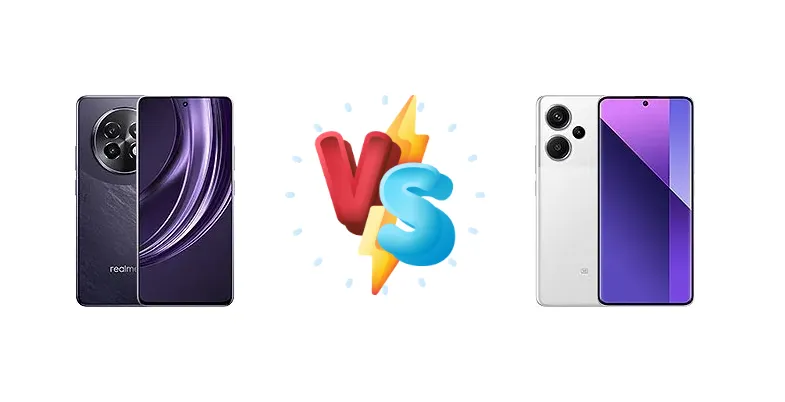
The Realme 13+ and Xiaomi Redmi Note 13 Pro+ represent the cutting edge of the mid-range smartphone market, both packing powerful Mediatek Dimensity chipsets and aggressive charging capabilities. This comparison dives deep into their specifications to determine which device offers the best blend of performance, battery life, and value for your money.
🏆 Quick Verdict
For the average user prioritizing rapid charging and a brighter display, the Xiaomi Redmi Note 13 Pro+ emerges as the winner. Its 120W charging and 1283 nits peak brightness provide a tangible advantage, despite the Realme 13+'s competitive chipset. However, the Realme 13+ remains a strong contender for those seeking a balanced experience.
| Network |
|---|
| 2G bands | GSM 850 / 900 / 1800 / 1900 | GSM 850 / 900 / 1800 / 1900 |
| 3G bands | HSDPA 850 / 900 / 2100 | HSDPA 800 / 850 / 900 / 1700(AWS) / 1900 / 2100 - International |
| 4G bands | 1, 3, 5, 8, 28, 40, 41 | 1, 2, 3, 4, 5, 7, 8, 12, 13, 17, 18, 19, 20, 26, 28, 32, 38, 40, 41, 66 - International |
| 5G bands | 1, 3, 5, 8, 28, 40, 41, 77, 78 SA/NSA | 1, 3, 5, 7, 8, 20, 28, 38, 40, 41, 66, 77, 78 SA/NSA- International |
| Speed | HSPA, LTE, 5G | HSPA, LTE, 5G |
| Technology | GSM / HSPA / LTE / 5G | GSM / CDMA / HSPA / EVDO / LTE / 5G |
| Launch |
|---|
| Announced | 2024, August 29 | 2023, September 21 |
| Status | Available. Released 2024, September 06 | Available. Released 2023, September 21 |
| Body |
|---|
| Build | - | Glass front (Gorilla Glass Victus), glass back or silicone polymer back (eco leather) |
| Dimensions | 161.7 x 74.7 x 7.6 mm (6.37 x 2.94 x 0.30 in) | 161.4 x 74.2 x 8.9 mm (6.35 x 2.92 x 0.35 in) |
| SIM | Nano-SIM + Nano-SIM | · Nano-SIM + eSIM· Nano-SIM + Nano-SIM |
| Weight | 185 g (6.53 oz) | 199 g or 204.5 g (7.02 oz) |
| Display |
|---|
| Protection | - | Corning Gorilla Glass Victus |
| Resolution | 1080 x 2400 pixels, 20:9 ratio (~395 ppi density) | 1220 x 2712 pixels, 20:9 ratio (~446 ppi density) |
| Size | 6.67 inches, 107.4 cm2 (~88.9% screen-to-body ratio) | 6.67 inches, 107.4 cm2 (~89.7% screen-to-body ratio) |
| Type | AMOLED, 120Hz, HDR10+, 600 nits (typ), 2000 nits (peak) | AMOLED, 68B colors, 120Hz, 1920Hz PWM, Dolby Vision, HDR10+, 1800 nits (peak) |
| Platform |
|---|
| CPU | Octa-core (4x2.5 GHz Cortex-A78 & 4x2.0 GHz Cortex-A55) | Octa-core (2x2.8 GHz Cortex-A715 & 6x2.0 GHz Cortex-A510) |
| Chipset | Mediatek Dimensity 7300 Energy (4 nm) | Mediatek Dimensity 7200 Ultra (4 nm) |
| GPU | Mali-G615 MC2 | Mali-G610 MC4 |
| OS | Android 14, Realme UI 5.0 | Android 13, up to 3 major Android upgrades, HyperOS |
| Memory |
|---|
| Card slot | microSDXC (uses shared SIM slot) | No |
| Internal | 128GB 8GB RAM, 256GB 8GB RAM, 256GB 12GB RAM, 512GB 12GB RAM | 256GB 8GB RAM, 256GB 12GB RAM, 512GB 8GB RAM, 512GB 12GB RAM, 512GB 16GB RAM |
| Main Camera |
|---|
| Features | LED flash, HDR, panorama | Dual-LED dual-tone flash, HDR, panorama |
| Triple | 50 MP, f/1.8, 26mm (wide), 1/1.95", PDAF, OIS
Auxiliary lenses | 200 MP, f/1.7, 23mm (wide), 1/1.4", 0.56µm, multi-directional PDAF, OIS
8 MP, f/2.2, 16mm, 120˚ (ultrawide), 1/4.0", 1.12µm
2 MP (macro) |
| Video | 4K@30fps, 1080p@30/60/120fps, gyro-EIS, OIS | 4K@24/30fps, 1080p@30/60/120fps, gyro-EIS |
| Selfie camera |
|---|
| Features | - | HDR, panorama |
| Single | 16 MP, f/2.4, 24mm (wide), 1/3.0" | 16 MP, f/2.4, (wide) |
| Video | 1080p@30fps | 1080p@30/60fps |
| Sound |
|---|
| 35mm jack | Yes | No |
| Loudspeaker | Yes, with stereo speakers | Yes, with stereo speakers |
| Comms |
|---|
| Bluetooth | 5.4, A2DP, LE | 5.3, A2DP, LE |
| Infrared port | - | Yes |
| NFC | Yes, 360˚ (market/region dependent) | Yes (market/region dependent) |
| Positioning | GPS, GLONASS, GALILEO, BDS, QZSS | GPS, GLONASS, BDS, GALILEO, QZSS |
| Radio | No | No |
| USB | USB Type-C 2.0 | USB Type-C 2.0, OTG |
| WLAN | Wi-Fi 802.11 a/b/g/n/ac/6, dual-band | Wi-Fi 802.11 a/b/g/n/ac/6, dual-band, Wi-Fi Direct |
| Features |
|---|
| Sensors | Fingerprint (under display, optical), accelerometer, gyro, proximity, compass | Fingerprint (under display, optical), accelerometer, gyro, proximity, compass |
| Battery |
|---|
| Charging | 80W wired, 50% in 19 min | 120W wired, PD3.0, 100% in 19 min |
| Type | 5000 mAh | Li-Po 5000 mAh |
| Misc |
|---|
| Colors | Victory Gold, Speed Green, Dark Purple | Midnight Black (Fushion Black), Moonlight White (Fushion White), Aurora Purple, Fushion Purple, Camo Green |
| Models | RMX5002, RMX5000 | 23090RA98C, 23090RA98G, 23090RA98I |
| Price | About 250 EUR | $ 299.98 / £ 299.00 / € 208.98 / ₹ 24,999 |
| SAR | - | 1.09 W/kg (head) 0.85 W/kg (body) |
| SAR EU | - | 0.98 W/kg (head) 1.00 W/kg (body) |
Realme 13+
- Potentially better sustained performance due to efficient Cortex-A78 cores.
- Competitive 80W fast charging.
- Likely a more balanced power consumption profile.
- Slower charging speed compared to the Redmi Note 13 Pro+.
- Display brightness likely lower than the Redmi Note 13 Pro+.
Xiaomi Redmi Note 13 Pro+
- Ultra-fast 120W charging with PD3.0 support.
- Significantly brighter 1283 nits display.
- Longer active use battery life (10:38h).
- Potentially more thermal throttling under sustained load.
- Higher price point compared to the Realme 13+ (likely).
Display Comparison
The Xiaomi Redmi Note 13 Pro+ boasts a notably brighter display, reaching a measured 1283 nits peak brightness. This is a significant advantage for outdoor use, ensuring excellent visibility even in direct sunlight. While the Realme 13+’s display specifications are not provided, the Redmi’s brightness level suggests a clear win in this category. The Redmi Note 13 Pro+ likely utilizes an AMOLED panel, common in this price range, offering vibrant colors and deep blacks. The absence of LTPO technology in either device suggests standard refresh rate management, potentially impacting battery life during dynamic content.
Camera Comparison
Without detailed camera specifications for the Realme 13+, it’s difficult to make a definitive comparison. However, the Redmi Note 13 Pro+ is expected to feature a high-resolution main sensor (likely 200MP, based on market trends) with optical image stabilization (OIS). The larger sensor size and OIS will contribute to better low-light performance and sharper images. The Realme 13+ will likely rely on software processing to compensate for any hardware limitations. The prevalence of 2MP macro lenses on both devices suggests they are primarily included for marketing purposes and offer limited practical value.
Performance
Both devices utilize 4nm Mediatek Dimensity chipsets, but differ in their core configurations. The Redmi Note 13 Pro+ features the Dimensity 7200 Ultra with a 2x2.8 GHz Cortex-A715 and 6x2.0 GHz Cortex-A510 configuration, prioritizing peak clock speeds. The Realme 13+ employs the Dimensity 7300 Energy, utilizing a 4x2.5 GHz Cortex-A78 and 4x2.0 GHz Cortex-A55 setup. The Cortex-A78 cores in the Realme 13+ are generally more efficient than the A715, potentially leading to better sustained performance and thermal management during extended gaming sessions. However, the higher clock speeds of the Redmi’s cores may translate to quicker responsiveness in short bursts. Both devices likely feature LPDDR5x RAM, ensuring ample memory bandwidth.
Battery Life
The Xiaomi Redmi Note 13 Pro+ demonstrates a clear advantage in battery performance, achieving 10 hours and 38 minutes of active use. This, combined with its 120W wired charging (capable of a full charge in 19 minutes with PD3.0 support), makes it a standout performer. The Realme 13+ offers 80W charging, reaching 50% charge in 19 minutes, but lacks the full charge speed of its competitor. While the Realme 13+'s battery capacity is unknown, the Redmi’s longer active use time suggests a more efficient combination of hardware and software optimization.
Buying Guide
Buy the Realme 13+ if you prioritize a balanced chipset with a focus on efficiency and are less concerned with the absolute fastest charging speeds. It's ideal for users who enjoy moderate gaming and everyday tasks. Buy the Xiaomi Redmi Note 13 Pro+ if you demand the quickest possible charging, a significantly brighter display for outdoor visibility, and a longer active use battery life, even if it comes at a slight premium.
Frequently Asked Questions
❓ Does the Dimensity 7300 Energy in the Realme 13+ struggle with demanding games like Genshin Impact?
The Dimensity 7300 Energy is a capable chipset, but Genshin Impact at maximum settings may require some graphical compromises. The Cortex-A78 cores should provide sufficient power for smooth gameplay at medium settings, and the 4nm process helps mitigate thermal throttling during extended sessions.
❓ How does the 120W charging on the Redmi Note 13 Pro+ affect long-term battery health?
While extremely fast charging is convenient, it can potentially accelerate battery degradation over time. However, Xiaomi likely incorporates battery health management features to mitigate this effect, such as optimized charging curves and temperature control. Using the phone overnight with adaptive charging enabled can further prolong battery lifespan.
❓ Is the difference in CPU architecture (A78 vs A715) noticeable in everyday tasks?
For typical everyday tasks like browsing, social media, and video streaming, the difference between the Cortex-A78 and A715 cores will be minimal. Both chipsets offer ample performance for these workloads. The architectural difference becomes more apparent during sustained, CPU-intensive tasks like video editing or heavy multitasking.