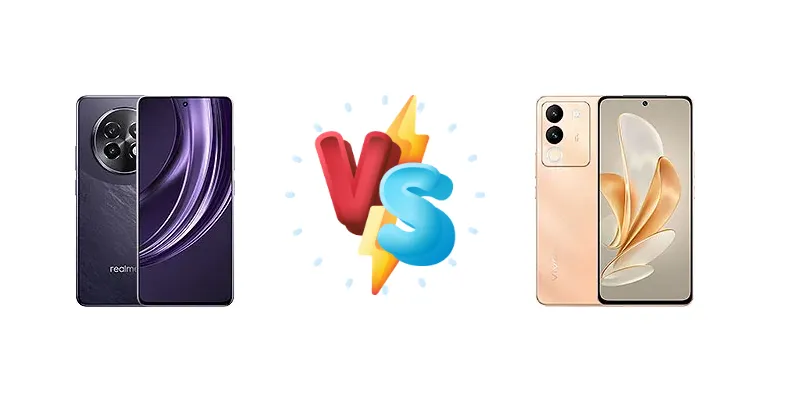
The Realme 13+ and vivo V29e represent distinct approaches to the competitive mid-range smartphone market. The Realme 13+ aims for a balance of performance and features, leveraging Mediatek's latest Dimensity 7300 Energy chipset. Conversely, the vivo V29e prioritizes affordability with Qualcomm’s Snapdragon 695 5G, making it a compelling option for budget-conscious consumers. This comparison will dissect their key differences to help you determine which device best suits your needs.
🏆 Quick Verdict
For the average user prioritizing performance and fast charging, the Realme 13+ is the clear winner. Its Mediatek Dimensity 7300 Energy chipset offers a substantial performance uplift over the Snapdragon 695 in the vivo V29e, coupled with significantly faster 80W charging. While the V29e remains a viable option for basic tasks, the 13+ provides a smoother, more responsive experience.
| Network |
|---|
| 2G bands | GSM 850 / 900 / 1800 / 1900 | GSM 850 / 900 / 1800 / 1900 |
| 3G bands | HSDPA 850 / 900 / 2100 | HSDPA 850 / 900 / 1700(AWS) / 1900 / 2100 |
| 4G bands | 1, 3, 5, 8, 28, 40, 41 | 1, 2, 3, 4, 5, 7, 8, 18, 19, 20, 26, 28, 38, 39, 40, 41 |
| 5G bands | 1, 3, 5, 8, 28, 40, 41, 77, 78 SA/NSA | 1, 3, 5, 7, 8, 28, 38, 40, 41, 77, 78 SA/NSA |
| Speed | HSPA, LTE, 5G | HSPA, LTE, 5G |
| Technology | GSM / HSPA / LTE / 5G | GSM / HSPA / LTE / 5G |
| Launch |
|---|
| Announced | 2024, August 29 | 2023, October 23 |
| Status | Available. Released 2024, September 06 | Available. Released 2023, October 23 |
| Body |
|---|
| Build | - | Glass front, plastic frame, glass back |
| Dimensions | 161.7 x 74.7 x 7.6 mm (6.37 x 2.94 x 0.30 in) | 162.4 x 74.9 x 7.7 mm (6.39 x 2.95 x 0.30 in) |
| SIM | Nano-SIM + Nano-SIM | Nano-SIM + Nano-SIM |
| Weight | 185 g (6.53 oz) | 190 g (6.70 oz) |
| Display |
|---|
| Resolution | 1080 x 2400 pixels, 20:9 ratio (~395 ppi density) | 1080 x 2400 pixels, 20:9 ratio (~395 ppi density) |
| Size | 6.67 inches, 107.4 cm2 (~88.9% screen-to-body ratio) | 6.67 inches, 107.4 cm2 (~88.3% screen-to-body ratio) |
| Type | AMOLED, 120Hz, HDR10+, 600 nits (typ), 2000 nits (peak) | AMOLED, 120Hz, 1150 nits (peak) |
| Platform |
|---|
| CPU | Octa-core (4x2.5 GHz Cortex-A78 & 4x2.0 GHz Cortex-A55) | Octa-core (2x2.2 GHz Kryo 660 Gold & 6x1.8 GHz Kryo 660 Silver) |
| Chipset | Mediatek Dimensity 7300 Energy (4 nm) | Qualcomm SM6375 Snapdragon 695 5G (6 nm) |
| GPU | Mali-G615 MC2 | Adreno 619 |
| OS | Android 14, Realme UI 5.0 | Android 13, Funtouch 13 |
| Memory |
|---|
| Card slot | microSDXC (uses shared SIM slot) | No |
| Internal | 128GB 8GB RAM, 256GB 8GB RAM, 256GB 12GB RAM, 512GB 12GB RAM | 256GB 8GB RAM, 256GB 12GB RAM |
| Main Camera |
|---|
| Dual | - | 64 MP, f/1.8, (wide), PDAF, OIS
8 MP, f/2.2, (ultrawide) |
| Features | LED flash, HDR, panorama | Ring-LED flash, panorama, HDR |
| Triple | 50 MP, f/1.8, 26mm (wide), 1/1.95", PDAF, OIS
Auxiliary lenses | - |
| Video | 4K@30fps, 1080p@30/60/120fps, gyro-EIS, OIS | 1080p@30fps |
| Selfie camera |
|---|
| Single | 16 MP, f/2.4, 24mm (wide), 1/3.0" | 50 MP, f/2.0, 22mm (wide), AF |
| Video | 1080p@30fps | 1080p@30fps |
| Sound |
|---|
| 35mm jack | Yes | No |
| Loudspeaker | Yes, with stereo speakers | Yes |
| Comms |
|---|
| Bluetooth | 5.4, A2DP, LE | 5.1, A2DP, LE |
| NFC | Yes, 360˚ (market/region dependent) | No |
| Positioning | GPS, GLONASS, GALILEO, BDS, QZSS | GPS, GLONASS, GALILEO, BDS, QZSS |
| Radio | No | No |
| USB | USB Type-C 2.0 | USB Type-C 2.0, OTG |
| WLAN | Wi-Fi 802.11 a/b/g/n/ac/6, dual-band | Wi-Fi 802.11 a/b/g/n/ac, dual-band |
| Features |
|---|
| Sensors | Fingerprint (under display, optical), accelerometer, gyro, proximity, compass | Fingerprint (under display, optical), accelerometer, gyro, proximity, compass |
| Battery |
|---|
| Charging | 80W wired, 50% in 19 min | 44W wired |
| Type | 5000 mAh | Li-Ion 4800 mAh |
| Misc |
|---|
| Colors | Victory Gold, Speed Green, Dark Purple | Forest Black, Rose Gold, Ice Creek Blue |
| Models | RMX5002, RMX5000 | V2317 |
| Price | About 250 EUR | About 320 EUR |
Realme 13+
- Significantly faster processor (Dimensity 7300 Energy)
- Ultra-fast 80W charging
- Improved power efficiency for longer battery life
- Potentially higher price point
- May generate more heat under sustained load (though 4nm helps)
vivo V29e
- More affordable price
- Decent performance for basic tasks
- 5G connectivity
- Slower processor (Snapdragon 695)
- Slower 44W charging
- Less capable GPU for gaming
Display Comparison
While specific display details are absent, both phones likely feature LCD or AMOLED panels common in this price bracket. However, the chipset difference suggests the Realme 13+ could potentially drive a higher refresh rate display more smoothly. The Snapdragon 695’s GPU is less powerful, potentially leading to dropped frames at higher refresh rates. Bezels and color accuracy will likely be comparable, but the Realme 13+’s processing power gives it headroom for more advanced display features.
Camera Comparison
Without specific camera sensor details, it’s difficult to make a definitive judgment. However, the processing power of the Dimensity 7300 Energy in the Realme 13+ will likely enable more sophisticated image processing algorithms, resulting in better dynamic range and noise reduction. The Snapdragon 695’s ISP is less capable, potentially leading to softer images and less detail in challenging lighting conditions. The presence of OIS (Optical Image Stabilization) on either device would be a significant advantage, but this information is currently unavailable. We can assume both phones will include standard wide and ultrawide lenses, but the Realme 13+’s superior processing power will likely give it an edge in image quality.
Performance
The core difference lies in the chipsets. The Realme 13+’s Mediatek Dimensity 7300 Energy (4nm) is a significant upgrade over the vivo V29e’s Qualcomm Snapdragon 695 5G (6nm). The 4nm process node of the Dimensity 7300 Energy translates to improved power efficiency and reduced thermal throttling, crucial for sustained performance. The Dimensity 7300 Energy’s CPU – an octa-core configuration with 4x2.5 GHz Cortex-A78 and 4x2.0 GHz Cortex-A55 cores – demonstrably outperforms the Snapdragon 695’s 2x2.2 GHz Kryo 660 Gold & 6x1.8 GHz Kryo 660 Silver setup, particularly in multi-threaded tasks and gaming. Users who frequently multitask, edit photos/videos, or play graphically intensive games will experience a noticeable difference with the Realme 13+.
Battery Life
The Realme 13+’s 80W wired charging is a game-changer, capable of charging the battery to 50% in just 19 minutes. This is significantly faster than the vivo V29e’s 44W charging. While battery capacity isn’t specified, the faster charging speed of the Realme 13+ mitigates the impact of a potentially smaller battery. Users who frequently find themselves needing a quick top-up will greatly benefit from the 13+’s charging capabilities. The Dimensity 7300 Energy’s improved power efficiency also contributes to better overall battery life.
Buying Guide
Buy the Realme 13+ if you need a phone capable of handling demanding applications, enjoy mobile gaming, and value rapid charging speeds. Its superior chipset and charging capabilities justify the potential price premium. Buy the vivo V29e if you prioritize affordability and primarily use your phone for basic communication, social media, and light web browsing. It’s a solid choice for users who don’t require high-end performance.
Frequently Asked Questions
❓ Will the Snapdragon 695 in the vivo V29e struggle with demanding games like Genshin Impact or Call of Duty Mobile?
Yes, the Snapdragon 695 is a mid-range chipset and will likely struggle to deliver a consistently smooth experience in graphically intensive games like Genshin Impact or Call of Duty Mobile, even at lower settings. Expect noticeable frame drops and potential stuttering. The Realme 13+’s Dimensity 7300 Energy is far better equipped to handle these titles.
❓ How much faster is the 80W charging on the Realme 13+ compared to the 44W charging on the vivo V29e in real-world usage?
The 80W charging on the Realme 13+ is substantially faster. While exact times depend on battery size, the 13+ can reach 50% charge in 19 minutes. The V29e’s 44W charging will likely take over an hour to reach the same level. This difference is particularly noticeable for users who need a quick power boost before leaving the house.
❓ Is the Dimensity 7300 Energy known to overheat during prolonged gaming sessions?
The Dimensity 7300 Energy is built on a 4nm process, which generally results in better thermal efficiency compared to the 6nm process used in the Snapdragon 695. While some heat generation is inevitable during prolonged gaming, the 7300 Energy is less prone to significant throttling than older chipsets. Realme likely incorporates thermal management solutions to further mitigate heat buildup.