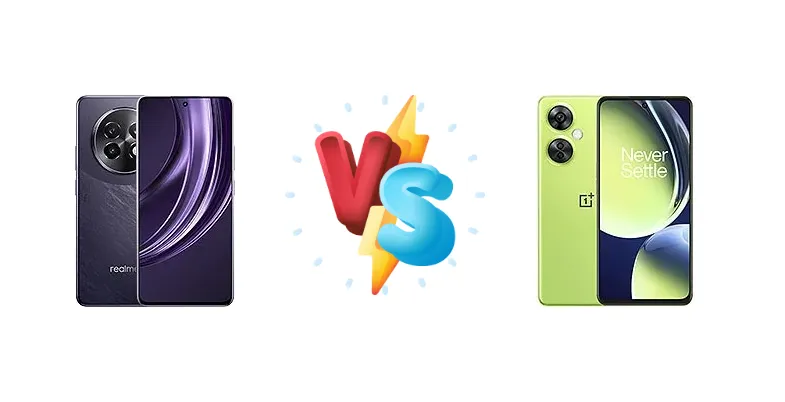
The Realme 13+ and OnePlus Nord CE 3 Lite represent compelling options in the increasingly competitive mid-range smartphone market. While both aim to deliver a balanced experience, they take distinctly different approaches to processing power and charging speed. This comparison dissects their key specifications to determine which device best suits your priorities.
🏆 Quick Verdict
For most users, the Realme 13+ emerges as the stronger contender. Its Mediatek Dimensity 7300 Energy chipset offers a significant performance advantage over the Snapdragon 695 in the Nord CE 3 Lite, translating to smoother multitasking and gaming. While the Nord CE 3 Lite boasts a slightly slower charging speed, the Realme 13+'s overall performance justifies the choice.
| Network |
|---|
| 2G bands | GSM 850 / 900 / 1800 / 1900 | GSM 850 / 900 / 1800 / 1900 |
| 3G bands | HSDPA 850 / 900 / 2100 | HSDPA 800 / 850 / 900 / 1700(AWS) / 1900 / 2100 - International |
| 4G bands | 1, 3, 5, 8, 28, 40, 41 | 1, 2, 3, 4, 5, 7, 8, 12, 13, 17, 18, 19, 20, 26, 28, 32, 38, 39, 40, 41, 66 - International |
| 5G bands | 1, 3, 5, 8, 28, 40, 41, 77, 78 SA/NSA | 1, 3, 5, 7, 8, 20, 28, 38, 40, 41, 66, 77, 78 SA/NSA - International |
| Speed | HSPA, LTE, 5G | HSPA, LTE, 5G |
| Technology | GSM / HSPA / LTE / 5G | GSM / HSPA / LTE / 5G |
| | - | 1, 3, 5, 8, 28, 40, 41, 77, 78 SA/NSA - India |
| Launch |
|---|
| Announced | 2024, August 29 | 2023, April 04 |
| Status | Available. Released 2024, September 06 | Available. Released 2023, April 11 |
| Body |
|---|
| Build | - | Glass front, plastic frame, plastic back |
| Dimensions | 161.7 x 74.7 x 7.6 mm (6.37 x 2.94 x 0.30 in) | 165.5 x 76 x 8.3 mm (6.52 x 2.99 x 0.33 in) |
| SIM | Nano-SIM + Nano-SIM | Nano-SIM + Nano-SIM |
| Weight | 185 g (6.53 oz) | 195 g (6.88 oz) |
| Display |
|---|
| Protection | - | Corning Gorilla Glass |
| Resolution | 1080 x 2400 pixels, 20:9 ratio (~395 ppi density) | 1080 x 2400 pixels, 20:9 ratio (~391 ppi density) |
| Size | 6.67 inches, 107.4 cm2 (~88.9% screen-to-body ratio) | 6.72 inches, 109.6 cm2 (~87.1% screen-to-body ratio) |
| Type | AMOLED, 120Hz, HDR10+, 600 nits (typ), 2000 nits (peak) | IPS LCD, 120Hz, 550 nits (typ), 680 nits (peak) |
| Platform |
|---|
| CPU | Octa-core (4x2.5 GHz Cortex-A78 & 4x2.0 GHz Cortex-A55) | Octa-core (2x2.2 GHz Kryo 660 Gold & 6x1.7 GHz Kryo 660 Silver) |
| Chipset | Mediatek Dimensity 7300 Energy (4 nm) | Qualcomm SM6375 Snapdragon 695 5G (6 nm) |
| GPU | Mali-G615 MC2 | Adreno 619 |
| OS | Android 14, Realme UI 5.0 | Android 13, OxygenOS 13.1 |
| Memory |
|---|
| Card slot | microSDXC (uses shared SIM slot) | microSDXC (uses shared SIM slot) |
| Internal | 128GB 8GB RAM, 256GB 8GB RAM, 256GB 12GB RAM, 512GB 12GB RAM | 128GB 8GB RAM, 256GB 8GB RAM |
| | - | UFS 2.2 |
| Main Camera |
|---|
| Features | LED flash, HDR, panorama | LED flash, HDR, panorama |
| Triple | 50 MP, f/1.8, 26mm (wide), 1/1.95", PDAF, OIS
Auxiliary lenses | 108 MP, f/1.8, (wide), 1/1.67", 0.64µm, PDAF
2 MP (macro)
Auxiliary lens |
| Video | 4K@30fps, 1080p@30/60/120fps, gyro-EIS, OIS | 1080p@30fps |
| Selfie camera |
|---|
| Features | - | HDR, panorama |
| Single | 16 MP, f/2.4, 24mm (wide), 1/3.0" | 16 MP, f/2.4, (wide), 1.0µm |
| Video | 1080p@30fps | 1080p@30fps |
| Sound |
|---|
| 3.5mm jack | - | Yes |
| 35mm jack | Yes | Yes |
| Loudspeaker | Yes, with stereo speakers | Yes, with stereo speakers |
| Comms |
|---|
| Bluetooth | 5.4, A2DP, LE | 5.1, A2DP, LE, aptX HD |
| NFC | Yes, 360˚ (market/region dependent) | Yes (market/region dependent) |
| Positioning | GPS, GLONASS, GALILEO, BDS, QZSS | GPS, GALILEO, GLONASS, BDS, QZSS |
| Radio | No | No |
| USB | USB Type-C 2.0 | USB Type-C 2.0, OTG |
| WLAN | Wi-Fi 802.11 a/b/g/n/ac/6, dual-band | Wi-Fi 802.11 a/b/g/n/ac, dual-band |
| Features |
|---|
| Sensors | Fingerprint (under display, optical), accelerometer, gyro, proximity, compass | Fingerprint (side-mounted), accelerometer, gyro, proximity, compass |
| Battery |
|---|
| Charging | 80W wired, 50% in 19 min | 67W wired, 80% in 30 min |
| Type | 5000 mAh | Li-Po 5000 mAh |
| Misc |
|---|
| Colors | Victory Gold, Speed Green, Dark Purple | Pastel Lime, Chromatic Gray |
| Models | RMX5002, RMX5000 | CPH2467, CPH2465 |
| Price | About 250 EUR | £ 169.98 / € 209.99 |
| SAR | - | 1.17 W/kg (head) 0.70 W/kg (body) |
| Tests |
|---|
| Performance | - |
AnTuTu: 412006 (v9)
GeekBench: 2052 (v5)
GFXBench: 17fps (ES 3.1 onscreen) |
Realme 13+
- Superior performance with Dimensity 7300 Energy
- Faster 80W charging
- Potentially better image processing
- May be slightly more expensive
- Software experience may not appeal to all
OnePlus Nord CE 3 Lite
- Familiar OnePlus software experience
- Competitive price point
- Decent performance for everyday tasks
- Slower Snapdragon 695 chipset
- Slower 67W charging
Display Comparison
Details regarding display specifications (resolution, refresh rate, panel type) are missing. However, given the price bracket, both likely feature LCD panels. The key differentiator will be brightness and color accuracy. Without specific data, we can assume both will offer adequate viewing experiences for everyday use, but neither will likely compete with flagship-level displays. Bezels are likely comparable, typical of this segment.
Camera Comparison
Camera details beyond the presence of sensors are absent. However, the Realme 13+ is likely to benefit from the increased processing power of the Dimensity 7300 for image processing. The Snapdragon 695’s ISP is capable, but will be limited in its ability to handle complex computational photography tasks. Without sensor size or aperture information, it’s difficult to definitively declare a winner, but the Realme 13+ has the potential for superior image quality due to its more powerful chipset. We anticipate both phones will include a standard suite of camera modes, but the Realme 13+ may offer faster processing and more advanced features.
Performance
The Realme 13+’s Mediatek Dimensity 7300 Energy (4nm) chipset is the clear winner here. The octa-core configuration, featuring four Cortex-A78 cores clocked at 2.5 GHz, provides a substantial performance boost over the OnePlus Nord CE 3 Lite’s Snapdragon 695 (6nm). The Snapdragon 695 utilizes Kryo 660 Gold and Silver cores, peaking at 2.2 GHz. The 4nm process node of the Dimensity 7300 also contributes to improved power efficiency and thermal management, meaning less throttling during sustained workloads. This translates to a smoother experience in demanding games and applications for the Realme 13+. The 6nm Snapdragon 695 is adequate for everyday tasks, but will struggle with graphically intensive games.
Battery Life
The Realme 13+ features 80W wired charging, capable of reaching 50% charge in just 19 minutes. The OnePlus Nord CE 3 Lite offers 67W wired charging, taking 30 minutes to reach 80%. While the Nord CE 3 Lite’s charging isn’t *slow*, the Realme 13+ provides a significantly faster top-up. Battery capacity is not specified for either device, but the faster charging of the Realme 13+ mitigates the impact of a potentially smaller battery. Users who frequently need to quickly recharge will strongly favor the Realme 13+.
Buying Guide
Buy the Realme 13+ if you prioritize performance for gaming, demanding apps, or future-proofing. The Dimensity 7300 Energy chipset provides a noticeable step up in processing power. Buy the OnePlus Nord CE 3 Lite if you value a familiar OnePlus software experience and are primarily focused on essential smartphone tasks like calling, texting, and social media, and want to save a bit of money.
Frequently Asked Questions
❓ Will the Snapdragon 695 in the OnePlus Nord CE 3 Lite struggle with demanding games like Genshin Impact?
Yes, the Snapdragon 695 is not ideally suited for graphically intensive games like Genshin Impact. While you may be able to run it on lower settings, expect noticeable frame drops and potential overheating. The Realme 13+'s Dimensity 7300 Energy will provide a significantly smoother gaming experience.
❓ How much faster is the 80W charging on the Realme 13+ compared to the 67W charging on the OnePlus Nord CE 3 Lite in real-world use?
The Realme 13+ can reach 50% charge in 19 minutes, while the Nord CE 3 Lite takes 30 minutes to reach 80%. This means a substantial difference in quick top-ups. If you frequently find yourself needing to quickly recharge your phone, the Realme 13+ is the clear winner.
❓ Does the Dimensity 7300 Energy chipset in the Realme 13+ generate more heat than the Snapdragon 695?
While the Dimensity 7300 Energy is more powerful, its 4nm process node is more efficient than the Snapdragon 695’s 6nm node. This means it generates less heat for a given level of performance, reducing the likelihood of thermal throttling during extended use.