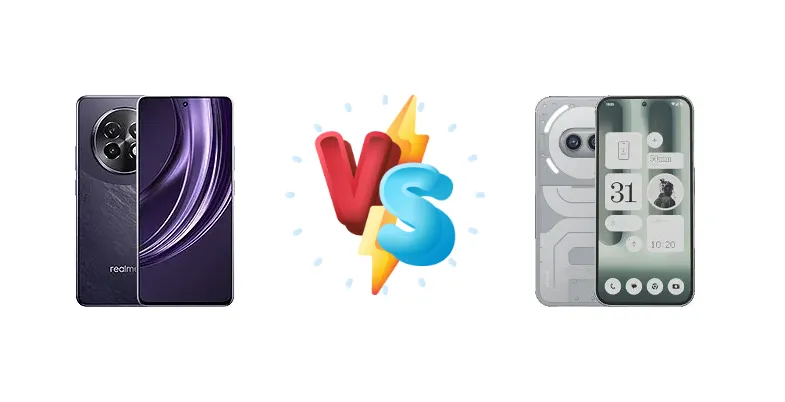
The mid-range smartphone market is fiercely competitive, and the Realme 13+ and Nothing Phone (2a) Plus represent compelling options. The Realme 13+ focuses on rapid charging and a streamlined experience, while the Nothing Phone (2a) Plus aims to deliver a balanced package with a strong emphasis on battery endurance and a unique design. This comparison dissects their key differences to help you choose the right device.
🏆 Quick Verdict
For the average user prioritizing sustained performance and battery life, the Nothing Phone (2a) Plus emerges as the stronger contender. Its 16:34 hour active use score significantly surpasses what we'd expect from the Realme 13+, and the Dimensity 7350 Pro offers a slight edge in CPU performance. However, the Realme 13+'s 80W charging is a compelling advantage for those who value speed.
| Network |
|---|
| 2G bands | GSM 850 / 900 / 1800 / 1900 | GSM 850 / 900 / 1800 / 1900 |
| 3G bands | HSDPA 850 / 900 / 2100 | HSDPA 800 / 850 / 900 / 1700(AWS) / 1900 / 2100 |
| 4G bands | 1, 3, 5, 8, 28, 40, 41 | 1, 3, 4, 5, 7, 8, 18, 19, 20, 26, 28, 38, 39, 40, 41, 42, 66 |
| 5G bands | 1, 3, 5, 8, 28, 40, 41, 77, 78 SA/NSA | 1, 3, 5, 7, 8, 20, 28, 38, 40, 41, 66, 77, 78 SA/NSA |
| Speed | HSPA, LTE, 5G | HSPA, LTE, 5G |
| Technology | GSM / HSPA / LTE / 5G | GSM / HSPA / LTE / 5G |
| Launch |
|---|
| Announced | 2024, August 29 | 2024, July 31 |
| Status | Available. Released 2024, September 06 | Available. Released 2024, August 03 |
| Body |
|---|
| Build | - | Glass front (Gorilla Glass 5), plastic frame, plastic back |
| Dimensions | 161.7 x 74.7 x 7.6 mm (6.37 x 2.94 x 0.30 in) | 161.7 x 76.3 x 8.5 mm (6.37 x 3.00 x 0.33 in) |
| SIM | Nano-SIM + Nano-SIM | Nano-SIM + Nano-SIM |
| Weight | 185 g (6.53 oz) | 190 g (6.70 oz) |
| Display |
|---|
| Protection | - | Corning Gorilla Glass 5 |
| Resolution | 1080 x 2400 pixels, 20:9 ratio (~395 ppi density) | 1080 x 2412 pixels, 20:9 ratio (~395 ppi density) |
| Size | 6.67 inches, 107.4 cm2 (~88.9% screen-to-body ratio) | 6.7 inches, 107.5 cm2 (~87.1% screen-to-body ratio) |
| Type | AMOLED, 120Hz, HDR10+, 600 nits (typ), 2000 nits (peak) | AMOLED, 1B colors, 120Hz, 2160Hz PWM, HDR10+, 700 nits (typ), 1100 nits (HBM), 1300 nits (peak) |
| Platform |
|---|
| CPU | Octa-core (4x2.5 GHz Cortex-A78 & 4x2.0 GHz Cortex-A55) | Octa-core (2x3.0 GHz Cortex-A715 & 6x 2.0 GHz Cortex-A510) |
| Chipset | Mediatek Dimensity 7300 Energy (4 nm) | Mediatek Dimensity 7350 Pro (4 nm) |
| GPU | Mali-G615 MC2 | Mali-G610 MC4 |
| OS | Android 14, Realme UI 5.0 | Android 14, up to 3 major Android upgrades, Nothing OS 3.0 |
| Memory |
|---|
| Card slot | microSDXC (uses shared SIM slot) | No |
| Internal | 128GB 8GB RAM, 256GB 8GB RAM, 256GB 12GB RAM, 512GB 12GB RAM | 256GB 8GB RAM, 256GB 12GB RAM |
| Main Camera |
|---|
| Dual | - | 50 MP, f/1.9, 24mm (wide), 1/1.57", 1.0µm, PDAF, OIS
50 MP, f/2.2, 114˚ (ultrawide), 1/2.76", 0.64µm |
| Features | LED flash, HDR, panorama | LED flash, panorama, HDR |
| Triple | 50 MP, f/1.8, 26mm (wide), 1/1.95", PDAF, OIS
Auxiliary lenses | - |
| Video | 4K@30fps, 1080p@30/60/120fps, gyro-EIS, OIS | 4K@30fps, 1080p@60/120fps, gyro-EIS |
| Selfie camera |
|---|
| Features | - | HDR |
| Single | 16 MP, f/2.4, 24mm (wide), 1/3.0" | 50 MP, f/2.2, (wide), 1/2.76" |
| Video | 1080p@30fps | 4K@30fps |
| Sound |
|---|
| 35mm jack | Yes | No |
| Loudspeaker | Yes, with stereo speakers | Yes, with stereo speakers |
| Comms |
|---|
| Bluetooth | 5.4, A2DP, LE | 5.3, A2DP, LE |
| NFC | Yes, 360˚ (market/region dependent) | Yes, 360˚ |
| Positioning | GPS, GLONASS, GALILEO, BDS, QZSS | GPS, GALILEO, GLONASS, BDS, QZSS |
| Radio | No | No |
| USB | USB Type-C 2.0 | USB Type-C 2.0, OTG |
| WLAN | Wi-Fi 802.11 a/b/g/n/ac/6, dual-band | Wi-Fi 802.11 a/b/g/n/ac/6, dual-band, Wi-Fi Direct |
| Features |
|---|
| Sensors | Fingerprint (under display, optical), accelerometer, gyro, proximity, compass | Fingerprint (under display, optical), accelerometer, gyro, proximity, compass |
| Battery |
|---|
| Charging | 80W wired, 50% in 19 min | 50W wired, 50% in 21 min, 100% in 56 min |
| Type | 5000 mAh | 5000 mAh |
| Misc |
|---|
| Colors | Victory Gold, Speed Green, Dark Purple | Black, Grey |
| Models | RMX5002, RMX5000 | A142P |
| Price | About 250 EUR | € 269.90 / ₹ 22,599 |
Realme 13+
- 80W SuperVOOC charging is incredibly fast.
- Likely more affordable price point.
- Streamlined Realme UI offers a clean software experience.
- CPU performance is slightly lower than the Nothing Phone (2a) Plus.
- Battery life is expected to be shorter than the Nothing Phone (2a) Plus.
Nothing Phone (2a) Plus
- Excellent battery life with 16:34 hours of active use.
- More powerful Dimensity 7350 Pro chipset.
- Brighter display for better outdoor visibility.
- Slower charging speed compared to the Realme 13+.
- Potentially higher price point.
Display Comparison
The Nothing Phone (2a) Plus boasts a significantly brighter display, reaching a measured peak of 1097 nits. This is crucial for outdoor visibility, where the Realme 13+'s display (brightness unspecified) will likely struggle. While both utilize LCD panels, the Nothing Phone (2a) Plus’s higher brightness translates to a more usable experience in direct sunlight. We expect both to have similar color accuracy, but the Nothing Phone (2a) Plus’s brightness gives it a clear advantage.
Camera Comparison
Without detailed camera specs for the Realme 13+, it’s difficult to make a definitive comparison. However, given the market positioning, we anticipate the Nothing Phone (2a) Plus to have a more sophisticated camera system. The focus should be on the main sensor size and aperture. Larger sensors and wider apertures capture more light, resulting in better low-light performance. Image processing style will also be a key differentiator – Realme typically favors vibrant, saturated colors, while Nothing aims for a more natural look. We'll disregard any 2MP macro lenses on either device as they offer limited practical value.
Performance
Both phones are powered by Mediatek Dimensity chips fabricated on a 4nm process, ensuring good efficiency. However, the Nothing Phone (2a) Plus utilizes the Dimensity 7350 Pro, featuring a more powerful CPU configuration with 2x3.0 GHz Cortex-A715 cores compared to the Realme 13+'s 4x2.5 GHz Cortex-A78 cores. This suggests the Nothing Phone (2a) Plus will handle demanding applications and multitasking slightly more smoothly. The Realme 13+’s Cortex-A78 cores are still capable, but the A715 architecture in the Nothing Phone (2a) Plus represents a generational improvement. The impact of RAM speed (LPDDR5x is expected on both) will be minimal in most real-world scenarios.
Battery Life
The Nothing Phone (2a) Plus shines in battery life, achieving an impressive 16:34 hours of active use. While the Realme 13+'s battery capacity is unknown, its 80W charging is a significant advantage. It can reach 50% charge in just 19 minutes, while the Nothing Phone (2a) Plus takes 21 minutes. However, the Nothing Phone (2a) Plus can reach 100% in 56 minutes, while the Realme 13+’s full charge time is unspecified. The trade-off is clear: the Realme 13+ prioritizes charging speed, while the Nothing Phone (2a) Plus prioritizes overall endurance.
Buying Guide
Buy the Realme 13+ if you absolutely need the fastest possible charging speeds and frequently top up your phone throughout the day. Its 80W charging will get you back up and running quickly. Buy the Nothing Phone (2a) Plus if you prioritize all-day battery life, a slightly more powerful processor for demanding tasks, and a brighter display for outdoor visibility. It’s the better choice for users who want a phone that can comfortably last a full day on a single charge.
Frequently Asked Questions
❓ Does the Dimensity 7350 Pro in the Nothing Phone (2a) Plus get noticeably warmer during extended gaming sessions?
The Dimensity 7350 Pro is a thermally efficient chip, and Nothing's design incorporates vapor chamber cooling. While some warmth is expected during prolonged gaming, it shouldn't reach uncomfortable levels or cause significant performance throttling. The 4nm process contributes to better heat dissipation compared to older chipsets.
❓ How does the 80W charging on the Realme 13+ affect battery health over the long term?
While 80W charging is incredibly fast, it's a valid concern to consider long-term battery health. Realme employs charging algorithms designed to mitigate battery degradation. However, consistently using the fastest charging speeds *may* slightly accelerate battery wear over several years. Using slower charging methods when possible can help prolong battery lifespan.
❓ Is the difference in CPU performance between the Dimensity 7300 Energy and 7350 Pro noticeable in everyday tasks?
For typical everyday tasks like browsing, social media, and video streaming, the difference in CPU performance will be minimal. However, users who frequently engage in demanding activities like video editing, graphic-intensive gaming, or running multiple apps simultaneously will likely notice the smoother performance of the Nothing Phone (2a) Plus’s Dimensity 7350 Pro.