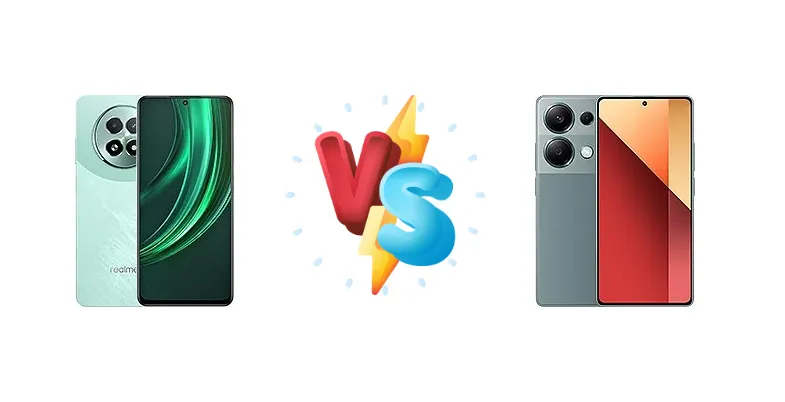
The Realme 13 and Xiaomi Redmi Note 13 Pro 4G represent compelling options in the increasingly competitive mid-range smartphone market. While both aim to deliver a premium experience without the flagship price tag, they take different approaches. The Realme 13 prioritizes processing power with its Dimensity 6300, while the Redmi Note 13 Pro 4G focuses on extended battery life and rapid charging. This comparison dissects their key differences to determine which device best suits your needs.
🏆 Quick Verdict
For the average user prioritizing all-day battery life and incredibly fast charging, the Xiaomi Redmi Note 13 Pro 4G is the clear winner. Its 67W charging, achieving 50% in just 16 minutes, and impressive 11:36h active use score outweigh the Realme 13’s slightly faster processor.
| Network |
|---|
| 2G bands | GSM 850 / 900 / 1800 / 1900 | GSM 850 / 900 / 1800 / 1900 |
| 3G bands | HSDPA 850 / 900 / 2100 | HSDPA 850 / 900 / 1700(AWS) / 1900 / 2100 |
| 4G bands | 1, 3, 5, 8, 28, 40, 41 | 1, 2, 3, 4, 5, 7, 8, 12, 13, 17, 18, 19, 20, 26, 28, 38, 40, 41, 66 |
| 5G bands | 1, 3, 5, 8, 28, 40, 41, 77, 78 SA/NSA | - |
| Speed | HSPA, LTE, 5G | HSPA, LTE |
| Technology | GSM / HSPA / LTE / 5G | GSM / HSPA / LTE |
| Launch |
|---|
| Announced | 2024, August 29 | 2024, January 15 |
| Status | Available. Released 2024, September 06 | Available. Released 2024, January 15 |
| Body |
|---|
| Build | - | Glass front (Gorilla Glass 5), plastic frame, plastic back |
| Dimensions | 165.6 x 76.1 x 7.8 mm (6.52 x 3.00 x 0.31 in) | 161.1 x 75 x 8 mm (6.34 x 2.95 x 0.31 in) |
| SIM | Nano-SIM + Nano-SIM | Nano-SIM + Nano-SIM |
| Weight | 190 g (6.70 oz) | 188 g (6.63 oz) |
| Display |
|---|
| Protection | - | Corning Gorilla Glass 5 |
| Resolution | 1080 x 2400 pixels, 20:9 ratio (~392 ppi density) | 1080 x 2400 pixels, 20:9 ratio (~395 ppi density) |
| Size | 6.72 inches, 109.0 cm2 (~86.5% screen-to-body ratio) | 6.67 inches, 107.4 cm2 (~88.9% screen-to-body ratio) |
| Type | IPS LCD, 120Hz, 580 nits (typ) | AMOLED, 1B colors, 120Hz, 500 nits (typ), 1000 nits (HBM), 1300 nits (peak) |
| Platform |
|---|
| CPU | Octa-core (2x2.4 GHz Cortex-A76 & 6x2.0 GHz Cortex-A55) | Octa-core (2x2.2 GHz Cortex-A76 & 6x2.0 GHz Cortex-A55) |
| Chipset | Mediatek Dimensity 6300 (6 nm) | Mediatek Helio G99 Ultra |
| GPU | Mali-G57 MC2 | Mali-G57 MC2 |
| OS | Android 14, Realme UI 5.0 | Android 13, up to 3 major Android upgrades, HyperOS |
| Memory |
|---|
| Card slot | microSDXC (uses shared SIM slot) | microSDXC (uses shared SIM slot) |
| Internal | 128GB 8GB RAM, 256GB 8GB RAM, 256GB 12GB RAM | 128GB 8GB RAM, 256GB 8GB RAM, 256GB 12GB RAM, 512GB 8GB RAM, 512GB 12GB RAM |
| Main Camera |
|---|
| Dual | 50 MP, f/1.8, 26mm (wide), PDAF, OIS
other unspecified camera | - |
| Features | LED flash, HDR, panorama | LED flash, HDR, panorama |
| Triple | - | 200 MP, f/1.7, 23mm (wide), 1/1.4", 0.56µm, multi-directional PDAF, OIS
8 MP, f/2.2, 15mm, 120˚ (ultrawide), 1/4.4", 1.0µm
2 MP (macro) |
| Video | 1440p@30fps, 1080p@30/60fps, gyro-EIS, OIS | 1080p@30/60fps |
| Selfie camera |
|---|
| Single | 16 MP, f/2.5, 24mm (wide), 1/3.0" | 16 MP, f/2.4, (wide), 1/3.0", 1.0µm |
| Video | 1080p@30fps | 1080p@30/60fps |
| Sound |
|---|
| 35mm jack | Yes | Yes |
| Loudspeaker | Yes, with stereo speakers | Yes, with dual speakers |
| Comms |
|---|
| Bluetooth | 5.3, A2DP, LE | 5.2, A2DP, LE |
| Infrared port | - | Yes |
| NFC | No | Yes (market/region dependent) |
| Positioning | GPS, GLONASS, GALILEO, BDS, QZSS | GPS, GLONASS, GALILEO, BDS |
| Radio | No | FM radio |
| USB | USB Type-C 2.0 | USB Type-C 2.0, OTG |
| WLAN | Wi-Fi 802.11 a/b/g/n/ac, dual-band | Wi-Fi 802.11 a/b/g/n/ac, dual-band |
| Features |
|---|
| Sensors | Fingerprint (side-mounted), accelerometer, gyro, proximity, compass | Fingerprint (under display, optical), accelerometer, gyro, compass |
| Battery |
|---|
| Charging | 45W wired, 50% in 30 min | 67W wired, 50% in 16 min, 100% in 46 min |
| Type | 5000 mAh | 5000 mAh |
| Misc |
|---|
| Colors | Speed Green, Dark Purple | Midnight Black, Lavender Purple, Forest Green |
| Models | RMX3951 | 23117RA68G, 2312FPCA6G |
| Price | ₹ 14,599 | € 92.00 / $ 269.99 / £ 299.99 |
| SAR | - | 1.09 W/kg (head) 1.09 W/kg (body) |
| SAR EU | - | 0.99 W/kg (head) 0.99 W/kg (body) |
Realme 13
- Potentially faster CPU performance with Dimensity 6300
- 6nm process node may offer better thermal efficiency
- Faster core clock speeds for demanding tasks
- Charging speed is slower at 45W
- Battery life is likely shorter than the Redmi Note 13 Pro 4G
- Display brightness is unknown and potentially lower
Xiaomi Redmi Note 13 Pro 4G
- Exceptional battery life with 11:36h active use
- Ultra-fast 67W charging (50% in 16 min, 100% in 46 min)
- Bright 1047 nit display for excellent outdoor visibility
- Slightly slower CPU performance compared to the Realme 13
- Helio G99 Ultra may throttle under sustained load
- Camera details are limited, making image quality assessment difficult
Display Comparison
The Xiaomi Redmi Note 13 Pro 4G boasts a significantly brighter display, reaching a measured peak of 1047 nits. This is a crucial advantage for outdoor use, where the Realme 13’s display brightness remains unspecified. While both likely utilize AMOLED panels (based on market trends), the Redmi’s higher peak brightness translates to better visibility in direct sunlight. Bezels are expected to be comparable, given the similar target price points, but the Redmi’s brightness is a clear differentiator.
Camera Comparison
Both devices are expected to feature multi-camera systems, but detailed sensor information is limited. The Redmi Note 13 Pro 4G’s camera is described as having 'Photo / Video' capabilities, suggesting a focus on overall image quality. Without specific sensor sizes or aperture details, it’s difficult to definitively assess camera performance. It’s likely both phones will include a primary sensor, ultrawide, and potentially a macro lens. We anticipate the Redmi Note 13 Pro 4G to lean towards a more balanced image processing style, while Realme often emphasizes vibrant, saturated colors.
Performance
The Realme 13’s Mediatek Dimensity 6300 (6nm) offers a slight architectural advantage over the Redmi Note 13 Pro 4G’s Helio G99 Ultra. The Dimensity 6300 features two Cortex-A76 cores clocked at 2.4 GHz, compared to the G99 Ultra’s 2.2 GHz Cortex-A76 cores. This translates to a modest performance boost in CPU-intensive tasks. However, the G99 Ultra’s efficiency gains from its architecture may offset this difference in real-world usage. Both phones share the same Cortex-A55 efficiency cores, suggesting similar multi-tasking capabilities. The Realme 13’s 6nm process node *should* result in slightly better thermal management, potentially reducing throttling during extended gaming sessions, but this requires independent testing.
Battery Life
The Xiaomi Redmi Note 13 Pro 4G excels in battery performance, achieving an impressive 11:36h of active use. While the Realme 13’s battery capacity is unknown, the Redmi’s endurance is a significant advantage. Furthermore, the Redmi’s 67W wired charging is substantially faster than the Realme 13’s 45W charging, reaching 50% charge in just 16 minutes versus 30 minutes. This difference in charging speed is a major convenience factor for users who need to quickly top up their devices.
Buying Guide
Buy the Realme 13 if you frequently engage in demanding tasks like mobile gaming or video editing and need the extra processing headroom offered by the Dimensity 6300. Buy the Xiaomi Redmi Note 13 Pro 4G if you prioritize battery longevity, quick top-ups with its 67W charging, and a brighter display for outdoor visibility. The Redmi is ideal for content consumers and users who need a phone that can reliably last a full day.
Frequently Asked Questions
❓ Does the Helio G99 Ultra in the Redmi Note 13 Pro 4G get hot during prolonged gaming sessions?
While the Helio G99 Ultra is a capable chipset, it's not known for exceptional thermal performance. Expect some degree of throttling during extended gaming, especially with graphically demanding titles. The Redmi Note 13 Pro 4G's thermal management system will play a crucial role in mitigating this, but it's unlikely to match the sustained performance of higher-end chipsets.
❓ Is the 45W charging on the Realme 13 significantly slower in real-world use compared to the Redmi's 67W?
Yes, the difference is noticeable. The Redmi Note 13 Pro 4G can reach 50% charge in just 16 minutes, while the Realme 13 takes 30 minutes. This translates to a substantial time saving for users who frequently need to quickly top up their battery. The 67W charging is a key advantage for the Redmi.
❓ How does the Dimensity 6300 in the Realme 13 compare to the Snapdragon 695 in terms of 5G connectivity?
The Realme 13 uses a 4G chipset, the Dimensity 6300, while the Snapdragon 695 is a 5G chipset. Therefore, the Redmi Note 13 Pro 4G does not support 5G connectivity. If 5G is a priority, neither of these phones are suitable options.