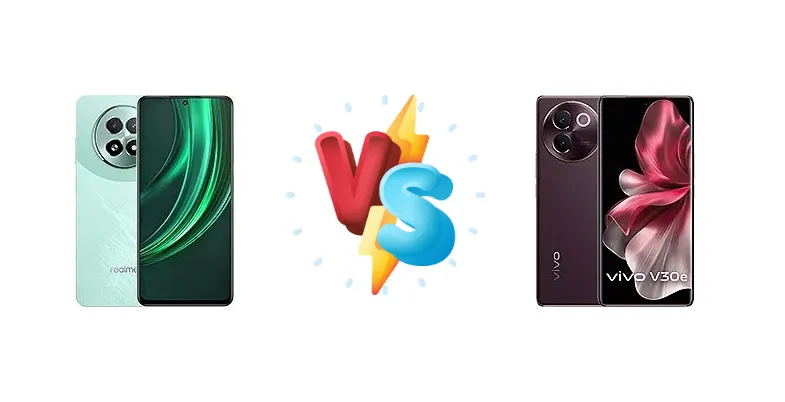
The Realme 13 and vivo V30e represent compelling options in the increasingly competitive mid-range smartphone market. Both aim to deliver a balanced experience, but they take different approaches to achieving it. The Realme 13 leverages Mediatek's Dimensity 6300, while the vivo V30e opts for Qualcomm's Snapdragon 6 Gen 1. This comparison will dissect the key differences to determine which device offers the best value for your money.
🏆 Quick Verdict
For the average user prioritizing efficiency and sustained performance, the vivo V30e emerges as the stronger contender. Its Snapdragon 6 Gen 1, built on a 4nm process, offers superior thermal management and potentially longer battery life compared to the Realme 13's 6nm Dimensity 6300. While charging speeds are comparable, the V30e's reverse wired charging adds a useful convenience feature.
| Network |
|---|
| 2G bands | GSM 850 / 900 / 1800 / 1900 | GSM 850 / 900 / 1800 / 1900 |
| 3G bands | HSDPA 850 / 900 / 2100 | HSDPA 850 / 900 / 1700(AWS) / 1900 / 2100 - Malaysia |
| 4G bands | 1, 3, 5, 8, 28, 40, 41 | 1, 2, 3, 4, 5, 7, 8, 18, 19, 20, 26, 28, 38, 39, 40, 41 - Malaysia |
| 5G bands | 1, 3, 5, 8, 28, 40, 41, 77, 78 SA/NSA | 1, 3, 5, 7, 8, 20, 28, 38, 40, 41, 77, 78 SA/NSA - Malaysia |
| Speed | HSPA, LTE, 5G | HSPA, LTE, 5G |
| Technology | GSM / HSPA / LTE / 5G | GSM / HSPA / LTE / 5G |
| Launch |
|---|
| Announced | 2024, August 29 | 2024, May 02 |
| Status | Available. Released 2024, September 06 | Available. Released 2024, May 09 |
| Body |
|---|
| Build | - | Glass front, plastic frame, glass back or plastic back |
| Dimensions | 165.6 x 76.1 x 7.8 mm (6.52 x 3.00 x 0.31 in) | 164.4 x 74.8 x 7.7 mm (6.47 x 2.94 x 0.30 in) |
| SIM | Nano-SIM + Nano-SIM | Nano-SIM + Nano-SIM |
| Weight | 190 g (6.70 oz) | 179 g or 188 g (6.31 oz) |
| Display |
|---|
| Protection | - | Schott Xensation |
| Resolution | 1080 x 2400 pixels, 20:9 ratio (~392 ppi density) | 1080 x 2400 pixels, 20:9 ratio (~388 ppi density) |
| Size | 6.72 inches, 109.0 cm2 (~86.5% screen-to-body ratio) | 6.78 inches, 111.0 cm2 (~90.3% screen-to-body ratio) |
| Type | IPS LCD, 120Hz, 580 nits (typ) | AMOLED, 1B colors, 120Hz, 1300 nits (peak) |
| Platform |
|---|
| CPU | Octa-core (2x2.4 GHz Cortex-A76 & 6x2.0 GHz Cortex-A55) | Octa-core (4x2.2 GHz Cortex-A78 & 4x1.8 GHz Cortex-A55) |
| Chipset | Mediatek Dimensity 6300 (6 nm) | Qualcomm SM6450 Snapdragon 6 Gen 1 (4 nm) |
| GPU | Mali-G57 MC2 | Adreno 710 |
| OS | Android 14, Realme UI 5.0 | Android 14, Funtouch 14 |
| Memory |
|---|
| Card slot | microSDXC (uses shared SIM slot) | microSDXC (uses shared SIM slot) |
| Internal | 128GB 8GB RAM, 256GB 8GB RAM, 256GB 12GB RAM | 128GB 8GB RAM, 256GB 8GB RAM, 256GB 12GB RAM |
| Main Camera |
|---|
| Dual | 50 MP, f/1.8, 26mm (wide), PDAF, OIS
other unspecified camera | 50 MP, f/1.8, 26mm (wide), 1/1.95", 0.8µm, PDAF, OIS (India only)
8 MP, f/2.2, 120˚ (ultrawide), 1/4.0", 1.12µm |
| Features | LED flash, HDR, panorama | Ring-LED flash, panorama, HDR |
| Video | 1440p@30fps, 1080p@30/60fps, gyro-EIS, OIS | 4K@30fps, 1080p@30fps |
| Selfie camera |
|---|
| Single | 16 MP, f/2.5, 24mm (wide), 1/3.0" | 50 MP, f/2.5, 25mm (wide), AF - India
32 MP, f/2.0, 24mm (wide) - Malaysia |
| Video | 1080p@30fps | 4K@30fps (India only), 1080p@30fps |
| Sound |
|---|
| 35mm jack | Yes | No |
| Loudspeaker | Yes, with stereo speakers | Yes |
| Comms |
|---|
| Bluetooth | 5.3, A2DP, LE | 5.1, A2DP, LE |
| NFC | No | Yes (market/region dependent) |
| Positioning | GPS, GLONASS, GALILEO, BDS, QZSS | GPS, GLONASS, GALILEO, BDS, QZSS, NavIC |
| Radio | No | No |
| USB | USB Type-C 2.0 | USB Type-C 2.0, OTG |
| WLAN | Wi-Fi 802.11 a/b/g/n/ac, dual-band | Wi-Fi 802.11 a/b/g/n/ac, dual-band |
| Features |
|---|
| Sensors | Fingerprint (side-mounted), accelerometer, gyro, proximity, compass | Fingerprint (under display, optical), accelerometer, gyro, proximity, compass |
| Battery |
|---|
| Charging | 45W wired, 50% in 30 min | 44W wired, PD
Reverse wired |
| Type | 5000 mAh | Li-Ion 5500 mAh |
| Misc |
|---|
| Colors | Speed Green, Dark Purple | Velvet Red (Coco Brown), Silk Blue, Sky Mirror |
| Models | RMX3951 | V2339 |
| Price | ₹ 14,599 | ₹ 23,999 |
Realme 13
- Potentially higher single-core performance due to faster CPU cores.
- Faster charging speed (marginally).
- Realme's UI often offers extensive customization options.
- Less efficient 6nm chipset may lead to higher temperatures.
- Likely shorter battery life compared to the V30e.
- Lacks reverse charging functionality.
vivo V30e
- More efficient 4nm chipset for better battery life and thermal management.
- Reverse wired charging for added convenience.
- Qualcomm's ISP potentially offers superior image processing.
- Slightly lower CPU clock speeds.
- May not offer the same level of UI customization as Realme.
- Charging speed is marginally slower.
Display Comparison
Neither device's display specifications are provided, so a direct comparison is limited. However, given the price bracket, we can anticipate both utilizing AMOLED panels. The key differentiator will likely be peak brightness and color calibration. Realme historically focuses on vibrant colors, while vivo often aims for more natural tones. The absence of LTPO technology suggests neither will offer adaptive refresh rates for significant power savings.
Camera Comparison
Without detailed camera specifications, a definitive comparison is challenging. However, the focus should be on the main sensor and image processing. Both brands typically employ software-heavy image processing. The Snapdragon 6 Gen 1’s ISP (Image Signal Processor) is generally considered more advanced, potentially leading to better dynamic range and noise reduction in the V30e. The absence of information regarding OIS (Optical Image Stabilization) makes it difficult to assess low-light performance. We can assume both will include standard features like portrait mode and night mode, but the quality will depend heavily on the underlying hardware and software tuning.
Performance
The core of the difference lies in the chipsets. The vivo V30e’s Snapdragon 6 Gen 1 (4nm) boasts a more efficient manufacturing process than the Realme 13’s Dimensity 6300 (6nm). While the Dimensity 6300 features two Cortex-A76 cores clocked at 2.4 GHz, the Snapdragon 6 Gen 1 counters with four Cortex-A78 cores at 2.2 GHz. The A78 is architecturally superior to the A76, offering better performance per clock. This translates to a likely advantage for the V30e in multi-threaded tasks and sustained workloads. The 4nm process further enhances the Snapdragon’s thermal efficiency, reducing the likelihood of throttling during prolonged gaming. The Realme 13 may show a slight edge in single-core benchmarks due to the higher clock speed, but the V30e will likely maintain a more consistent frame rate over time.
Battery Life
Charging speeds are nearly identical, with the Realme 13 offering 45W wired charging (50% in 30 minutes) and the vivo V30e providing 44W wired charging with PD (Power Delivery) and reverse wired charging. The V30e’s reverse wired charging is a significant advantage for users who need to top up accessories or share power with others. Battery capacity is not specified for either device, but the Snapdragon 6 Gen 1’s superior efficiency suggests the V30e will likely deliver longer real-world battery life, even with a similar capacity. The 4nm process inherently consumes less power than the 6nm process used in the Dimensity 6300.
Buying Guide
Buy the Realme 13 if you prioritize raw CPU clock speed for bursty tasks and are comfortable with potentially warmer operation during extended gaming sessions. Buy the vivo V30e if you value sustained performance, efficient power consumption, and the added convenience of reverse wireless charging, making it ideal for users who frequently share power with friends or accessories.
Frequently Asked Questions
❓ Will the Snapdragon 6 Gen 1 in the vivo V30e handle demanding games like PUBG Mobile smoothly?
Yes, the Snapdragon 6 Gen 1 is capable of running PUBG Mobile at high settings. While it won't deliver the same performance as flagship chipsets, its architecture and efficiency will provide a stable and enjoyable gaming experience, with less throttling than the Dimensity 6300 under sustained load.
❓ Does the Realme 13's 45W charging significantly outperform the vivo V30e's 44W charging in real-world use?
The difference in charging speed is minimal. Both phones offer fast charging, and the 1W difference will likely translate to only a few minutes difference in overall charging time. The V30e's inclusion of Power Delivery (PD) ensures compatibility with a wider range of chargers.
❓ Is the reverse wired charging feature on the vivo V30e useful for everyday scenarios?
Absolutely. Reverse wired charging is incredibly convenient for topping up accessories like wireless earbuds, smartwatches, or even a friend's phone in a pinch. It adds a layer of versatility that the Realme 13 lacks.