
Realme 13 Pro+ vs Samsung Galaxy A55: Which Mid-Range Phone Reigns Supreme?
| Phones Images | |||||
|---|---|---|---|---|---|
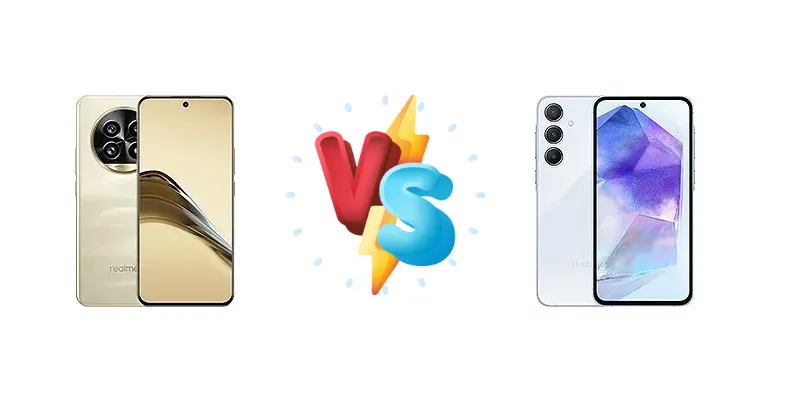
|
🏆 Quick Verdict
For users prioritizing display brightness and charging speed, the Realme 13 Pro+ emerges as the winner. Its significantly brighter 1398 nits display and 80W charging are compelling advantages. However, the Samsung Galaxy A55 remains a solid choice for those deeply embedded in the Samsung ecosystem and valuing software polish.
| PHONES | ||
|---|---|---|
| Phone Names | Realme 13 Pro+ | Samsung Galaxy A55 |
| Network | ||
|---|---|---|
| 2G bands | GSM 850 / 900 / 1800 / 1900 | GSM 850 / 900 / 1800 / 1900 |
| 3G bands | HSDPA 850 / 900 / 2100 | HSDPA 850 / 900 / 1700(AWS) / 1900 / 2100 |
| 4G bands | 1, 3, 5, 8, 28, 40, 41 | 1, 2, 3, 4, 5, 7, 8, 12, 17, 20, 25, 26, 28, 32, 38, 40, 41, 66 |
| 5G bands | 1, 3, 5, 8, 28, 40, 41, 77, 78 SA/NSA | 1, 3, 5, 7, 8, 20, 28, 38, 40, 41, 66, 77, 78 SA/NSA/Sub6 |
| Speed | HSPA, LTE, 5G | HSPA, LTE, 5G |
| Technology | GSM / HSPA / LTE / 5G | GSM / HSPA / LTE / 5G |
| Launch | ||
|---|---|---|
| Announced | 2024, July 30 | 2024, March 11 |
| Status | Available. Released 2024, August 06 | Available. Released 2024, March 15 |
| Body | ||
|---|---|---|
| Build | Glass front (Gorilla Glass 7i), plastic frame, glass back | Glass front (Gorilla Glass Victus+), glass back (Gorilla Glass), aluminum frame |
| Dimensions | 161.3 x 73.9 x 8.2 or 8.4 mm | 161.1 x 77.4 x 8.2 mm (6.34 x 3.05 x 0.32 in) |
| SIM | Nano-SIM + Nano-SIM | · Nano-SIM· Nano-SIM + eSIM· Nano-SIM + Nano-SIM· Nano-SIM + Nano-SIM + eSIM (max 2 at a time) |
| Weight | 185.5 g or 190 g (6.56 oz) | 213 g (7.51 oz) |
| Display | ||
|---|---|---|
| Protection | Corning Gorilla Glass 7i | Corning Gorilla Glass Victus+ |
| Resolution | 1080 x 2412 pixels, 20:9 ratio (~394 ppi density) | 1080 x 2340 pixels, 19.5:9 ratio (~390 ppi density) |
| Size | 6.7 inches, 108.0 cm2 (~90.6% screen-to-body ratio) | 6.6 inches, 106.9 cm2 (~85.8% screen-to-body ratio) |
| Type | AMOLED, 1B colors, 120Hz, 600 nits (typ), 1200 nits (HBM), 2000 nits (peak) | Super AMOLED, 120Hz, HDR10+, 1000 nits (HBM) |
| Platform | ||
|---|---|---|
| CPU | Octa-core (4x2.40 GHz Cortex-A78 & 4x1.95 GHz Cortex-A55) | Octa-core (4x2.75 GHz Cortex-A78 & 4x2.0 GHz Cortex-A55) |
| Chipset | Qualcomm SM7435-AB Snapdragon 7s Gen 2 (4 nm) | Exynos 1480 (4 nm) |
| GPU | Adreno 710 | Xclipse 530 |
| OS | Android 14, Realme UI 5.0 | Android 14, up to 4 major Android upgrades, One UI 6.1 |
| Memory | ||
|---|---|---|
| Card slot | No | microSDXC (uses shared SIM slot) |
| Internal | 256GB 8GB RAM, 256GB 12GB RAM, 512GB 12GB RAM | 128GB 6GB RAM, 128GB 8GB RAM, 256GB 6GB RAM, 256GB 8GB RAM, 256GB 12GB RAM |
| Main Camera | ||
|---|---|---|
| Features | LED flash, HDR, panorama | LED flash, panorama, HDR |
| Triple | 50 MP, f/1.9, 24mm (wide), 1/1.56", 1.0µm, multi-directional PDAF, OIS 50 MP, f/2.7, 73mm, (periscope telephoto), 1/1.95", 0.8µm, multi-directional PDAF, OIS, 3x optical zoom 8 MP, f/2.2, 16mm, 112˚ (ultrawide), 1/4.0", 1.12µm | 50 MP, f/1.8, (wide), 1/1.56", 1.0µm, PDAF, OIS 12 MP, f/2.2, 123˚ (ultrawide), 1/3.06", 1.12µm 5 MP (macro) |
| Video | 4K@30fps, 1080p@30/60/120fps, gyro-EIS | 4K@30fps, 1080p@30/60fps, gyro-EIS |
| Selfie camera | ||
|---|---|---|
| Single | 32 MP, f/2.5, 21mm (wide), 1/2.74", 0.8µm | 32 MP, f/2.2, 26mm (wide), 1/2.74", 0.8µm |
| Video | 4K@30fps, 1080p@30fps | 4K@30fps, 1080p@30/60fps |
| Sound | ||
|---|---|---|
| 35mm jack | No | No |
| Loudspeaker | Yes, with stereo speakers | Yes, with stereo speakers |
| Comms | ||
|---|---|---|
| Bluetooth | 5.2, A2DP, LE | 5.3, A2DP, LE |
| NFC | Yes, 360˚ (market/region dependent) | Yes (market/region dependent) |
| Positioning | GPS, GLONASS, GALILEO, BDS, QZSS | GPS, GALILEO, GLONASS, BDS, QZSS |
| Radio | No | No |
| USB | USB Type-C 2.0 | USB Type-C 2.0, OTG |
| WLAN | Wi-Fi 802.11 a/b/g/n/ac/6, dual-band | Wi-Fi 802.11 a/b/g/n/ac/6, dual-band, Wi-Fi Direct |
| Features | ||
|---|---|---|
| Sensors | Fingerprint (under display, optical), accelerometer, gyro, proximity, compass | Fingerprint (under display, optical), accelerometer, gyro, compass |
| Battery | ||
|---|---|---|
| Charging | 80W wired, 50% in 19 min, 100% in 49 min | 25W wired |
| Type | 5200 mAh | Li-Ion 5000 mAh |
| Misc | ||
|---|---|---|
| Colors | Monet Gold, Emerald Green, Monet Purple | Iceblue, Lilac, Navy, Lemon |
| Models | RMX3920, RMX3921 | SM-A556V, SM-A556B, SM-A556B/DS, SM-A556E, SM-A556E/DS, SM-A5560 |
| Price | $ 549.00 / ₹ 24,999 | $ 324.99 / £ 251.50 / € 319.99 / ₹ 23,998 |
| SAR EU | - | 0.68 W/kg (head) 1.04 W/kg (body) |
Realme 13 Pro+
- Significantly brighter display for outdoor visibility
- Much faster 80W charging
- Potentially better gaming performance due to Adreno GPU
- Realme’s software update commitment may be shorter than Samsung’s
- Brand recognition is lower than Samsung
Samsung Galaxy A55
- Strong brand reputation and software support
- Potentially more refined software experience
- Samsung ecosystem integration
- Dimmer display compared to the Realme 13 Pro+
- Significantly slower 25W charging
- Exynos 1480 may be prone to thermal throttling under sustained load
Display Comparison
The Realme 13 Pro+ immediately stands out with its measured peak brightness of 1398 nits, significantly exceeding the Samsung Galaxy A55’s 1010 nits. This difference translates to superior visibility in direct sunlight. While both utilize 4nm chipsets, the display’s power draw will impact overall efficiency. We lack panel technology details (LTPO vs standard AMOLED) but the brightness gap is a clear win for the Realme. Bezels appear comparable based on available imagery, and color accuracy will likely be excellent on both, though Samsung historically has a slight edge in calibration.
Camera Comparison
Without detailed camera specs, a direct comparison is difficult. However, the market positioning suggests the Realme 13 Pro+ may prioritize camera features. We can infer that both phones will feature multi-camera systems, but the sensor sizes and optical image stabilization (OIS) are crucial differentiators. Larger sensors capture more light, resulting in better low-light performance. OIS is essential for sharp photos and stable videos. Image processing styles will also differ – Samsung typically favors vibrant, saturated colors, while Realme often aims for a more natural look. The presence of a 2MP macro camera on either device is largely irrelevant; image quality will be limited.
Performance
Both phones employ 4nm chipsets, but the architectures differ. The Galaxy A55’s Exynos 1480 features a slightly higher peak CPU clock speed (2.75 GHz vs 2.40 GHz on the Realme’s Snapdragon 7s Gen 2). However, the Snapdragon 7s Gen 2 utilizes Cortex-A78 cores, known for their efficiency, and benefits from Qualcomm’s optimized software. The A55’s Exynos 1480 may offer a marginal advantage in raw CPU benchmarks, but the real-world impact will depend on thermal management. Both devices likely utilize LPDDR5x RAM, but the speed and configuration could vary, impacting multitasking performance. The Snapdragon’s Adreno GPU is generally considered more powerful than the Exynos’s Xclipse GPU, potentially giving the Realme an edge in gaming.
Battery Life
Battery life is remarkably similar, with the Realme 13 Pro+ achieving 13:39 hours of active use compared to the Galaxy A55’s 13:27 hours. This suggests efficient power management on both sides. However, the charging speeds are drastically different. The Realme 13 Pro+ supports 80W wired charging, reaching 50% in just 19 minutes and 100% in 49 minutes. The Samsung Galaxy A55 is limited to 25W charging, a significantly slower pace. This difference is a major advantage for the Realme, especially for users who frequently need to top up their battery quickly.
Buying Guide
Buy the Realme 13 Pro+ if you need a vibrant, easily visible display for outdoor use and value incredibly fast charging. This phone is ideal for media consumers and power users who don't want to be tethered to a charger. Buy the Samsung Galaxy A55 if you prefer a more established brand with a long track record of software updates and a generally more conservative, refined user experience. It's a better fit for users prioritizing long-term software support and a seamless Samsung ecosystem integration.