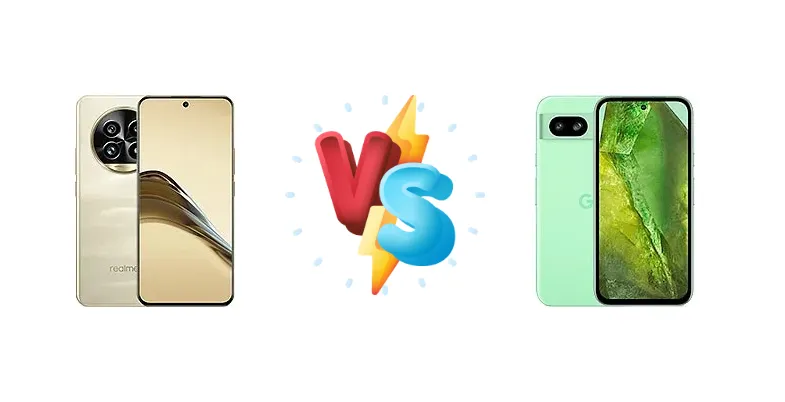
The Realme 13 Pro+ and Google Pixel 8a represent compelling options in the increasingly competitive mid-range smartphone market. The Realme focuses on rapid charging and a bright display, while the Pixel 8a prioritizes software experience and long-term battery health. This comparison dissects their key differences to determine which device best suits your needs.
🏆 Quick Verdict
For the average user prioritizing longevity and a refined software experience, the Google Pixel 8a is the stronger choice. Its exceptional 40:06h endurance rating and Google's software support outweigh the Realme 13 Pro+'s faster charging and slightly brighter display.
| Network |
|---|
| 2G bands | GSM 850 / 900 / 1800 / 1900 | GSM 850 / 900 / 1800 / 1900 |
| 3G bands | HSDPA 850 / 900 / 2100 | HSDPA 800 / 850 / 900 / 1700(AWS) / 1900 / 2100 |
| 4G bands | 1, 3, 5, 8, 28, 40, 41 | 1, 2, 3, 4, 5, 7, 8, 12, 17, 18, 19, 20, 26, 28, 32, 38, 40, 41, 42, 66 - G6GPR (International) |
| 5G bands | 1, 3, 5, 8, 28, 40, 41, 77, 78 SA/NSA | 1, 2, 3, 5, 7, 8, 12, 20, 26, 28, 38, 40, 41, 66, 75, 76, 77, 78 SA/NSA/Sub6 - G6GPR (International) |
| Speed | HSPA, LTE, 5G | HSPA, LTE, 5G |
| Technology | GSM / HSPA / LTE / 5G | GSM / HSPA / LTE / 5G |
| Launch |
|---|
| Announced | 2024, July 30 | 2024, May 07 |
| Status | Available. Released 2024, August 06 | Available. Released 2024, May 14 |
| Body |
|---|
| Build | Glass front (Gorilla Glass 7i), plastic frame, glass back | Glass front (Gorilla Glass 3), aluminum frame, plastic back |
| Dimensions | 161.3 x 73.9 x 8.2 or 8.4 mm | 152.1 x 72.7 x 8.9 mm (5.99 x 2.86 x 0.35 in) |
| SIM | Nano-SIM + Nano-SIM | Nano-SIM + eSIM |
| Weight | 185.5 g or 190 g (6.56 oz) | 188 g (6.63 oz) |
| Display |
|---|
| Protection | Corning Gorilla Glass 7i | Corning Gorilla Glass 3, Mohs level 5 |
| Resolution | 1080 x 2412 pixels, 20:9 ratio (~394 ppi density) | 1080 x 2400 pixels, 20:9 ratio (~430 ppi density) |
| Size | 6.7 inches, 108.0 cm2 (~90.6% screen-to-body ratio) | 6.1 inches, 90.3 cm2 (~81.6% screen-to-body ratio) |
| Type | AMOLED, 1B colors, 120Hz, 600 nits (typ), 1200 nits (HBM), 2000 nits (peak) | OLED, HDR, 120Hz, 2000 nits (peak) |
| Platform |
|---|
| CPU | Octa-core (4x2.40 GHz Cortex-A78 & 4x1.95 GHz Cortex-A55) | Nona-core (1x3.0 GHz Cortex-X3 & 4x2.45 GHz Cortex-A715 & 4x2.15 GHz Cortex-A510) |
| Chipset | Qualcomm SM7435-AB Snapdragon 7s Gen 2 (4 nm) | Google Tensor G3 (4 nm) |
| GPU | Adreno 710 | Immortalis-G715s MC10 |
| OS | Android 14, Realme UI 5.0 | Android 14, upgradable to Android 16, up to 7 major Android upgrades |
| Memory |
|---|
| Card slot | No | No |
| Internal | 256GB 8GB RAM, 256GB 12GB RAM, 512GB 12GB RAM | 128GB 8GB RAM, 256GB 8GB RAM |
| Main Camera |
|---|
| Dual | - | 64 MP (16 MP eff.), f/1.9, 26mm (wide), 1/1.73", 0.8µm, dual pixel PDAF, OIS
13 MP, f/2.2, 120˚ (ultrawide), 1.12µm |
| Features | LED flash, HDR, panorama | Dual-LED flash, Pixel Shift, Ultra HDR, panorama, Best Take |
| Triple | 50 MP, f/1.9, 24mm (wide), 1/1.56", 1.0µm, multi-directional PDAF, OIS
50 MP, f/2.7, 73mm, (periscope telephoto), 1/1.95", 0.8µm, multi-directional PDAF, OIS, 3x optical zoom
8 MP, f/2.2, 16mm, 112˚ (ultrawide), 1/4.0", 1.12µm | - |
| Video | 4K@30fps, 1080p@30/60/120fps, gyro-EIS | 4K@30/60fps, 1080p@30/60/120/240fps, OIS |
| Selfie camera |
|---|
| Features | - | HDR, panorama |
| Single | 32 MP, f/2.5, 21mm (wide), 1/2.74", 0.8µm | 13 MP, f/2.2, 20mm (ultrawide), 1.12µm |
| Video | 4K@30fps, 1080p@30fps | 4K@30fps, 1080p@30/60fps |
| Sound |
|---|
| 35mm jack | No | No |
| Loudspeaker | Yes, with stereo speakers | Yes, with stereo speakers |
| Comms |
|---|
| Bluetooth | 5.2, A2DP, LE | 5.3, A2DP, LE |
| NFC | Yes, 360˚ (market/region dependent) | Yes |
| Positioning | GPS, GLONASS, GALILEO, BDS, QZSS | GPS, GLONASS, GALILEO, BDS, QZSS, NavIC |
| Radio | No | No |
| USB | USB Type-C 2.0 | USB Type-C 3.2 |
| WLAN | Wi-Fi 802.11 a/b/g/n/ac/6, dual-band | Wi-Fi 802.11 a/b/g/n/ac/6e, dual/tri-band (market/region dependent) |
| Features |
|---|
| Sensors | Fingerprint (under display, optical), accelerometer, gyro, proximity, compass | Fingerprint (under display, optical), accelerometer, gyro, proximity, compass, barometer |
| Battery |
|---|
| Charging | 80W wired, 50% in 19 min, 100% in 49 min | 18W wired, PD3.0
7.5W wireless
Bypass charging |
| Type | 5200 mAh | Li-Po 4492 mAh |
| Misc |
|---|
| Colors | Monet Gold, Emerald Green, Monet Purple | Obsidian, Porcelain, Bay, Aloe |
| Models | RMX3920, RMX3921 | GKV4X, G6GPR, G8HHN, G576D |
| Price | $ 549.00 / ₹ 24,999 | $ 229.98 / C$ 417.99 / £ 279.00 / € 299.99 / ₹ 33,300 |
| EU LABEL |
|---|
| Battery | - | 40:06h endurance, 1000 cycles |
| Energy | - | Class B |
| Free fall | - | Class A (270 falls) |
| Repairability | - | Class B |
Realme 13 Pro+
- 80W fast charging significantly reduces downtime.
- Bright 1398 nit display excels in outdoor visibility.
- Snapdragon 7s Gen 2 offers solid mid-range performance.
- Significantly shorter battery life compared to the Pixel 8a.
- Software support likely shorter than Google's Pixel line.
Google Pixel 8a
- Exceptional 40:06h battery endurance for all-day use.
- Google Tensor G3 provides a smooth and responsive experience.
- Renowned Pixel camera with excellent computational photography.
- Slower 18W wired charging.
- May not match the Realme's peak display brightness in direct sunlight.
Display Comparison
The Pixel 8a boasts a slightly brighter display at 1508 nits compared to the Realme 13 Pro+'s 1398 nits, offering better visibility in direct sunlight. While both utilize a 4nm process for their respective chipsets, the display technology isn't specified for either, making it difficult to assess color accuracy or refresh rate without further testing. The higher peak brightness of the Pixel 8a is a tangible benefit for outdoor use, while the Realme's brightness is still excellent.
Camera Comparison
Without detailed camera specs, a direct comparison is limited. However, Google’s Pixel line is renowned for its computational photography, leveraging software algorithms to produce excellent images even with potentially smaller sensors. The Realme 13 Pro+ likely relies more on hardware specifications, but without knowing sensor size or aperture, it’s difficult to assess its low-light performance. The Pixel 8a’s image processing is a key differentiator, appealing to users who prioritize consistently good photos without manual adjustments.
Performance
The Google Pixel 8a’s Tensor G3, with its nona-core CPU (1x3.0 GHz Cortex-X3, 4x2.45 GHz Cortex-A715, 4x2.15 GHz Cortex-A510), is architecturally more complex than the Realme 13 Pro+'s octa-core Snapdragon 7s Gen 2 (4x2.40 GHz Cortex-A78 & 4x1.95 GHz Cortex-A55). The Cortex-X3 in the Pixel 8a is a prime core designed for peak performance, while the Snapdragon 7s Gen 2 focuses on efficiency. While raw clock speeds don't tell the whole story, the Tensor G3 is likely to offer a smoother experience in demanding tasks, benefiting users who frequently edit videos or play graphically intensive games. Both chips are built on a 4nm process, suggesting comparable power efficiency.
Battery Life
The Pixel 8a’s endurance rating of 40:06h significantly surpasses the Realme 13 Pro+'s 13:39h active use score. This difference is substantial, indicating the Pixel 8a can last nearly three times longer on a single charge. While the Realme 13 Pro+ offers incredibly fast 80W wired charging (0-50% in 19 minutes, 100% in 49 minutes), the Pixel 8a’s 18W charging is considerably slower. However, the Pixel 8a’s superior battery life and reported 1000 cycle lifespan mitigate the slower charging speed, making it a more sustainable long-term solution.
Buying Guide
Buy the Realme 13 Pro+ if you need blazing-fast 80W charging and a display that cuts through direct sunlight. This phone is ideal for users who frequently top up their battery throughout the day and value a vibrant viewing experience. Buy the Google Pixel 8a if you prefer a consistently smooth software experience, exceptional battery life, and a camera known for its computational photography prowess. This is the phone for users who want a reliable daily driver with long-term support.
Frequently Asked Questions
❓ Does the Google Tensor G3 chip in the Pixel 8a get hot during extended gaming sessions?
While the Tensor G3 is a capable chip, it's known to run warmer than some competing Snapdragon processors. Google has implemented thermal management solutions, but prolonged, demanding gaming may result in some throttling to maintain stable performance. The Pixel 8a's overall efficiency helps mitigate this, but it's something to consider for hardcore mobile gamers.
❓ How does the 18W charging on the Pixel 8a compare to the 80W charging on the Realme 13 Pro+ in real-world use?
The Realme 13 Pro+'s 80W charging is significantly faster, fully charging the phone in under an hour. The Pixel 8a's 18W charging will take considerably longer. However, the Pixel 8a's exceptional battery life means you'll likely need to charge it less frequently, offsetting the slower charging speed for many users. The Realme is better for quick top-ups, while the Pixel prioritizes long-term battery health.
❓ What kind of software updates can Pixel 8a users expect?
Google guarantees at least 7 years of software updates for the Pixel 8a, including Android OS updates and security patches. This is a significant advantage over the Realme 13 Pro+, which typically receives fewer years of support. This long-term support ensures your phone remains secure and up-to-date with the latest features.