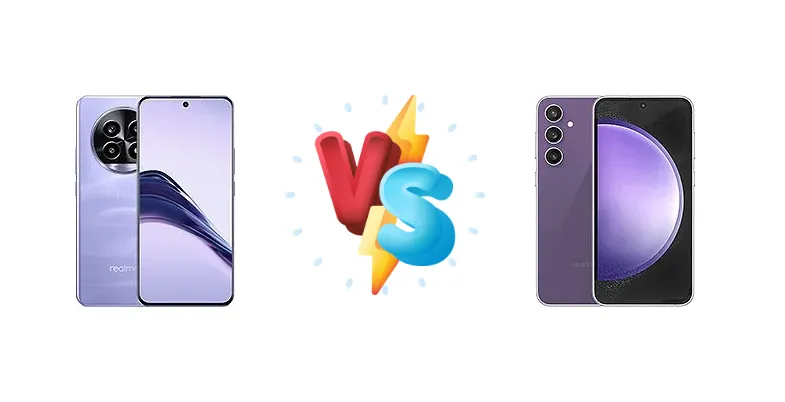
The Realme 13 Pro and Samsung Galaxy S23 FE represent compelling options in the increasingly competitive mid-range smartphone market. The Realme aims to deliver strong performance at a disruptive price, while the S23 FE attempts to bring a flagship experience down to a more accessible level. This comparison dissects their key differences to determine which device offers the best overall package.
🏆 Quick Verdict
For the average user prioritizing a balance of performance and value, the Realme 13 Pro emerges as the stronger contender. Its Snapdragon 7s Gen 2 offers efficient performance, and the 45W charging is significantly faster than the S23 FE’s 25W. While the S23 FE boasts a brighter display, the Realme’s overall package delivers more bang for your buck.
| Network |
|---|
| 2G bands | GSM 850 / 900 / 1800 / 1900 | GSM 850 / 900 / 1800 / 1900 |
| 3G bands | HSDPA 850 / 900 / 2100 | HSDPA 850 / 900 / 1700(AWS) / 1900 / 2100 |
| 4G bands | 1, 3, 5, 8, 28, 40, 41 | 1, 2, 3, 4, 5, 7, 8, 12, 13, 17, 20, 26, 28, 38, 40, 41, 66 - International |
| 5G bands | 1, 3, 5, 8, 28, 40, 41, 77, 78 SA/NSA | 1, 2, 3, 5, 7, 8, 20, 28, 38, 40, 41, 66, 77, 78 SA/NSA/Sub6 - International |
| Speed | HSPA, LTE, 5G | HSPA, LTE, 5G |
| Technology | GSM / HSPA / LTE / 5G | GSM / HSPA / LTE / 5G |
| Launch |
|---|
| Announced | 2024, July 30 | 2023, October 04 |
| Status | Available. Released 2024, August 06 | Available. Released 2023, October 05 |
| Body |
|---|
| Build | - | Glass front (Gorilla Glass 5), glass back (Gorilla Glass 5), aluminum frame |
| Dimensions | 161.3 x 73.9 x 8.2 or 8.4 mm | 158 x 76.5 x 8.2 mm (6.22 x 3.01 x 0.32 in) |
| SIM | Nano-SIM + Nano-SIM | · Nano-SIM· Nano-SIM + Nano-SIM· Nano-SIM + Nano-SIM + eSIM (max 2 at a time) |
| Weight | 183.5 g or 188 g (6.49 oz) | 209 g (7.37 oz) |
| Display |
|---|
| Protection | Corning Gorilla Glass 7i | Corning Gorilla Glass 5 |
| Resolution | 1080 x 2412 pixels, 20:9 ratio (~394 ppi density) | 1080 x 2340 pixels, 19.5:9 ratio (~403 ppi density) |
| Size | 6.7 inches, 108.0 cm2 (~90.6% screen-to-body ratio) | 6.4 inches, 100.5 cm2 (~83.2% screen-to-body ratio) |
| Type | AMOLED, 1B colors, 120Hz, 600 nits (typ), 1200 nits (HBM), 2000 nits (peak) | Dynamic AMOLED 2X, 120Hz, HDR10+, 1450 nits (peak) |
| Platform |
|---|
| CPU | Octa-core (4x2.40 GHz Cortex-A78 & 4x1.95 GHz Cortex-A55) | Octa-core (1x2.8 GHz Cortex-X2 & 3x2.50 GHz Cortex-A710 & 4x1.8 GHz Cortex-A510) - InternationalOcta-core (1x3.00 GHz Cortex-X2 & 3x2.50 GHz Cortex-A710 & 4x1.80 GHz Cortex-A510) - USA |
| Chipset | Qualcomm SM7435-AB Snapdragon 7s Gen 2 (4 nm) | Exynos 2200 (4 nm) - InternationalQualcomm SM8450 Snapdragon 8 Gen 1 (4 nm) - USA |
| GPU | Adreno 710 | Xclipse 920 - InternationalAdreno 730 - USA |
| OS | Android 14, Realme UI 5.0 | Android 13, up to 4 major Android upgrades, One UI 8 |
| Memory |
|---|
| Card slot | No | No |
| Internal | 128GB 8GB RAM, 256GB 8GB RAM, 256GB 12GB RAM, 512GB 12GB RAM | 128GB 8GB RAM, 256GB 8GB RAM |
| Main Camera |
|---|
| Dual | 50 MP, f/1.9, 26mm (wide), 1/1.95", 0.8µm, multi-directional PDAF, OIS
8 MP, f/2.2, 16mm, 112˚ (ultrawide), 1/4.0", 1.12µm | - |
| Features | LED flash, HDR, panorama | LED flash, HDR, panorama |
| Triple | - | 50 MP, f/1.8, 23mm (wide), 1/1.57", 1.0µm, dual pixel PDAF, OIS
8 MP, f/2.4, 76mm (telephoto), 1/4.5", 1.0µm, PDAF, OIS, 3x optical zoom
12 MP, f/2.2, 13mm, 123˚ (ultrawide), 1/3.0", 1.12µm |
| Video | 4K@30fps, 1080p@30/60/120fps, gyro-EIS | 8K@24fps, 4K@30/60fps, 1080p@30/60/120/240fps |
| Selfie camera |
|---|
| Single | 32 MP, f/2.5, 22mm (wide) | 10 MP, f/2.4, 25mm (wide), 1/3.0", 1.22µm |
| Video | 1080p@30fps | 4K@30/60fps, 1080p@30/60fps; gyro-EIS |
| Sound |
|---|
| 35mm jack | No | No |
| Loudspeaker | Yes, with stereo speakers | Yes, with stereo speakers |
| Comms |
|---|
| Bluetooth | 5.2, A2DP, LE | 5.3, A2DP, LE |
| NFC | Yes, 360˚ (market/region dependent) | Yes |
| Positioning | GPS, GLONASS, GALILEO, BDS, QZSS | GPS, GLONASS, GALILEO, BDS |
| Radio | No | Unspecified |
| USB | USB Type-C 2.0 | USB Type-C, OTG |
| WLAN | Wi-Fi 802.11 a/b/g/n/ac/6, dual-band | Wi-Fi 802.11 a/b/g/n/ac/6e, dual-band, Wi-Fi Direct |
| Features |
|---|
| Sensors | Fingerprint (under display, optical), accelerometer, gyro, proximity, compass | Fingerprint (under display, optical), accelerometer, gyro, compass |
| Battery |
|---|
| Charging | 45W wired, 50% in 27 min | 25W wired, PD3.0, 50% in 30 min
15W wireless
Reverse wireless |
| Type | 5200 mAh | Li-Ion 4500 mAh |
| Misc |
|---|
| Colors | Monet Gold, Emerald Green, Monet Purple | Mint, Cream, Graphite, Purple, Indigo, Tangerine |
| Models | RMX3990 | SM-S711B, SM-S711B/DS, SM-S711U1, SM-S711U, SM-S711W, SM-S7110, SM-S711N |
| Price | $ 499.00 / ₹ 18,500 | $ 219.95 / C$ 327.90 / £ 248.99 / € 272.00 / ₹ 34,999 |
| SAR | - | 0.80 W/kg (head) 0.72 W/kg (body) |
| SAR EU | - | 0.76 W/kg (head) 1.04 W/kg (body) |
Realme 13 Pro
- Faster 45W charging
- More power-efficient chipset (Snapdragon 7s Gen 2)
- Potentially lower price point
- Likely less powerful CPU/GPU
- Potentially less refined camera system
Samsung Galaxy S23 FE
- Brighter and more color-accurate display
- More versatile camera system (expected)
- Wireless and reverse wireless charging
- Slower 25W charging
- Potential for thermal throttling (Exynos variant)
- Higher price
Display Comparison
The Samsung Galaxy S23 FE takes the lead in display specifications with a measured peak brightness of 985 nits, ensuring excellent visibility even in direct sunlight. While the Realme 13 Pro’s display specs are not provided, it’s likely to be lower. The S23 FE’s panel technology, though not explicitly stated as LTPO, benefits from Samsung’s expertise in display manufacturing, likely offering excellent color accuracy and viewing angles. Bezels are expected to be minimal on both devices, reflecting current design trends. The S23 FE’s brightness advantage is a key differentiator for outdoor users.
Camera Comparison
The Samsung Galaxy S23 FE is expected to offer a more versatile camera system, though specific sensor details are missing. Samsung’s image processing is known for its vibrant colors and strong dynamic range. The Realme 13 Pro’s camera specifications are not detailed, but it’s reasonable to assume a primary sensor with a respectable megapixel count. The S23 FE’s inclusion of OIS (Optical Image Stabilization) will provide sharper images and smoother video recording, particularly in low-light conditions. The S23 FE’s video capabilities are likely to be superior, benefiting from the more powerful chipset and advanced image processing algorithms. We’d caution against placing too much stock in the presence of a 2MP macro camera on either device; these sensors typically offer limited practical benefit.
Performance
The performance landscape is more nuanced. The Samsung Galaxy S23 FE, depending on the region, utilizes either the Exynos 2200 or the Snapdragon 8 Gen 1. Both are 4nm chips, but the Snapdragon 8 Gen 1 (USA variant) boasts a slightly higher peak CPU clock speed (3.00 GHz vs 2.8 GHz on the Exynos). However, the Exynos 2200 has historically faced thermal throttling concerns under sustained load. The Realme 13 Pro’s Snapdragon 7s Gen 2 (4nm) offers a more efficient architecture with its Cortex-A78 cores clocked at 2.40 GHz. While not matching the peak performance of the Snapdragon 8 Gen 1 or Exynos 2200, the 7s Gen 2 excels in sustained performance due to its superior thermal efficiency, making it ideal for extended gaming sessions. The S23 FE’s LPDDR5 RAM is likely faster than the Realme’s, but the real-world impact will depend on software optimization.
Battery Life
The Samsung Galaxy S23 FE demonstrates strong battery performance, achieving an active use score of 8:28h. This suggests a well-optimized software and efficient power management. The Realme 13 Pro’s battery capacity is unknown, but its Snapdragon 7s Gen 2 chipset is inherently more power-efficient than the Exynos 2200 or Snapdragon 8 Gen 1. The Realme 13 Pro’s 45W wired charging is a significant advantage, achieving 50% charge in just 27 minutes, compared to the S23 FE’s slower 30-minute timeframe for the same level. The S23 FE also offers 15W wireless charging and reverse wireless charging, features absent on the Realme 13 Pro.
Buying Guide
Buy the Realme 13 Pro if you need a phone that prioritizes efficient performance for daily tasks and gaming, coupled with fast charging and a competitive price. Buy the Samsung Galaxy S23 FE if you prefer a brighter, more color-accurate display, a more established brand ecosystem, and potentially a wider range of software features, and are willing to pay a premium for it.
Frequently Asked Questions
❓ Does the Exynos 2200 in the Galaxy S23 FE overheat during prolonged gaming sessions?
The Exynos 2200 has a history of thermal throttling under sustained load. While Samsung has implemented optimizations, demanding games may still cause the device to heat up and experience performance drops. The Realme 13 Pro’s Snapdragon 7s Gen 2 is more thermally efficient and less prone to throttling.
❓ Is the 2MP macro camera on either phone worth using?
Generally, 2MP macro cameras offer limited image quality and detail. They are often included for marketing purposes but rarely deliver significant improvements over standard photos taken with the main sensor. Don't base your purchasing decision on the presence of a 2MP macro camera.
❓ Does the Samsung Galaxy S23 FE support 90fps or higher frame rates in popular games like PUBG Mobile?
The Galaxy S23 FE, with its powerful chipset, is capable of running PUBG Mobile at high frame rates. However, achieving a consistent 90fps will depend on the game settings and the specific Exynos or Snapdragon variant. The Realme 13 Pro will likely support 60fps, but may struggle to maintain higher frame rates in demanding titles.
❓ How does the charging speed of the Realme 13 Pro compare to other phones in its price range?
The Realme 13 Pro’s 45W charging is notably faster than many competitors in the mid-range segment, which often offer 33W or 25W charging. This translates to significantly less time spent tethered to a charger.