
Realme 13 Pro vs Nothing Phone (2): A Detailed Comparison
| Phones Images | |||||
|---|---|---|---|---|---|
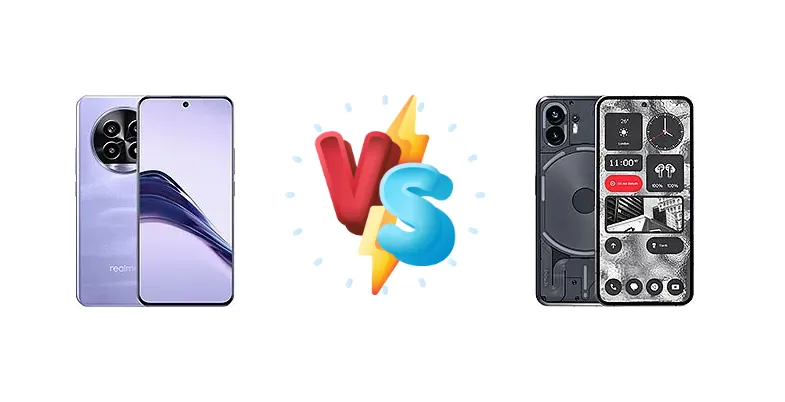
|
🏆 Quick Verdict
For the average user prioritizing raw performance and value, the Nothing Phone (2) is the clear winner. Its Snapdragon 8+ Gen 1 chipset provides a significant performance leap over the Realme 13 Pro’s Snapdragon 7s Gen 2, justifying the price difference. However, the Realme 13 Pro remains a compelling option for budget-conscious buyers.
| PHONES | ||
|---|---|---|
| Phone Names | Realme 13 Pro | Nothing Phone (2) |
| Network | ||
|---|---|---|
| 2G bands | GSM 850 / 900 / 1800 / 1900 | GSM 850 / 900 / 1800 / 1900 |
| 3G bands | HSDPA 850 / 900 / 2100 | HSDPA 800 / 850 / 900 / 1700(AWS) / 1900 / 2100 |
| 4G bands | 1, 3, 5, 8, 28, 40, 41 | 1, 2, 3, 4, 5, 7, 8, 12, 17, 18, 19, 20, 25, 26, 28, 30, 32, 34, 38, 39, 40, 41, 42, 48, 66, 71 |
| 5G bands | 1, 3, 5, 8, 28, 40, 41, 77, 78 SA/NSA | 1, 2, 3, 5, 7, 8, 12, 20, 25, 28, 30, 38, 40, 41, 66, 71, 75, 77, 78 SA/NSA |
| Speed | HSPA, LTE, 5G | HSPA, LTE, 5G |
| Technology | GSM / HSPA / LTE / 5G | GSM / HSPA / LTE / 5G |
| Launch | ||
|---|---|---|
| Announced | 2024, July 30 | 2023, July 11 |
| Status | Available. Released 2024, August 06 | Available. Released 2023, July 17 |
| Body | ||
|---|---|---|
| Build | - | Glass front (Gorilla Glass 5), glass back (Gorilla Glass 5), aluminum frame |
| Dimensions | 161.3 x 73.9 x 8.2 or 8.4 mm | 162.1 x 76.4 x 8.6 mm (6.38 x 3.01 x 0.34 in) |
| SIM | Nano-SIM + Nano-SIM | Nano-SIM + Nano-SIM |
| Weight | 183.5 g or 188 g (6.49 oz) | 201.2 g (7.09 oz) |
| Display | ||
|---|---|---|
| Protection | Corning Gorilla Glass 7i | Corning Gorilla Glass 5 |
| Resolution | 1080 x 2412 pixels, 20:9 ratio (~394 ppi density) | 1080 x 2412 pixels, 20:9 ratio (~394 ppi density) |
| Size | 6.7 inches, 108.0 cm2 (~90.6% screen-to-body ratio) | 6.7 inches, 108.0 cm2 (~87.2% screen-to-body ratio) |
| Type | AMOLED, 1B colors, 120Hz, 600 nits (typ), 1200 nits (HBM), 2000 nits (peak) | LTPO OLED, 1B colors, 120Hz, 1920Hz PWM, HDR10+, 1600 nits (HBM), 1600 nits (peak) |
| Platform | ||
|---|---|---|
| CPU | Octa-core (4x2.40 GHz Cortex-A78 & 4x1.95 GHz Cortex-A55) | Octa-core (1x3.0 GHz Cortex-X2 & 3x2.5 GHz Cortex-A710 & 4x1.80 GHz Cortex-A510) |
| Chipset | Qualcomm SM7435-AB Snapdragon 7s Gen 2 (4 nm) | Qualcomm SM8475 Snapdragon 8+ Gen 1 (4 nm) |
| GPU | Adreno 710 | Adreno 730 |
| OS | Android 14, Realme UI 5.0 | Android 13, upgradable to Android 15, up to 3 major Android upgrades, Nothing OS 3.0 |
| Memory | ||
|---|---|---|
| Card slot | No | No |
| Internal | 128GB 8GB RAM, 256GB 8GB RAM, 256GB 12GB RAM, 512GB 12GB RAM | 128GB 8GB RAM, 256GB 12GB RAM, 512GB 12GB RAM |
| Main Camera | ||
|---|---|---|
| Dual | 50 MP, f/1.9, 26mm (wide), 1/1.95", 0.8µm, multi-directional PDAF, OIS 8 MP, f/2.2, 16mm, 112˚ (ultrawide), 1/4.0", 1.12µm | 50 MP, f/1.9, 24mm (wide), 1/1.56", 1.0µm, PDAF, OIS 50 MP, f/2.2, 114˚ (ultrawide), 1/2.76", 0.64µm, AF |
| Features | LED flash, HDR, panorama | LED flash, panorama, HDR |
| Video | 4K@30fps, 1080p@30/60/120fps, gyro-EIS | 4K@30/60fps, 1080p@30/60fps, gyro-EIS, live HDR, OIS |
| Selfie camera | ||
|---|---|---|
| Features | - | HDR |
| Single | 32 MP, f/2.5, 22mm (wide) | 32 MP, f/2.5, (wide), 1/2.74", 0.8µm |
| Video | 1080p@30fps | 1080p@30fps |
| Sound | ||
|---|---|---|
| 35mm jack | No | No |
| Loudspeaker | Yes, with stereo speakers | Yes, with stereo speakers |
| Comms | ||
|---|---|---|
| Bluetooth | 5.2, A2DP, LE | 5.3, A2DP, LE, aptX HD, aptX Adaptive |
| NFC | Yes, 360˚ (market/region dependent) | Yes |
| Positioning | GPS, GLONASS, GALILEO, BDS, QZSS | GPS (L1+L5), GLONASS (L1), BDS (B1I+B1c), GALILEO (E1), QZSS (L1), NavIC |
| Radio | No | No |
| USB | USB Type-C 2.0 | USB Type-C 2.0, OTG |
| WLAN | Wi-Fi 802.11 a/b/g/n/ac/6, dual-band | Wi-Fi 802.11 a/b/g/n/ac/6, dual-band, Wi-Fi Direct |
| Features | ||
|---|---|---|
| Sensors | Fingerprint (under display, optical), accelerometer, gyro, proximity, compass | Fingerprint (under display, optical), accelerometer, proximity, gyro, compass |
| Battery | ||
|---|---|---|
| Charging | 45W wired, 50% in 27 min | 45W wired, PD3.0, PPS, QC4, 100% in 55 min 15W wireless, 100% in 130 min 5W reverse wireless |
| Type | 5200 mAh | Li-Ion 4700 mAh |
| Misc | ||
|---|---|---|
| Colors | Monet Gold, Emerald Green, Monet Purple | White, Dark Gray |
| Models | RMX3990 | A065 |
| Price | $ 499.00 / ₹ 18,500 | $ 379.99 / £ 370.00 |
Realme 13 Pro
- More affordable price point
- Efficient Snapdragon 7s Gen 2 chipset
- Fast 45W wired charging
- Less powerful processor compared to the Nothing Phone (2)
- Likely lower peak display brightness
- Missing advanced features like wireless charging
Nothing Phone (2)
- Flagship-level Snapdragon 8+ Gen 1 performance
- Brighter display with potential LTPO technology
- Wireless and reverse wireless charging capabilities
- Higher price tag
- Longer full charge time (55 minutes vs 27 minutes to 50%)
- Glyph Interface may not appeal to all users
Display Comparison
The Nothing Phone (2) boasts a brighter display, reaching a measured peak brightness of 998 nits, which translates to better visibility outdoors. While the Realme 13 Pro’s display specifications are currently unavailable, it’s likely to fall short of this peak brightness. The Nothing Phone (2)'s display technology is also likely to include LTPO for adaptive refresh rates, improving battery efficiency. The Nothing Phone (2)'s Glyph Interface, while subjective, adds a unique visual element not found on the Realme.
Camera Comparison
Detailed camera specifications for the Realme 13 Pro are missing, but the Nothing Phone (2) is expected to offer a more versatile and capable camera system. The Nothing Phone (2)'s camera system is designed for both photo and video, suggesting a focus on image quality and features. The larger sensor size (likely on the main camera) and wider apertures on the Nothing Phone (2) will allow for better low-light performance and shallower depth of field. The Realme 13 Pro will likely rely on software processing to compensate for any hardware limitations.
Performance
The core difference lies in the chipsets. The Nothing Phone (2) is powered by the Qualcomm SM8475 Snapdragon 8+ Gen 1 (4 nm), featuring an octa-core CPU with a high-clocked Cortex-X2 prime core at 3.0 GHz. This architecture is significantly more powerful than the Realme 13 Pro’s Qualcomm SM7435-AB Snapdragon 7s Gen 2 (4 nm) which utilizes a Cortex-A78 based core configuration peaking at 2.40 GHz. This translates to faster app loading times, smoother multitasking, and superior gaming performance on the Nothing Phone (2). The Snapdragon 8+ Gen 1 also benefits from a more powerful Adreno GPU. While both chips are built on a 4nm process, the architectural differences give the Nothing Phone (2) a clear advantage.
Battery Life
The Nothing Phone (2) demonstrates impressive battery endurance, achieving an active use score of 14:21h and an endurance rating of 103h. While the Realme 13 Pro offers 45W wired charging, reaching 50% in 27 minutes, the Nothing Phone (2) achieves 100% charge in 55 minutes with the same 45W wired charging, and adds the convenience of 15W wireless charging and 5W reverse wireless charging. The Nothing Phone (2)'s superior battery life, combined with its charging versatility, provides a more complete power solution.
Buying Guide
Buy the Realme 13 Pro if you need a reliable daily driver with solid performance for everyday tasks and light gaming, and prioritize affordability. You'll appreciate its efficient chipset and fast charging. Buy the Nothing Phone (2) if you prefer a more premium experience, demand smoother performance for demanding games and applications, and value a distinctive design with added features like wireless charging and a longer-lasting battery.