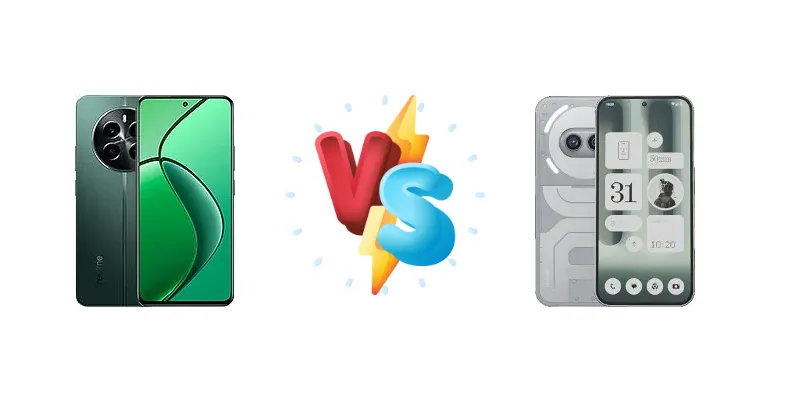
The Realme 13 4G and Nothing Phone (2a) Plus represent distinct approaches to the mid-range smartphone market. The Realme focuses on delivering essential features at an aggressive price point, while the Nothing Phone (2a) Plus aims for a more refined experience with a focus on design and performance. This comparison dissects their key differences to determine which device best suits your needs.
🏆 Quick Verdict
For the average user prioritizing performance and a brighter display, the Nothing Phone (2a) Plus is the superior choice. Its Mediatek Dimensity 7350 Pro chipset and 1097 nit display offer a noticeable upgrade over the Realme 13 4G’s Snapdragon 685 and less bright screen. However, the Realme 13 4G remains a compelling option for budget-conscious buyers.
| Network |
|---|
| 2G bands | GSM 850 / 900 / 1800 / 1900 | GSM 850 / 900 / 1800 / 1900 |
| 3G bands | HSDPA 900 / 2100 | HSDPA 800 / 850 / 900 / 1700(AWS) / 1900 / 2100 |
| 4G bands | 1, 3, 5, 8, 40 | 1, 3, 4, 5, 7, 8, 18, 19, 20, 26, 28, 38, 39, 40, 41, 42, 66 |
| 5G bands | - | 1, 3, 5, 7, 8, 20, 28, 38, 40, 41, 66, 77, 78 SA/NSA |
| Speed | HSPA, LTE | HSPA, LTE, 5G |
| Technology | GSM / HSPA / LTE | GSM / HSPA / LTE / 5G |
| Launch |
|---|
| Announced | 2024, August 07 | 2024, July 31 |
| Status | Available. Released 2024, August 08 | Available. Released 2024, August 03 |
| Body |
|---|
| Build | - | Glass front (Gorilla Glass 5), plastic frame, plastic back |
| Dimensions | 163 x 75.5 x 7.9 mm (6.42 x 2.97 x 0.31 in) | 161.7 x 76.3 x 8.5 mm (6.37 x 3.00 x 0.33 in) |
| SIM | Nano-SIM + Nano-SIM | Nano-SIM + Nano-SIM |
| Weight | 187 g (6.60 oz) | 190 g (6.70 oz) |
| Display |
|---|
| Protection | - | Corning Gorilla Glass 5 |
| Resolution | 1080 x 2400 pixels, 20:9 ratio (~395 ppi density) | 1080 x 2412 pixels, 20:9 ratio (~395 ppi density) |
| Size | 6.67 inches, 107.4 cm2 (~87.3% screen-to-body ratio) | 6.7 inches, 107.5 cm2 (~87.1% screen-to-body ratio) |
| Type | AMOLED, 120Hz, 600 nits (typ), 2000 nits (peak) | AMOLED, 1B colors, 120Hz, 2160Hz PWM, HDR10+, 700 nits (typ), 1100 nits (HBM), 1300 nits (peak) |
| Platform |
|---|
| CPU | Octa-core (4x2.8 GHz Cortex-A73 & 4x1.9 GHz Cortex-A53) | Octa-core (2x3.0 GHz Cortex-A715 & 6x 2.0 GHz Cortex-A510) |
| Chipset | Qualcomm SM6225 Snapdragon 685 (6 nm) | Mediatek Dimensity 7350 Pro (4 nm) |
| GPU | Adreno 610 | Mali-G610 MC4 |
| OS | Android 14, Realme UI 5.0 | Android 14, up to 3 major Android upgrades, Nothing OS 3.0 |
| Memory |
|---|
| Card slot | microSDXC (uses shared SIM slot) | No |
| Internal | 128GB 8GB RAM, 256GB 8GB RAM | 256GB 8GB RAM, 256GB 12GB RAM |
| Main Camera |
|---|
| Dual | 50 MP, f/1.9, 26mm (wide), 1/1.95", PDAF, OIS
Auxiliary lens | 50 MP, f/1.9, 24mm (wide), 1/1.57", 1.0µm, PDAF, OIS
50 MP, f/2.2, 114˚ (ultrawide), 1/2.76", 0.64µm |
| Features | LED flash, HDR, panorama | LED flash, panorama, HDR |
| Video | 1080p@30fps, gyro-EIS | 4K@30fps, 1080p@60/120fps, gyro-EIS |
| Selfie camera |
|---|
| Features | Panorama | HDR |
| Single | 16 MP, f/2.5, (wide) | 50 MP, f/2.2, (wide), 1/2.76" |
| Video | 1080p@30fps | 4K@30fps |
| Sound |
|---|
| 35mm jack | Yes | No |
| Loudspeaker | Yes, with dual speakers | Yes, with stereo speakers |
| Comms |
|---|
| Bluetooth | 5.0, A2DP, LE | 5.3, A2DP, LE |
| NFC | Yes, 360˚ | Yes, 360˚ |
| Positioning | GPS, GALILEO, GLONASS, QZSS, BDS | GPS, GALILEO, GLONASS, BDS, QZSS |
| Radio | Unspecified | No |
| USB | USB Type-C 2.0 | USB Type-C 2.0, OTG |
| WLAN | Wi-Fi 802.11 a/b/g/n/ac, dual-band | Wi-Fi 802.11 a/b/g/n/ac/6, dual-band, Wi-Fi Direct |
| Features |
|---|
| Sensors | Fingerprint (under display, optical), accelerometer, gyro, proximity, compass | Fingerprint (under display, optical), accelerometer, gyro, proximity, compass |
| Battery |
|---|
| Charging | 67W wired, 50% in 19 min, 100% in 47 min | 50W wired, 50% in 21 min, 100% in 56 min |
| Type | 5000 mAh | 5000 mAh |
| Misc |
|---|
| Colors | Skyline Blue, Pioneer Green | Black, Grey |
| Models | - | A142P |
| Price | About 170 EUR | € 269.90 / ₹ 22,599 |
Realme 13 4G
- Faster 67W charging
- Potentially lower price point
- Reliable Qualcomm chipset
- Less powerful processor
- Likely dimmer display
- Unknown battery capacity
Nothing Phone (2a) Plus
- Significantly brighter display (1097 nits)
- More powerful Mediatek Dimensity 7350 Pro
- Longer battery life (16:34h active use)
- Slower 50W charging
- Higher price compared to Realme 13 4G
- May lack expandable storage
Display Comparison
The Nothing Phone (2a) Plus boasts a significantly brighter display, reaching a measured peak of 1097 nits, compared to an unstated brightness for the Realme 13 4G. This difference translates to vastly improved visibility under direct sunlight. While both likely utilize LCD panels given the price points, the Nothing Phone (2a) Plus’s higher brightness is a clear advantage. The Realme 13 4G’s display specifications are currently unknown, making a detailed comparison of color accuracy and resolution impossible, but it’s reasonable to expect the Nothing Phone (2a) Plus to offer a more vibrant and detailed visual experience.
Camera Comparison
Without detailed camera specifications for the Realme 13 4G, a direct comparison is limited. However, the Nothing Phone (2a) Plus is expected to have a more sophisticated camera system, leveraging the processing power of the Dimensity 7350 Pro. The Realme 13 4G likely features a standard camera setup for its price range, while the Nothing Phone (2a) Plus may offer features like improved dynamic range and low-light performance. It's important to note that many phones in this price bracket include low-resolution macro lenses that offer limited real-world benefit.
Performance
The core difference lies in the chipsets: the Realme 13 4G utilizes the Qualcomm SM6225 Snapdragon 685 (6nm), while the Nothing Phone (2a) Plus is powered by the Mediatek Dimensity 7350 Pro (4nm). The Dimensity 7350 Pro’s newer architecture (Cortex-A715 vs A73) and smaller 4nm process node provide a substantial performance advantage, particularly in demanding tasks. The Nothing Phone (2a) Plus’s CPU configuration of 2x3.0 GHz Cortex-A715 and 6x 2.0 GHz Cortex-A510 cores will deliver faster app loading times and smoother multitasking compared to the Realme’s 4x2.8 GHz Cortex-A73 & 4x1.9 GHz Cortex-A53 setup. The 4nm process also contributes to better thermal efficiency, potentially reducing throttling during extended gaming sessions.
Battery Life
The Nothing Phone (2a) Plus demonstrates impressive battery life, achieving an active use score of 16:34h. While the Realme 13 4G’s battery capacity is unknown, its 67W wired charging is faster than the Nothing Phone (2a) Plus’s 50W charging. The Realme 13 4G can reach 50% charge in 19 minutes and 100% in 47 minutes, while the Nothing Phone (2a) Plus takes 21 minutes for 50% and 56 minutes for a full charge. This means the Realme 13 4G offers quicker top-ups, but the Nothing Phone (2a) Plus compensates with significantly longer battery endurance.
Buying Guide
Buy the Realme 13 4G if you need a reliable smartphone for basic tasks, prioritize fast charging (67W) over raw processing power, and are on a very tight budget. Buy the Nothing Phone (2a) Plus if you prefer a smoother user experience, a significantly brighter display for outdoor visibility, and are willing to spend a bit more for improved performance and a more modern chipset.
Frequently Asked Questions
❓ Does the Mediatek Dimensity 7350 Pro in the Nothing Phone (2a) Plus get hot during prolonged gaming sessions?
The Dimensity 7350 Pro’s 4nm process node is designed for improved thermal efficiency compared to the 6nm Snapdragon 685 in the Realme 13 4G. While some heat generation is inevitable during gaming, the Nothing Phone (2a) Plus is expected to manage temperatures more effectively, reducing the likelihood of significant performance throttling.
❓ Is the 67W charging on the Realme 13 4G significantly faster in real-world use than the 50W charging on the Nothing Phone (2a) Plus?
While the Realme 13 4G charges faster on paper (19 minutes to 50%, 47 minutes to 100%), the Nothing Phone (2a) Plus’s longer battery life means you’ll likely need to charge it less frequently. The difference in charging speed may only be noticeable for users who frequently need quick top-ups throughout the day.
❓ Given the Realme 13 4G's 4G connectivity, is it a poor choice for users in areas with strong 5G coverage?
If you live in an area with robust 5G infrastructure, the Realme 13 4G’s lack of 5G support will result in slower data speeds compared to a 5G-enabled device. The Nothing Phone (2a) Plus's 5G capabilities would be a significant advantage in such scenarios, offering faster downloads and smoother streaming.