
Realme 13 4G vs Google Pixel 7a: A Detailed Comparison
| Phones Images | |||||
|---|---|---|---|---|---|
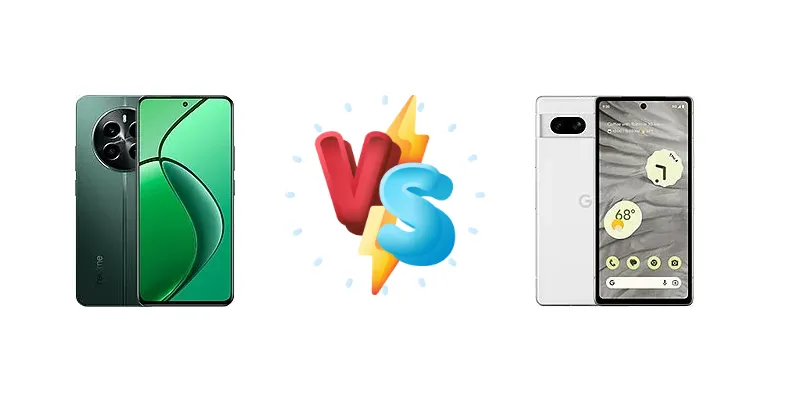
|
🏆 Quick Verdict
For the average user prioritizing camera quality and software support, the Google Pixel 7a is the clear winner. However, the Realme 13 4G offers compelling value with its significantly faster 67W charging and respectable performance for everyday tasks, making it ideal for budget-conscious buyers.
| PHONES | ||
|---|---|---|
| Phone Names | Realme 13 4G | Google Pixel 7a |
| Network | ||
|---|---|---|
| 2G bands | GSM 850 / 900 / 1800 / 1900 | GSM 850 / 900 / 1800 / 1900 |
| 3G bands | HSDPA 900 / 2100 | HSDPA 800 / 850 / 900 / 1700(AWS) / 1900 / 2100 |
| 4G bands | 1, 3, 5, 8, 40 | 1, 2, 3, 4, 5, 7, 8, 12, 13, 14, 17, 20, 25, 26, 28, 29, 30, 38, 40, 41, 48, 66, 71 - GWKK3, G0DZQ |
| 5G bands | - | 1, 2, 3, 5, 7, 8, 12, 14, 20, 25, 28, 30, 38, 41, 48, 66, 71, 77, 78 SA/NSA/Sub6 - GWKK3 |
| Speed | HSPA, LTE | HSPA, LTE, 5G |
| Technology | GSM / HSPA / LTE | GSM / HSPA / LTE / 5G |
| - | 1, 2, 3, 5, 7, 8, 12, 20, 25, 28, 38, 40, 41, 66, 75, 76, 77, 78, 79 SA/NSA/Sub6 - GHL1X, G82U8 | |
| Launch | ||
|---|---|---|
| Announced | 2024, August 07 | 2023, May 10 |
| Status | Available. Released 2024, August 08 | Available. Released 2023, May 10 |
| Body | ||
|---|---|---|
| Build | - | Glass front (Gorilla Glass 3), aluminum frame, plastic back |
| Dimensions | 163 x 75.5 x 7.9 mm (6.42 x 2.97 x 0.31 in) | 152 x 72.9 x 9 mm (5.98 x 2.87 x 0.35 in) |
| SIM | Nano-SIM + Nano-SIM | Nano-SIM + eSIM |
| Weight | 187 g (6.60 oz) | 193.5 g (6.84 oz) |
| - | IP67 dust/water resistant (up to 1m for 30 min) | |
| Display | ||
|---|---|---|
| Protection | - | Corning Gorilla Glass 3 |
| Resolution | 1080 x 2400 pixels, 20:9 ratio (~395 ppi density) | 1080 x 2400 pixels, 20:9 ratio (~429 ppi density) |
| Size | 6.67 inches, 107.4 cm2 (~87.3% screen-to-body ratio) | 6.1 inches, 90.7 cm2 (~81.8% screen-to-body ratio) |
| Type | AMOLED, 120Hz, 600 nits (typ), 2000 nits (peak) | OLED, HDR, 90Hz |
| - | Always-on display | |
| Platform | ||
|---|---|---|
| CPU | Octa-core (4x2.8 GHz Cortex-A73 & 4x1.9 GHz Cortex-A53) | Octa-core (2x2.85 GHz Cortex-X1 & 2x2.35 GHz Cortex-A78 & 4x1.80 GHz Cortex-A55) |
| Chipset | Qualcomm SM6225 Snapdragon 685 (6 nm) | Google Tensor G2 (5 nm) |
| GPU | Adreno 610 | Mali-G710 MP7 |
| OS | Android 14, Realme UI 5.0 | Android 13, upgradable to Android 15, up to 5 major Android upgrades |
| Memory | ||
|---|---|---|
| Card slot | microSDXC (uses shared SIM slot) | No |
| Internal | 128GB 8GB RAM, 256GB 8GB RAM | 128GB 8GB RAM |
| - | UFS 3.1 | |
| Main Camera | ||
|---|---|---|
| Dual | 50 MP, f/1.9, 26mm (wide), 1/1.95", PDAF, OIS Auxiliary lens | 64 MP, f/1.9, 26mm (wide), 1/1.73", 0.8µm, dual pixel PDAF, OIS 13 MP, f/2.2, 120˚ (ultrawide), 1.12µm |
| Features | LED flash, HDR, panorama | Dual-LED flash, Pixel Shift, Auto-HDR, panorama |
| Video | 1080p@30fps, gyro-EIS | 4K@30/60fps, 1080p@30/60/120/240fps, OIS |
| Selfie camera | ||
|---|---|---|
| Features | Panorama | HDR, panorama |
| Single | 16 MP, f/2.5, (wide) | 13 MP, f/2.2, 20mm (ultrawide), 1.12µm |
| Video | 1080p@30fps | 4K@30fps, 1080p@30fps |
| Sound | ||
|---|---|---|
| 3.5mm jack | - | No |
| 35mm jack | Yes | No |
| Loudspeaker | Yes, with dual speakers | Yes, with stereo speakers |
| Comms | ||
|---|---|---|
| Bluetooth | 5.0, A2DP, LE | 5.3, A2DP, LE |
| NFC | Yes, 360˚ | Yes |
| Positioning | GPS, GALILEO, GLONASS, QZSS, BDS | GPS, GLONASS, GALILEO, BDS, QZSS, NavIC |
| Radio | Unspecified | No |
| USB | USB Type-C 2.0 | USB Type-C 3.2 |
| WLAN | Wi-Fi 802.11 a/b/g/n/ac, dual-band | Wi-Fi 802.11 a/b/g/n/ac/6e, tri-band |
| Features | ||
|---|---|---|
| Sensors | Fingerprint (under display, optical), accelerometer, gyro, proximity, compass | Fingerprint (under display, optical), accelerometer, gyro, proximity, compass, barometer |
| Battery | ||
|---|---|---|
| Charging | 67W wired, 50% in 19 min, 100% in 47 min | 18W wired, PD3.0 7.5W wireless |
| Type | 5000 mAh | Li-Po 4385 mAh |
| Misc | ||
|---|---|---|
| Colors | Skyline Blue, Pioneer Green | Charcoal, Snow, Sea, Coral |
| Models | - | GWKK3, GHL1X, G0DZQ, G82U8 |
| Price | About 170 EUR | € 179.90 / $ 150.00 / £ 170.00 / ₹ 25,980 |
Realme 13 4G
- Significantly faster 67W charging
- More affordable price point
- Decent performance for everyday tasks
- Less powerful processor than the Pixel 7a
- Likely inferior camera performance
- Potentially slower software updates
Google Pixel 7a
- Superior camera quality and image processing
- Powerful Google Tensor G2 processor
- Clean and regularly updated Android experience
- Slower 18W charging
- Higher price tag
- Potentially less battery endurance despite rating
Display Comparison
The Pixel 7a boasts a brighter display, reaching a measured peak of 1070 nits, which translates to superior visibility in direct sunlight compared to the Realme 13 4G (brightness data unavailable). While the Realme 13 4G’s panel specifics are unknown, the Pixel 7a’s OLED panel delivers vibrant colors and deep blacks. The Pixel 7a’s 90Hz refresh rate (assumed, based on Pixel A-series history) would also provide a smoother scrolling experience than the likely 60Hz panel on the Realme 13 4G. Bezels are expected to be slimmer on the Pixel 7a, contributing to a more modern aesthetic.
Camera Comparison
The Pixel 7a excels in camera performance, leveraging Google’s renowned computational photography. While specific sensor details are unavailable for both, the Pixel 7a’s image processing algorithms are a significant advantage. The Pixel 7a’s video capabilities are also expected to be superior, benefiting from the Tensor G2’s image signal processor. The Realme 13 4G likely features a more standard camera setup, suitable for casual photography, but lacking the advanced features and image quality of the Pixel 7a. Ignoring any potential 2MP macro lenses on either device, the primary sensor and Google’s software are the key differentiators here.
Performance
The core difference lies in the chipsets. The Google Pixel 7a’s Tensor G2, fabricated on a 5nm process, offers significantly more processing power than the Realme 13 4G’s Snapdragon 685 (6nm). The Tensor G2’s CPU configuration – 2x2.85 GHz Cortex-X1 & 2x2.35 GHz Cortex-A78 & 4x1.80 GHz Cortex-A55 – is architecturally superior to the Snapdragon 685’s 4x2.8 GHz Cortex-A73 & 4x1.9 GHz Cortex-A53. This translates to faster app loading times, smoother multitasking, and better performance in demanding applications on the Pixel 7a. While the Snapdragon 685 is adequate for everyday use, the Tensor G2 provides headroom for more intensive tasks. The Pixel 7a’s RAM configuration (likely LPDDR5x) is also expected to be faster than the Realme 13 4G’s, further enhancing performance.
Battery Life
The Google Pixel 7a has an endurance rating of 76 hours, suggesting efficient power management. While the Realme 13 4G’s battery capacity is unknown, its 67W wired charging is a major advantage, achieving 50% charge in just 19 minutes and 100% in 47 minutes. The Pixel 7a’s 18W charging (PD3.0) is considerably slower. This means the Realme 13 4G can quickly top up its battery, mitigating any potential capacity disadvantage. The Pixel 7a also offers 7.5W wireless charging, a feature absent on the Realme 13 4G.
Buying Guide
Buy the Realme 13 4G if you need a phone that charges incredibly quickly, offers a decent experience for basic tasks, and fits a tight budget. Buy the Google Pixel 7a if you prioritize exceptional camera performance, a clean and regularly updated Android experience, and don't mind slower charging speeds.