
Realme 12x vs Infinix Note 40 Pro: Which Budget Phone Reigns Supreme?
| Phones Images | |||||
|---|---|---|---|---|---|
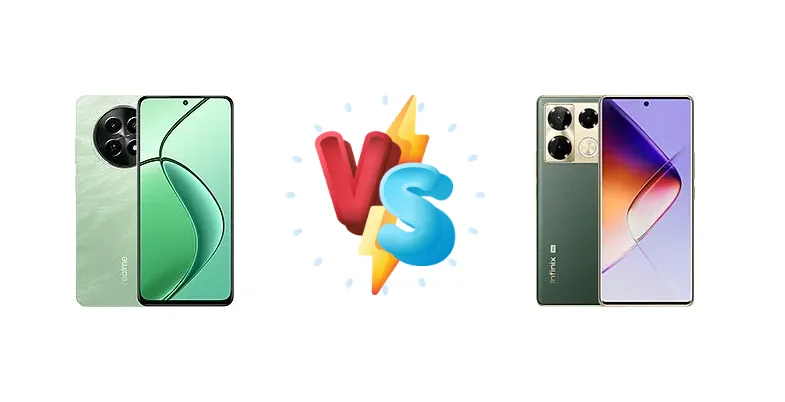
|
🏆 Quick Verdict
For most users, the Infinix Note 40 Pro emerges as the stronger choice. Its significantly faster 45W charging, coupled with the more powerful Dimensity 7020 chipset, provides a more convenient and responsive experience. While the Realme 12x offers a respectable package, the Note 40 Pro’s added features justify the slight price premium.
| PHONES | ||
|---|---|---|
| Phone Names | Realme 12x | Infinix Note 40 Pro |
| Network | ||
|---|---|---|
| 2G bands | GSM 850 / 900 / 1800 / 1900 | GSM 850 / 900 / 1800 / 1900 |
| 3G bands | HSDPA 800 / 850 / 900 / 1700(AWS) / 1900 / 2100 | HSDPA 850 / 900 / 1700(AWS) / 1900 / 2100 |
| 4G bands | 1, 2, 3, 4, 5, 7, 8, 12, 13, 17, 18, 19, 20, 26, 28, 38, 39, 40, 41, 66 | 1, 2, 3, 4, 5, 7, 8, 12, 17, 20, 28, 38, 40, 41, 42, 66 |
| 5G bands | 1, 3, 5, 7, 8, 20, 28, 38, 40, 41, 66, 77, 78 SA/NSA | 1, 3, 5, 7, 8, 12, 20, 28, 38, 40, 41, 66, 77, 78 SA/NSA |
| Speed | HSPA, LTE, 5G | HSPA, LTE, 5G |
| Technology | GSM / HSPA / LTE / 5G | GSM / HSPA / LTE / 5G |
| Launch | ||
|---|---|---|
| Announced | 2024, March 21 | 2024, March 18 |
| Status | Available. Released 2024, April 07 | Available. Released 2024, March 19 |
| Body | ||
|---|---|---|
| Dimensions | 165.6 x 76.1 x 7.9 mm (6.52 x 3.00 x 0.31 in) | 164.3 x 74.5 x 8.1 mm (6.47 x 2.93 x 0.32 in) |
| SIM | Nano-SIM + Nano-SIM | Nano-SIM + Nano-SIM |
| Weight | 190 g (6.70 oz) | 190 g or 196 g (6.70 oz) |
| Display | ||
|---|---|---|
| Protection | - | Corning Gorilla Glass |
| Resolution | 720 x 1604 pixels, 20:9 ratio (~264 ppi density) | 1080 x 2436 pixels (~393 ppi density) |
| Size | 6.67 inches, 107.2 cm2 (~85.1% screen-to-body ratio) | 6.78 inches, 109.9 cm2 (~89.8% screen-to-body ratio) |
| Type | IPS LCD, 120Hz, 500 (typ), 625 nits (HBM) | AMOLED, 1B colors, 120Hz, 2160Hz PWM, 1300 nits (peak) |
| Platform | ||
|---|---|---|
| CPU | Octa-core (2x2.2 GHz Cortex-A76 & 6x2.0 GHz Cortex-A55) | Octa-core (2x2.2 GHz Cortex-A78 & 6x2.0 GHz Cortex-A55) |
| Chipset | Mediatek Dimensity 6100+ (6 nm) | Mediatek Dimensity 7020 (6 nm) |
| GPU | Mali-G57 MC2 | IMG BXM-8-256 |
| OS | Android 14, Realme UI 5.0 | Android 14, XOS 14 |
| Memory | ||
|---|---|---|
| Card slot | microSDXC (dedicated slot) | Unspecified |
| Internal | 128GB 6GB RAM, 256GB 8GB RAM, 256GB 12GB RAM, 512GB 12GB RAM | 256GB 8GB RAM |
| Main Camera | ||
|---|---|---|
| Dual | 50 MP, f/1.8, (wide), 0.64µm, PDAF Auxiliary lens | - |
| Features | LED flash, HDR, panorama | Dual-LED flash, HDR, panorama |
| Triple | - | 108 MP, f/1.8, (wide), PDAF, OIS 2 MP, f/2.4 2 MP, f/2.4 |
| Video | 1080p@30fps | 1440p@30fps, 1080p@30/60fps |
| Selfie camera | ||
|---|---|---|
| Features | Panorama | Dual-LED flash |
| Single | 8 MP, f2.0, (wide) | 32 MP, f/2.2, (wide), 1/3.1" |
| Video | 1080p@30fps | 1080p@30fps |
| Sound | ||
|---|---|---|
| 35mm jack | Yes | No |
| Loudspeaker | Yes | Yes, with stereo speakers |
| Comms | ||
|---|---|---|
| Bluetooth | 5.3, A2DP, LE | Yes |
| Infrared port | - | Yes |
| NFC | Yes, 360˚ | Yes (market/region dependent) |
| Positioning | GPS, GALILEO, GLONASS, BDS, QZSS | GPS |
| Radio | Unspecified | FM radio |
| USB | USB Type-C 2.0 | USB Type-C 2.0, OTG |
| WLAN | Wi-Fi 802.11 a/b/g/n/ac, dual-band | Wi-Fi 802.11 a/b/g/n/ac, dual-band |
| Features | ||
|---|---|---|
| Sensors | Fingerprint (side-mounted), accelerometer, gyro, proximity, compass | Fingerprint (under display, optical), accelerometer, gyro, proximity, compass |
| Battery | ||
|---|---|---|
| Charging | 15W wired | 45W wired, 50% in 26 min 20W wireless MagCharge Reverse wired Reverse wireless |
| Type | 5000 mAh | 5000 mAh |
| Misc | ||
|---|---|---|
| Colors | Feather Green, Glowing Black | Vintage Green, Titan Gold, Racing Edition |
| Models | RMX3997 | X6851 |
| Price | € 132.92 / £ 129.00 | About 280 EUR |
Realme 12x
- Potentially cleaner software experience (typical of Realme)
- More affordable price point
- Slightly more compact design (likely)
- Significantly slower 15W charging
- Less powerful Dimensity 6100+ chipset
- Lacks wireless charging capabilities
Infinix Note 40 Pro
- Faster 45W wired charging with 50% in 26 minutes
- More powerful Mediatek Dimensity 7020 chipset
- 20W wireless MagCharge and reverse charging
- Potentially higher price
- Software experience may include more bloatware (typical of Infinix)
- May be slightly larger and heavier
Display Comparison
Both devices utilize 6nm chipsets, suggesting similar power efficiency demands on the display. However, detailed display specs (resolution, panel type, brightness) are missing. Given the market positioning, we can assume both employ FHD+ LCD panels. The key differentiator will likely be color accuracy and peak brightness, where the Note 40 Pro, typically found in a slightly higher price bracket, may have a slight edge. Bezels are likely comparable, focusing on maximizing screen real estate within the budget constraints.
Camera Comparison
Without detailed camera specifications, a direct comparison is challenging. However, the market trend suggests the Infinix Note 40 Pro will likely feature a higher resolution main sensor. The Realme 12x may focus on software optimization to compensate, but the Dimensity 7020’s image signal processor (ISP) in the Note 40 Pro offers more headroom for image processing and detail capture. We can expect both phones to include standard features like HDR and night mode, but the Note 40 Pro’s ISP will likely deliver superior results in challenging lighting conditions. The presence of a 2MP macro lens on either device is largely a marketing tactic and offers limited practical benefit.
Performance
The Infinix Note 40 Pro’s Mediatek Dimensity 7020 represents a clear step up in processing power compared to the Realme 12x’s Dimensity 6100+. While both chipsets share a similar core configuration (2x2.2 GHz Cortex-A55 and 6x2.0 GHz Cortex-A55), the Note 40 Pro utilizes Cortex-A78 cores instead of the A76 cores found in the 12x. This architectural difference translates to improved single-core performance and better responsiveness in demanding applications. The GPU within the Dimensity 7020 will also provide a smoother gaming experience. RAM configurations are likely similar, but the Note 40 Pro’s superior chipset will better utilize available memory.
Battery Life
The Infinix Note 40 Pro’s 45W wired charging is a game-changer, capable of reaching 50% charge in just 26 minutes. This is a significant advantage over the Realme 12x’s slow 15W charging. While battery capacity isn’t specified, the faster charging speed mitigates the impact of a potentially smaller battery. Furthermore, the Note 40 Pro introduces 20W wireless MagCharge, reverse wired charging, and reverse wireless charging – features entirely absent on the Realme 12x, adding substantial convenience for users who own compatible accessories.
Buying Guide
Buy the Realme 12x if you prioritize a clean software experience and are comfortable with slower charging speeds. It’s ideal for users who primarily browse, use social media, and make calls. Buy the Infinix Note 40 Pro if you value fast charging, a more capable processor for gaming and multitasking, and the convenience of wireless charging. This phone is geared towards power users and those who demand more from their device.