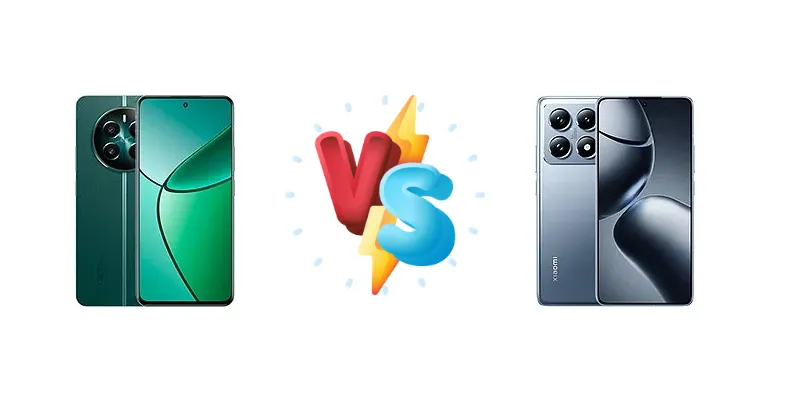
The Realme 12+ and Xiaomi 14T Pro represent compelling options in the increasingly competitive mid-range smartphone market. While both leverage MediaTek's Dimensity series, they diverge significantly in chipset choice and charging technology, creating a clear battle between efficiency and raw power. This comparison will dissect these differences to determine which device delivers the best overall experience.
🏆 Quick Verdict
For the average user prioritizing sustained performance and future-proofing, the Xiaomi 14T Pro emerges as the winner. Its Dimensity 9300+ chipset, coupled with 120W charging, offers a noticeable advantage, despite a slightly shorter active use battery score. However, the Realme 12+ remains a strong contender for budget-conscious buyers.
| Network |
|---|
| 2G bands | GSM 850 / 900 / 1800 / 1900 | GSM 850 / 900 / 1800 / 1900 |
| 3G bands | HSDPA 850 / 900 / 2100 | HSDPA 800 / 850 / 900 / 1700(AWS) / 1900 / 2100 |
| 4G bands | 1, 3, 5, 8, 28, 40, 41 | 1, 2, 3, 4, 5, 7, 8, 12, 13, 17, 18, 19, 20, 25, 26, 28, 32, 38, 39, 40, 41, 42, 48, 66 |
| 5G bands | 1, 3, 5, 8, 28, 40, 41, 77, 78 SA/NSA | 1, 2, 3, 5, 7, 8, 12, 20, 25, 26, 28, 38, 40, 41, 48, 66, 75, 77, 78 SA/NSA |
| Speed | HSPA, LTE, 5G | HSPA, LTE, 5G |
| Technology | GSM / HSPA / LTE / 5G | GSM / HSPA / LTE / 5G |
| Launch |
|---|
| Announced | 2024, February 29 | 2024, September 26 |
| Status | Available. Released 2024, March 02 | Available. Released 2024, September 26 |
| Body |
|---|
| Build | Glass front, silicone polymer back (eco leather), plastic frame | Glass front (Gorilla Glass 5), aluminum frame, glass back (Panda X) |
| Dimensions | 163 x 75.5 x 7.9 mm (6.42 x 2.97 x 0.31 in) | 160.4 x 75.1 x 8.4 mm (6.31 x 2.96 x 0.33 in) |
| SIM | Nano-SIM + Nano-SIM | · Nano-SIM + eSIM· eSIM + eSIM· Nano-SIM + Nano-SIM |
| Weight | 190 g (6.70 oz) | 209 g (7.37 oz) |
| Display |
|---|
| Protection | - | Corning Gorilla Glass 5 |
| Resolution | 1080 x 2400 pixels, 20:9 ratio (~395 ppi density) | 1220 x 2712 pixels, 20:9 ratio (~446 ppi density) |
| Size | 6.67 inches, 107.4 cm2 (~87.3% screen-to-body ratio) | 6.67 inches, 107.4 cm2 (~89.1% screen-to-body ratio) |
| Type | AMOLED, 120Hz, HDR10+, 600 nits (typ), 2000 nits (peak) | AMOLED, 68B colors, 144Hz, 3840Hz PWM, Dolby Vision, HDR10+, 1600 nits (HBM), 4000 nits (peak) |
| Platform |
|---|
| CPU | Octa-core (2x2.6 GHz Cortex-A78 & 6x2.0 GHz Cortex-A55) | Octa-core (1x3.4 GHz Cortex-X4 & 3x2.85 GHz Cortex-X4 & 4x2.0 GHz Cortex-A720) |
| Chipset | Mediatek Dimensity 7050 (6 nm) | Mediatek Dimensity 9300+ (4 nm) |
| GPU | Mali-G68 MC4 | Immortalis-G720 MC12 |
| OS | Android 14, up to 2 major Android upgrades, Realme UI 5.0 | Android 14, HyperOS |
| Memory |
|---|
| Card slot | microSDXC (uses shared SIM slot) | No |
| Internal | 128GB 8GB RAM, 256GB 6GB RAM, 256GB 8GB RAM, 256GB 12GB RAM, 512GB 12GB RAM | 256GB 12GB RAM, 512GB 12GB RAM, 512GB 16GB RAM, 1TB 12GB RAM |
| Main Camera |
|---|
| Features | LED flash, HDR, panorama | Leica lens, Ultra HDR, LED flash, HDR, panorama |
| Triple | 50 MP, f/1.9, 26mm (wide), 1/1.95", PDAF, OIS
8 MP, f/2.2, 16mm, 112˚ (ultrawide), 1/4.0", 1.12µm
2 MP (macro) | 50 MP, f/1.6, 23mm (wide), 1/1.31", 1.2µm, PDAF, OIS
50 MP, f/2.0, 60mm (telephoto), 1/2.88", 0.61µm, PDAF, 2.6x optical zoom
12 MP, f/2.2, 15mm (ultrawide), 1/3.06", 1.12µm |
| Video | 4K@30fps, 1080p@30/60fps, gyro-EIS | 8K@24/30fps, 4K@24/30/60fps, 1080p@30/60/120/240/960fps, gyro-EIS, 10-bit Rec. 2020, HDR10+ |
| Selfie camera |
|---|
| Features | - | HDR |
| Single | 16 MP, f/2.5, 24mm (wide), 1/3.0" | 32 MP, f/2.0, 25mm (wide), 1/3.44", 0.64µm |
| Video | 1080p@30fps | 4K@30fps, 1080p@30/60fps, HDR10+ |
| Sound |
|---|
| 35mm jack | Yes | No |
| Loudspeaker | Yes, with stereo speakers | Yes, with stereo speakers |
| Comms |
|---|
| Bluetooth | 5.2, A2DP, LE | 5.4, A2DP, LE, LHDC |
| Infrared port | - | Yes |
| NFC | Yes, 360˚ (market/region dependent) | Yes (market/region dependent) |
| Positioning | GPS, GLONASS, GALILEO, BDS, QZSS | GPS (L1+L5), BDS (B1I+B1C+B2a+B2b), GALILEO (E1+E5a+E5b), QZSS (L1+L5), NavIC (L5), GLONASS |
| Radio | No | No |
| USB | USB Type-C 2.0 | USB Type-C 2.0, OTG |
| WLAN | Wi-Fi 802.11 a/b/g/n/ac/6, dual-band | Wi-Fi 802.11 a/b/g/n/ac/6e/7, dual-band, Wi-Fi Direct |
| Features |
|---|
| Sensors | Fingerprint (under display, optical), accelerometer, gyro, proximity, compass | Fingerprint (under display, optical), accelerometer, gyro, proximity, compass |
| Battery |
|---|
| Charging | 67W wired, 50% in 19 min | 120W wired, PD3.0, QC4, 100% in 19 min
50W wireless, 100% in 45 min |
| Type | 5000 mAh | Li-Po 5000 mAh |
| Misc |
|---|
| Colors | Pioneer Green, Navigator Beige | Titan Gray, Titan Blue, Titan Black |
| Models | RMX3867 | 2407FPN8EG |
| Price | € 192.98 / $ 200.22 / £ 203.26 / ₹ 18,999 | $ 550.00 / £ 498.00 / € 539.99 |
| SAR EU | - | 0.99 W/kg (head) 1.00 W/kg (body) |
Realme 12+
- Longer battery life in active use tests
- Potentially more affordable price point
- Reliable MediaTek Dimensity 7050 chipset
- Slower charging speed (67W)
- Less powerful chipset compared to the Xiaomi
- Potentially less advanced image processing
Xiaomi 14T Pro
- Significantly faster 120W wired charging
- More powerful Mediatek Dimensity 9300+ chipset
- 50W wireless charging support
- Slightly shorter battery life in active use tests
- Likely higher price point
- Potential for increased heat under sustained load
Display Comparison
Both the Realme 12+ and Xiaomi 14T Pro feature bright displays, reaching measured peak brightness levels of 1148 nits and 1228 nits respectively. While the Xiaomi 14T Pro edges out the Realme in peak brightness, the difference is unlikely to be dramatically noticeable in most real-world scenarios. Neither specification details refresh rate or panel technology (OLED/LCD), which are crucial for a complete display assessment. However, given the price points, it's reasonable to assume both utilize AMOLED panels. The Xiaomi's slightly brighter display may benefit users frequently exposed to direct sunlight.
Camera Comparison
Without detailed camera specifications, a direct comparison is limited. However, the chipset's image signal processor (ISP) plays a crucial role. The Dimensity 9300+ in the Xiaomi 14T Pro likely offers more advanced image processing capabilities, potentially resulting in better dynamic range and low-light performance. The Realme 12+ will still deliver acceptable results, but the Xiaomi has the potential for superior image quality. We can assume both phones will feature a primary camera, but sensor size and optical image stabilization (OIS) are unknown variables that would significantly impact image quality.
Performance
The core difference lies in the chipsets. The Xiaomi 14T Pro boasts the Mediatek Dimensity 9300+, built on a more efficient 4nm process, featuring a 1x3.4 GHz Cortex-X4 prime core and 3x2.85 GHz Cortex-X4 performance cores. This contrasts with the Realme 12+'s Dimensity 7050 (6nm), utilizing 2x2.6 GHz Cortex-A78 and 6x2.0 GHz Cortex-A55 cores. The 4nm node and newer core architecture of the 9300+ translate to superior performance and thermal efficiency, minimizing throttling during extended gaming sessions. The Xiaomi’s CPU configuration suggests a significant advantage in multi-core tasks. While both phones likely feature LPDDR5x RAM, the chipset difference will be the dominant factor in overall responsiveness.
Battery Life
The Realme 12+ achieves an active use battery score of 13:03h, slightly surpassing the Xiaomi 14T Pro’s 12:32h. However, this advantage is offset by the Xiaomi’s significantly faster 120W wired charging, achieving 100% charge in just 19 minutes – the same time the Realme 12+ takes to reach 50%. The Xiaomi also adds 50W wireless charging, a feature absent on the Realme. The faster charging of the Xiaomi 14T Pro provides a more convenient user experience, allowing for quick top-ups throughout the day, effectively mitigating the slightly shorter battery life.
Buying Guide
Buy the Realme 12+ if you need exceptional battery life and prioritize value for money, accepting a slight performance trade-off. It’s ideal for users who primarily browse, consume media, and engage in light gaming. Buy the Xiaomi 14T Pro if you prefer a faster, more responsive experience, especially for demanding tasks like gaming and video editing, and value the convenience of incredibly rapid charging, even if it means slightly less screen-on time.
Frequently Asked Questions
❓ Does the Dimensity 9300+ in the Xiaomi 14T Pro get noticeably hot during prolonged gaming sessions?
While the 4nm process improves thermal efficiency, the Dimensity 9300+ is a powerful chipset. Expect some heat during extended gaming, but the Xiaomi 14T Pro likely incorporates effective cooling solutions to mitigate throttling and maintain consistent performance. The Realme 12+'s Dimensity 7050 will generate less heat, but also offer lower peak performance.
❓ How does the 120W charging on the Xiaomi 14T Pro impact battery health over the long term?
Modern smartphones employ sophisticated charging algorithms to protect battery health even with extremely fast charging. While theoretically faster charging could accelerate degradation, Xiaomi's 120W charging system includes safeguards to minimize this effect. The convenience of rapid charging often outweighs the minimal potential impact on long-term battery lifespan.
❓ Is the difference in active use battery life between the two phones significant in real-world usage?
The 71-minute difference in active use scores is noticeable, but not necessarily game-changing. The Xiaomi 14T Pro’s 120W charging largely compensates for this, allowing for quick top-ups. User habits – such as screen brightness, app usage, and network connectivity – will have a greater impact on daily battery life than this specific difference.