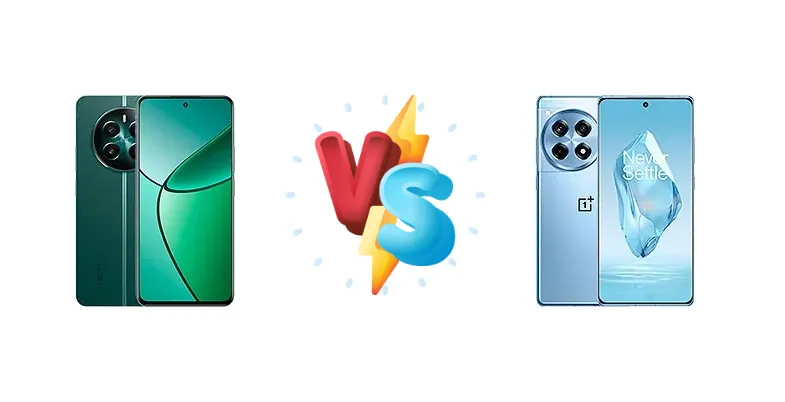
The Realme 12+ and OnePlus 12R represent compelling options in the increasingly competitive mid-range smartphone market. The Realme 12+ aims to deliver a premium experience at a more accessible price point, while the OnePlus 12R leverages flagship-level processing power from last year's top tier. This comparison dives deep into the specifications and real-world performance to determine which device offers the best value.
🏆 Quick Verdict
For the average user prioritizing sustained performance and faster charging, the OnePlus 12R is the clear winner. Its Snapdragon 8 Gen 2 chipset provides a significant performance advantage, and the 100W charging dramatically reduces downtime. However, the Realme 12+ offers a respectable experience for everyday tasks and boasts a slightly brighter display.
| Network |
|---|
| 2G bands | GSM 850 / 900 / 1800 / 1900 | GSM 850 / 900 / 1800 / 1900 |
| 3G bands | HSDPA 850 / 900 / 2100 | HSDPA 850 / 900 / 1700(AWS) / 1900 / 2100 |
| 4G bands | 1, 3, 5, 8, 28, 40, 41 | 1, 2, 3, 4, 5, 7, 8, 12, 17, 18, 19, 20, 26, 28, 32, 38, 39, 40, 41, 66 |
| 5G bands | 1, 3, 5, 8, 28, 40, 41, 77, 78 SA/NSA | 1, 2, 3, 5, 7, 8, 12, 20, 28, 38, 40, 41, 66, 77, 78 SA/NSA |
| Speed | HSPA, LTE, 5G | HSPA, LTE, 5G |
| Technology | GSM / HSPA / LTE / 5G | GSM / CDMA / HSPA / LTE / 5G |
| Launch |
|---|
| Announced | 2024, February 29 | 2024, January 23 |
| Status | Available. Released 2024, March 02 | Available. Released 2024, February 06 |
| Body |
|---|
| Build | Glass front, silicone polymer back (eco leather), plastic frame | Glass front (Gorilla Glass Victus 2), aluminum frame, glass back |
| Dimensions | 163 x 75.5 x 7.9 mm (6.42 x 2.97 x 0.31 in) | 163.3 x 75.3 x 8.8 mm (6.43 x 2.96 x 0.35 in) |
| SIM | Nano-SIM + Nano-SIM | · Nano-SIM + Nano-SIM + eSIM (max 2 at a time)· Nano-SIM + Nano-SIM |
| Weight | 190 g (6.70 oz) | 207 g (7.30 oz) |
| Display |
|---|
| Protection | - | Corning Gorilla Glass Victus 2 |
| Resolution | 1080 x 2400 pixels, 20:9 ratio (~395 ppi density) | 1264 x 2780 pixels (~450 ppi density) |
| Size | 6.67 inches, 107.4 cm2 (~87.3% screen-to-body ratio) | 6.78 inches, 111.7 cm2 (~90.9% screen-to-body ratio) |
| Type | AMOLED, 120Hz, HDR10+, 600 nits (typ), 2000 nits (peak) | LTPO4 AMOLED, 1B colors, 120Hz, HDR10+, Dolby Vision, 1600 nits (HBM), 4500 nits (peak) |
| Platform |
|---|
| CPU | Octa-core (2x2.6 GHz Cortex-A78 & 6x2.0 GHz Cortex-A55) | Octa-core (1x3.2 GHz Cortex-X3 & 2x2.8 GHz Cortex-A715 & 2x2.8 GHz Cortex-A710 & 3x2.0 GHz Cortex-A510) |
| Chipset | Mediatek Dimensity 7050 (6 nm) | Qualcomm SM8550-AB Snapdragon 8 Gen 2 (4 nm) |
| GPU | Mali-G68 MC4 | Adreno 740 |
| OS | Android 14, up to 2 major Android upgrades, Realme UI 5.0 | Android 14, up to 3 major Android upgrades, OxygenOS 15 |
| Memory |
|---|
| Card slot | microSDXC (uses shared SIM slot) | No |
| Internal | 128GB 8GB RAM, 256GB 6GB RAM, 256GB 8GB RAM, 256GB 12GB RAM, 512GB 12GB RAM | 128GB 8GB RAM, 256GB 8GB RAM, 256GB 12GB RAM, 256GB 16GB RAM |
| Main Camera |
|---|
| Features | LED flash, HDR, panorama | Laser AF, color spectrum sensor, LED flash, HDR, panorama |
| Triple | 50 MP, f/1.9, 26mm (wide), 1/1.95", PDAF, OIS
8 MP, f/2.2, 16mm, 112˚ (ultrawide), 1/4.0", 1.12µm
2 MP (macro) | 50 MP, f/1.8, 24mm (wide), 1/1.56", 1.0µm, multi-directional PDAF, OIS
8 MP, f/2.2, 16mm, 112˚ (ultrawide), 1/4.0", 1.12µm
2 MP (macro) |
| Video | 4K@30fps, 1080p@30/60fps, gyro-EIS | 4K@30/60fps, 1080p@30/60/120/240fps, gyro-EIS, OIS |
| Selfie camera |
|---|
| Features | - | HDR, panorama |
| Single | 16 MP, f/2.5, 24mm (wide), 1/3.0" | 16 MP, f/2.4, 26mm (wide), 1/3", 1.0µm |
| Video | 1080p@30fps | 1080p@30fps, gyro-EIS |
| Sound |
|---|
| 35mm jack | Yes | No |
| Loudspeaker | Yes, with stereo speakers | Yes, with stereo speakers |
| Comms |
|---|
| Bluetooth | 5.2, A2DP, LE | 5.3, A2DP, LE, aptX HD |
| Infrared port | - | Yes |
| NFC | Yes, 360˚ (market/region dependent) | Yes |
| Positioning | GPS, GLONASS, GALILEO, BDS, QZSS | GPS, GALILEO, GLONASS, BDS, QZSS |
| Radio | No | No |
| USB | USB Type-C 2.0 | USB Type-C 2.0 |
| WLAN | Wi-Fi 802.11 a/b/g/n/ac/6, dual-band | Wi-Fi 802.11 a/b/g/n/ac/6/7, dual-band |
| Features |
|---|
| Sensors | Fingerprint (under display, optical), accelerometer, gyro, proximity, compass | Fingerprint (under display, optical), accelerometer, gyro, proximity, compass |
| Battery |
|---|
| Charging | 67W wired, 50% in 19 min | 100W wired, 100% in 26 min |
| Type | 5000 mAh | Li-Ion 5500 mAh |
| Misc |
|---|
| Colors | Pioneer Green, Navigator Beige | Iron Gray, Cool Blue, Electric Violet, Sunset Dune |
| Models | RMX3867 | CPH2609, CPH2585, CPH2611 |
| Price | € 192.98 / $ 200.22 / £ 203.26 / ₹ 18,999 | € 410.84 / $ 399.95 / £ 649.00 |
| SAR | - | 1.19 W/kg (head) 0.82 W/kg (body) |
Realme 12+
- Slightly brighter display (1148 nits)
- More affordable price point
- Solid battery life for everyday use
- Less powerful processor (Dimensity 7050)
- Slower charging speed (67W)
OnePlus 12R
- Flagship-level performance (Snapdragon 8 Gen 2)
- Incredibly fast 100W charging
- Longer battery life (14:32h active use)
- Potentially higher price
- May run slightly warmer under heavy load
Display Comparison
Both the Realme 12+ and OnePlus 12R feature excellent displays, with the OnePlus 12R edging out the Realme 12+ in peak brightness, reaching 1181 nits compared to the Realme’s 1148 nits. While both are highly visible outdoors, the OnePlus 12R offers a slight advantage in direct sunlight. Panel technology details are missing, but both likely utilize AMOLED panels given the vibrant colors. Bezels appear comparable, and without detailed color accuracy measurements, it’s difficult to declare a definitive winner in color reproduction, though OnePlus typically calibrates its displays well.
Camera Comparison
Detailed camera specs are limited, but the focus should be on the main sensors. Without knowing the megapixel counts or sensor sizes, it’s difficult to make a definitive judgment. However, the image processing style is a key differentiator between Realme and OnePlus. Realme typically leans towards more saturated and vibrant images, while OnePlus aims for a more natural look. The absence of information on Optical Image Stabilization (OIS) is a drawback; its presence would significantly improve low-light performance and video stabilization on either device. We can safely assume both phones include standard wide and ultrawide lenses, but the quality will depend heavily on the sensor and image processing.
Performance
The performance gap is the most significant differentiator. The OnePlus 12R’s Snapdragon 8 Gen 2 (4nm) is a substantial upgrade over the Realme 12+'s Mediatek Dimensity 7050 (6nm). The Snapdragon 8 Gen 2’s Cortex-X3 prime core, clocked at 3.2 GHz, provides a significant boost in single-core performance, crucial for responsive app launches and smooth UI navigation. The Dimensity 7050’s Cortex-A78 cores, while capable, are less efficient and offer lower peak performance. The 4nm process node of the Snapdragon 8 Gen 2 also translates to better thermal efficiency, minimizing throttling during extended gaming sessions. The OnePlus 12R will handle graphically intensive games at higher settings with greater consistency.
Battery Life
The OnePlus 12R boasts a clear advantage in charging speed with its 100W wired charging, achieving a full charge in just 26 minutes. The Realme 12+’s 67W charging, while respectable, takes considerably longer, reaching 50% in 19 minutes. In terms of battery life, the OnePlus 12R’s active use score of 14:32h surpasses the Realme 12+'s 13:03h. The Snapdragon 8 Gen 2’s superior power efficiency contributes to this longer runtime, despite the potential for higher peak power draw during demanding tasks. The combination of efficient processing and fast charging makes the OnePlus 12R the more convenient option for power users.
Buying Guide
Buy the Realme 12+ if you prioritize a vibrant display and solid all-day battery life for typical usage, and are comfortable with a slightly less powerful processor. It’s ideal for social media users, casual gamers, and those who value a bright, clear screen. Buy the OnePlus 12R if you demand top-tier performance for demanding games, multitasking, and future-proofing, and appreciate the convenience of incredibly fast charging. This phone is geared towards power users and mobile gamers.
Frequently Asked Questions
❓ Does the Dimensity 7050 in the Realme 12+ struggle with demanding games like Genshin Impact?
While the Dimensity 7050 is a capable chip, it will likely require lower graphics settings and may exhibit some frame drops in graphically intensive games like Genshin Impact. The Snapdragon 8 Gen 2 in the OnePlus 12R offers a significantly smoother gaming experience at higher settings.
❓ How much faster is the 100W charging on the OnePlus 12R compared to the 67W charging on the Realme 12+ in real-world use?
The 100W charging on the OnePlus 12R can fully charge the device in approximately 26 minutes, while the Realme 12+ takes considerably longer. This difference is particularly noticeable when you need a quick top-up before leaving the house or during a short break.
❓ Is the Realme 12+ a good choice for someone who primarily uses their phone for social media and browsing?
Yes, the Realme 12+ is an excellent choice for everyday users. Its bright display and solid battery life make it well-suited for social media, browsing, and streaming content. The Dimensity 7050 is more than capable of handling these tasks smoothly.