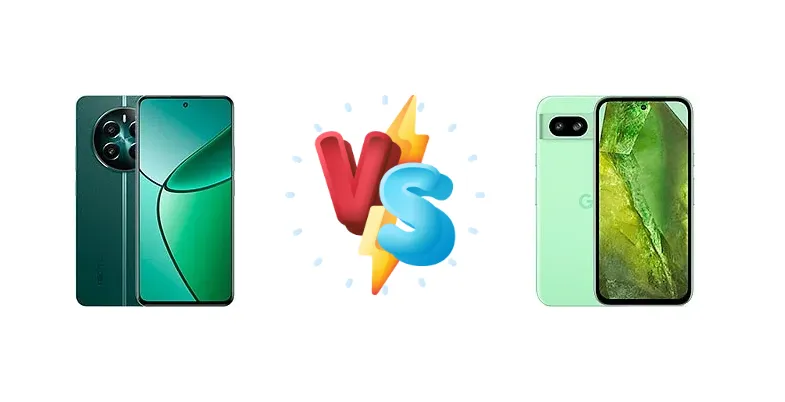
The Realme 12+ and Google Pixel 8a represent compelling options in the increasingly competitive mid-range smartphone market. The Realme 12+ focuses on delivering a strong all-around experience with fast charging and a bright display, while the Pixel 8a leverages Google’s Tensor G3 chip and renowned software experience. This comparison dissects their key differences to determine which device best suits your needs.
🏆 Quick Verdict
For the average user prioritizing long-term battery life and a consistently smooth software experience, the Google Pixel 8a is the superior choice. Its exceptional 40:06h endurance and Google’s Tensor G3 chip outweigh the Realme 12+'s faster charging and slightly brighter display.
| Network |
|---|
| 2G bands | GSM 850 / 900 / 1800 / 1900 | GSM 850 / 900 / 1800 / 1900 |
| 3G bands | HSDPA 850 / 900 / 2100 | HSDPA 800 / 850 / 900 / 1700(AWS) / 1900 / 2100 |
| 4G bands | 1, 3, 5, 8, 28, 40, 41 | 1, 2, 3, 4, 5, 7, 8, 12, 17, 18, 19, 20, 26, 28, 32, 38, 40, 41, 42, 66 - G6GPR (International) |
| 5G bands | 1, 3, 5, 8, 28, 40, 41, 77, 78 SA/NSA | 1, 2, 3, 5, 7, 8, 12, 20, 26, 28, 38, 40, 41, 66, 75, 76, 77, 78 SA/NSA/Sub6 - G6GPR (International) |
| Speed | HSPA, LTE, 5G | HSPA, LTE, 5G |
| Technology | GSM / HSPA / LTE / 5G | GSM / HSPA / LTE / 5G |
| Launch |
|---|
| Announced | 2024, February 29 | 2024, May 07 |
| Status | Available. Released 2024, March 02 | Available. Released 2024, May 14 |
| Body |
|---|
| Build | Glass front, silicone polymer back (eco leather), plastic frame | Glass front (Gorilla Glass 3), aluminum frame, plastic back |
| Dimensions | 163 x 75.5 x 7.9 mm (6.42 x 2.97 x 0.31 in) | 152.1 x 72.7 x 8.9 mm (5.99 x 2.86 x 0.35 in) |
| SIM | Nano-SIM + Nano-SIM | Nano-SIM + eSIM |
| Weight | 190 g (6.70 oz) | 188 g (6.63 oz) |
| Display |
|---|
| Protection | - | Corning Gorilla Glass 3, Mohs level 5 |
| Resolution | 1080 x 2400 pixels, 20:9 ratio (~395 ppi density) | 1080 x 2400 pixels, 20:9 ratio (~430 ppi density) |
| Size | 6.67 inches, 107.4 cm2 (~87.3% screen-to-body ratio) | 6.1 inches, 90.3 cm2 (~81.6% screen-to-body ratio) |
| Type | AMOLED, 120Hz, HDR10+, 600 nits (typ), 2000 nits (peak) | OLED, HDR, 120Hz, 2000 nits (peak) |
| Platform |
|---|
| CPU | Octa-core (2x2.6 GHz Cortex-A78 & 6x2.0 GHz Cortex-A55) | Nona-core (1x3.0 GHz Cortex-X3 & 4x2.45 GHz Cortex-A715 & 4x2.15 GHz Cortex-A510) |
| Chipset | Mediatek Dimensity 7050 (6 nm) | Google Tensor G3 (4 nm) |
| GPU | Mali-G68 MC4 | Immortalis-G715s MC10 |
| OS | Android 14, up to 2 major Android upgrades, Realme UI 5.0 | Android 14, upgradable to Android 16, up to 7 major Android upgrades |
| Memory |
|---|
| Card slot | microSDXC (uses shared SIM slot) | No |
| Internal | 128GB 8GB RAM, 256GB 6GB RAM, 256GB 8GB RAM, 256GB 12GB RAM, 512GB 12GB RAM | 128GB 8GB RAM, 256GB 8GB RAM |
| Main Camera |
|---|
| Dual | - | 64 MP (16 MP eff.), f/1.9, 26mm (wide), 1/1.73", 0.8µm, dual pixel PDAF, OIS
13 MP, f/2.2, 120˚ (ultrawide), 1.12µm |
| Features | LED flash, HDR, panorama | Dual-LED flash, Pixel Shift, Ultra HDR, panorama, Best Take |
| Triple | 50 MP, f/1.9, 26mm (wide), 1/1.95", PDAF, OIS
8 MP, f/2.2, 16mm, 112˚ (ultrawide), 1/4.0", 1.12µm
2 MP (macro) | - |
| Video | 4K@30fps, 1080p@30/60fps, gyro-EIS | 4K@30/60fps, 1080p@30/60/120/240fps, OIS |
| Selfie camera |
|---|
| Features | - | HDR, panorama |
| Single | 16 MP, f/2.5, 24mm (wide), 1/3.0" | 13 MP, f/2.2, 20mm (ultrawide), 1.12µm |
| Video | 1080p@30fps | 4K@30fps, 1080p@30/60fps |
| Sound |
|---|
| 35mm jack | Yes | No |
| Loudspeaker | Yes, with stereo speakers | Yes, with stereo speakers |
| Comms |
|---|
| Bluetooth | 5.2, A2DP, LE | 5.3, A2DP, LE |
| NFC | Yes, 360˚ (market/region dependent) | Yes |
| Positioning | GPS, GLONASS, GALILEO, BDS, QZSS | GPS, GLONASS, GALILEO, BDS, QZSS, NavIC |
| Radio | No | No |
| USB | USB Type-C 2.0 | USB Type-C 3.2 |
| WLAN | Wi-Fi 802.11 a/b/g/n/ac/6, dual-band | Wi-Fi 802.11 a/b/g/n/ac/6e, dual/tri-band (market/region dependent) |
| Features |
|---|
| Sensors | Fingerprint (under display, optical), accelerometer, gyro, proximity, compass | Fingerprint (under display, optical), accelerometer, gyro, proximity, compass, barometer |
| Battery |
|---|
| Charging | 67W wired, 50% in 19 min | 18W wired, PD3.0
7.5W wireless
Bypass charging |
| Type | 5000 mAh | Li-Po 4492 mAh |
| Misc |
|---|
| Colors | Pioneer Green, Navigator Beige | Obsidian, Porcelain, Bay, Aloe |
| Models | RMX3867 | GKV4X, G6GPR, G8HHN, G576D |
| Price | € 192.98 / $ 200.22 / £ 203.26 / ₹ 18,999 | $ 229.98 / C$ 417.99 / £ 279.00 / € 299.99 / ₹ 33,300 |
| EU LABEL |
|---|
| Battery | - | 40:06h endurance, 1000 cycles |
| Energy | - | Class B |
| Free fall | - | Class A (270 falls) |
| Repairability | - | Class B |
Realme 12+
- Significantly faster 67W wired charging
- Brighter display (1148 nits)
- Potentially more versatile zoom capabilities
- Inferior battery endurance (13:03h)
- Less efficient 6nm chipset
- Software updates may be less frequent
Google Pixel 8a
- Exceptional battery life (40:06h endurance)
- More efficient 4nm Tensor G3 chip
- Superior software experience and guaranteed updates
- Excellent computational photography
- Slower 18W wired charging
- Lower peak display brightness (1508 nits)
- Wireless charging is slower at 7.5W
Display Comparison
The Pixel 8a boasts a brighter display, reaching a measured 1508 nits compared to the Realme 12+'s 1148 nits. This translates to better visibility under direct sunlight. While both displays are adequate, the Pixel 8a’s higher peak brightness provides a noticeable advantage. Details regarding panel technology (OLED vs LCD, refresh rate) are missing for the Realme 12+, but the Pixel 8a’s OLED panel will likely offer superior contrast and color accuracy. Bezels appear comparable based on available imagery, but a direct comparison requires hands-on testing.
Camera Comparison
While both phones likely feature multi-camera systems, the Pixel 8a’s strength lies in Google’s computational photography. The Tensor G3 chip is specifically designed to accelerate image processing algorithms, resulting in excellent dynamic range and low-light performance. Sensor sizes and apertures are not specified for either device, but Google’s software optimization often compensates for hardware limitations. The Realme 12+ may offer more versatile zoom capabilities, but the Pixel 8a is expected to deliver more consistently high-quality images in a wider range of conditions. We'll ignore the likely presence of low-resolution macro lenses on both devices.
Performance
The core difference lies in the chipsets. The Google Pixel 8a’s Tensor G3, fabricated on a 4nm process, offers a more efficient architecture than the Realme 12+'s Mediatek Dimensity 7050 (6nm). The Tensor G3’s nona-core configuration (1x3.0 GHz Cortex-X3, 4x2.45 GHz Cortex-A715, 4x2.15 GHz Cortex-A510) is designed for AI and machine learning tasks, enhancing features like voice recognition and image processing. The Dimensity 7050’s octa-core setup (2x2.6 GHz Cortex-A78 & 6x2.0 GHz Cortex-A55) is a capable performer, but the Tensor G3’s architectural advantages suggest superior sustained performance and thermal management. RAM specifications are not provided, but the Pixel 8a’s optimized software should provide a smoother experience.
Battery Life
The Pixel 8a dominates in battery endurance, achieving a remarkable 40:06h rating with 1000 cycles, compared to the Realme 12+'s 13:03h active use score. This significant difference suggests the Pixel 8a’s 4nm Tensor G3 chip is far more power-efficient. While the Realme 12+ offers significantly faster 67W wired charging (50% in 19 minutes) versus the Pixel 8a’s 18W (PD3.0) and 7.5W wireless, the Pixel 8a’s vastly superior battery life minimizes the need for frequent charging. The Pixel 8a also offers bypass charging, allowing it to be used while charging, a feature absent on the Realme 12+.
Buying Guide
Buy the Realme 12+ if you need a phone that can rapidly replenish its battery – its 67W charging is significantly faster than the Pixel 8a’s 18W. This is ideal for users who frequently find themselves needing a quick power boost. Buy the Google Pixel 8a if you prioritize long-lasting battery life, a refined software experience with guaranteed updates, and Google’s computational photography prowess, even if it means slower charging speeds.
Frequently Asked Questions
❓ Does the Mediatek Dimensity 7050 in the Realme 12+ struggle with demanding games like Genshin Impact?
The Dimensity 7050 is a capable chipset, but it may require reduced graphics settings for consistently smooth gameplay in graphically intensive titles like Genshin Impact. The Pixel 8a’s Tensor G3, with its more efficient architecture, is likely to offer a more stable gaming experience, though it may not match flagship-level performance.
❓ How does the Pixel 8a’s software update policy compare to Realme’s?
Google guarantees at least 7 years of software updates for the Pixel 8a, including security patches and OS upgrades. Realme’s update policy is typically shorter, usually offering 2-3 years of major Android updates and 3-4 years of security patches. This makes the Pixel 8a a more future-proof investment.
❓ Is the 7.5W wireless charging on the Pixel 8a worth considering, or is it too slow?
7.5W wireless charging is considerably slower than the Realme 12+'s 67W wired charging. However, it offers convenience for users who prefer to top up their phone overnight or use wireless charging pads. It's a secondary charging method, not a replacement for wired charging.