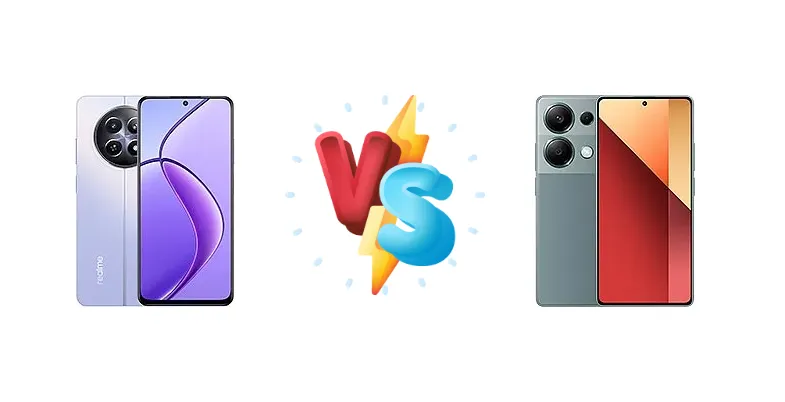
The Realme 12 and Xiaomi Redmi Note 13 Pro 4G represent compelling options in the increasingly competitive mid-range smartphone market. Both aim to deliver a premium experience without the flagship price tag, but they take different approaches. The Realme 12 prioritizes processing power with the Dimensity 6100+, while the Redmi Note 13 Pro 4G focuses on extended battery life and rapid charging. This comparison will dissect their key differences to determine which device best suits your needs.
🏆 Quick Verdict
For the average user prioritizing all-day battery life and incredibly fast charging, the Xiaomi Redmi Note 13 Pro 4G is the clear winner. Its 67W charging, achieving 50% in just 16 minutes, significantly outperforms the Realme 12’s 45W solution. While the Realme 12 offers a slightly more modern chipset, the Redmi Note 13 Pro 4G’s real-world endurance and charging convenience are more impactful for daily use.
| Network |
|---|
| 2G bands | GSM 850 / 900 / 1800 / 1900 | GSM 850 / 900 / 1800 / 1900 |
| 3G bands | HSDPA 850 / 900 / 2100 | HSDPA 850 / 900 / 1700(AWS) / 1900 / 2100 |
| 4G bands | 1, 3, 5, 8, 28, 40, 41 | 1, 2, 3, 4, 5, 7, 8, 12, 13, 17, 18, 19, 20, 26, 28, 38, 40, 41, 66 |
| 5G bands | 1, 3, 5, 8, 28, 40, 41, 77, 78 SA/NSA | - |
| Speed | HSPA, LTE, 5G | HSPA, LTE |
| Technology | GSM / HSPA / LTE / 5G | GSM / HSPA / LTE |
| Launch |
|---|
| Announced | 2024, March 06 | 2024, January 15 |
| Status | Available. Released 2024, March 06 | Available. Released 2024, January 15 |
| Body |
|---|
| Build | - | Glass front (Gorilla Glass 5), plastic frame, plastic back |
| Dimensions | 165.6 x 76.1 x 7.7 mm (6.52 x 3.00 x 0.30 in) | 161.1 x 75 x 8 mm (6.34 x 2.95 x 0.31 in) |
| SIM | Nano-SIM + Nano-SIM | Nano-SIM + Nano-SIM |
| Weight | 188 g (6.63 oz) | 188 g (6.63 oz) |
| Display |
|---|
| Protection | - | Corning Gorilla Glass 5 |
| Resolution | 1080 x 2400 pixels, 20:9 ratio (~392 ppi density) | 1080 x 2400 pixels, 20:9 ratio (~395 ppi density) |
| Size | 6.72 inches, 109.0 cm2 (~86.5% screen-to-body ratio) | 6.67 inches, 107.4 cm2 (~88.9% screen-to-body ratio) |
| Type | IPS LCD, 120Hz, 800 nits (typ), 950 nits (HBM) | AMOLED, 1B colors, 120Hz, 500 nits (typ), 1000 nits (HBM), 1300 nits (peak) |
| Platform |
|---|
| CPU | Octa-core (2x2.2 GHz Cortex-A76 & 6x2.0 GHz Cortex-A55) | Octa-core (2x2.2 GHz Cortex-A76 & 6x2.0 GHz Cortex-A55) |
| Chipset | Mediatek Dimensity 6100+ (6 nm) | Mediatek Helio G99 Ultra |
| GPU | Mali-G57 MC2 | Mali-G57 MC2 |
| OS | Android 14, Realme UI 5.0 | Android 13, up to 3 major Android upgrades, HyperOS |
| Memory |
|---|
| Card slot | microSDXC (uses shared SIM slot) | microSDXC (uses shared SIM slot) |
| Internal | 128GB 6GB RAM, 128GB 8GB RAM, 256GB 8GB RAM, 512GB 8GB RAM | 128GB 8GB RAM, 256GB 8GB RAM, 256GB 12GB RAM, 512GB 8GB RAM, 512GB 12GB RAM |
| Main Camera |
|---|
| Dual | 108 MP, f/1.8, 24mm (wide), 1/1.67", PDAF
Auxiliary lens | - |
| Features | LED flash, HDR, panorama | LED flash, HDR, panorama |
| Triple | - | 200 MP, f/1.7, 23mm (wide), 1/1.4", 0.56µm, multi-directional PDAF, OIS
8 MP, f/2.2, 15mm, 120˚ (ultrawide), 1/4.4", 1.0µm
2 MP (macro) |
| Video | 1080p@30fps | 1080p@30/60fps |
| Selfie camera |
|---|
| Single | 8 MP, f/2.0, 26mm (wide) | 16 MP, f/2.4, (wide), 1/3.0", 1.0µm |
| Video | 1080p@30fps | 1080p@30/60fps |
| Sound |
|---|
| 35mm jack | Yes | Yes |
| Loudspeaker | Yes, with stereo speakers | Yes, with dual speakers |
| Comms |
|---|
| Bluetooth | 5.2, A2DP, LE | 5.2, A2DP, LE |
| Infrared port | - | Yes |
| NFC | No | Yes (market/region dependent) |
| Positioning | GPS, GLONASS, GALILEO, BDS, QZSS | GPS, GLONASS, GALILEO, BDS |
| Radio | No | FM radio |
| USB | USB Type-C 2.0 | USB Type-C 2.0, OTG |
| WLAN | Wi-Fi 802.11 a/b/g/n/ac, dual-band | Wi-Fi 802.11 a/b/g/n/ac, dual-band |
| Features |
|---|
| Sensors | Fingerprint (side-mounted), accelerometer, gyro, proximity, compass | Fingerprint (under display, optical), accelerometer, gyro, compass |
| Battery |
|---|
| Charging | 45W wired, 50% in 30 min | 67W wired, 50% in 16 min, 100% in 46 min |
| Type | 5000 mAh | 5000 mAh |
| Misc |
|---|
| Colors | Twilight Purple, Woodland Green | Midnight Black, Lavender Purple, Forest Green |
| Models | RMX3999 | 23117RA68G, 2312FPCA6G |
| Price | ₹ 15,999 | € 92.00 / $ 269.99 / £ 299.99 |
| SAR | - | 1.09 W/kg (head) 1.09 W/kg (body) |
| SAR EU | - | 0.99 W/kg (head) 0.99 W/kg (body) |
Realme 12
- Potentially faster CPU/GPU performance with Dimensity 6100+
- 6nm process node for improved efficiency
- Sleek design (based on Realme’s typical aesthetic)
- Slower charging speed (45W vs 67W)
- Unknown battery capacity
- Display brightness likely lower than Redmi Note 13 Pro 4G
Xiaomi Redmi Note 13 Pro 4G
- Excellent battery life (11:36h active use)
- Ultra-fast 67W charging (50% in 16 min)
- Bright display (1047 nits peak brightness)
- Helio G99 Ultra chipset may offer slightly less raw performance
- Camera performance details are limited
- May not be ideal for intensive gaming
Display Comparison
The Xiaomi Redmi Note 13 Pro 4G boasts a significantly brighter display, reaching a measured peak of 1047 nits. This is crucial for outdoor visibility, especially in direct sunlight, a scenario where the Realme 12’s display specifications are currently unknown. While both likely utilize AMOLED panels given their market segment, the Redmi’s higher peak brightness provides a tangible advantage for content consumption. The absence of refresh rate data for both phones makes it difficult to assess smoothness, but the Redmi’s brightness is a clear win.
Camera Comparison
Detailed camera specifications are limited, but both phones likely feature multi-camera setups. The Redmi Note 13 Pro 4G’s camera is described as having Photo/Video capabilities, suggesting a focus on versatility. Without knowing sensor sizes or aperture values, it’s difficult to make a definitive judgment. However, the Redmi Note 13 Pro 4G’s marketing often emphasizes camera capabilities, hinting at a potentially more refined image processing pipeline. We’d caution against relying heavily on the image quality of any 2MP macro lenses commonly found in this price range.
Performance
Both the Realme 12 and Redmi Note 13 Pro 4G are equipped with octa-core CPUs featuring the same core configuration: 2x2.2 GHz Cortex-A76 and 6x2.0 GHz Cortex-A55. However, the Realme 12 utilizes the Mediatek Dimensity 6100+ built on a 6nm process, while the Redmi Note 13 Pro 4G employs the Mediatek Helio G99 Ultra. The Dimensity 6100+ generally offers a slight performance edge in CPU-intensive tasks and GPU performance due to its newer architecture and more efficient process node. However, the real-world difference will likely be subtle for everyday tasks. The Redmi Note 13 Pro 4G’s focus appears to be on efficiency rather than raw power.
Battery Life
The Xiaomi Redmi Note 13 Pro 4G shines in the battery department. It achieves an impressive 11:36h of active use, indicating excellent endurance. Coupled with its 67W wired charging – reaching 50% in just 16 minutes and 100% in 46 minutes – it offers a significantly faster charging experience than the Realme 12’s 45W charging, which takes 30 minutes to reach 50%. While the Realme 12’s battery capacity is unknown, the Redmi’s combination of longevity and charging speed is a major advantage.
Buying Guide
Buy the Realme 12 if you need a phone that can handle moderately demanding games and multitasking with a bit more headroom, and you don't mind sacrificing some battery life for that performance boost. Buy the Xiaomi Redmi Note 13 Pro 4G if you prioritize all-day battery life, incredibly fast charging, and a bright, vibrant display for media consumption – making it ideal for users who are constantly on the go and value convenience.
Frequently Asked Questions
❓ Does the Mediatek Helio G99 Ultra in the Redmi Note 13 Pro 4G struggle with demanding games like PUBG or Genshin Impact?
While the Helio G99 Ultra is a capable chipset, it's not designed for ultra-high frame rates in graphically intensive games. You'll likely be able to play PUBG at medium settings with stable frame rates, but Genshin Impact may require lower settings to maintain smooth gameplay. The Realme 12’s Dimensity 6100+ offers a slight advantage in gaming, but neither phone will deliver a flagship-level gaming experience.
❓ How much faster is the 67W charging on the Redmi Note 13 Pro 4G compared to the 45W charging on the Realme 12 in real-world use?
The difference is substantial. The Redmi Note 13 Pro 4G reaches 50% charge in just 16 minutes, while the Realme 12 takes 30 minutes. This means you can get a significant boost in battery life in a much shorter amount of time with the Redmi, making it ideal for users who frequently need to top up their phone quickly. The Redmi also fully charges in 46 minutes, compared to an unknown time for the Realme 12, but it will certainly be longer.
❓ Is the Redmi Note 13 Pro 4G’s battery life significantly impacted by using the 67W fast charging frequently?
No, modern charging technologies are designed to minimize battery degradation. The Redmi Note 13 Pro 4G incorporates intelligent charging algorithms that regulate the charging process to protect the battery's long-term health. While all batteries degrade over time, using the 67W charger frequently shouldn't significantly accelerate this process.