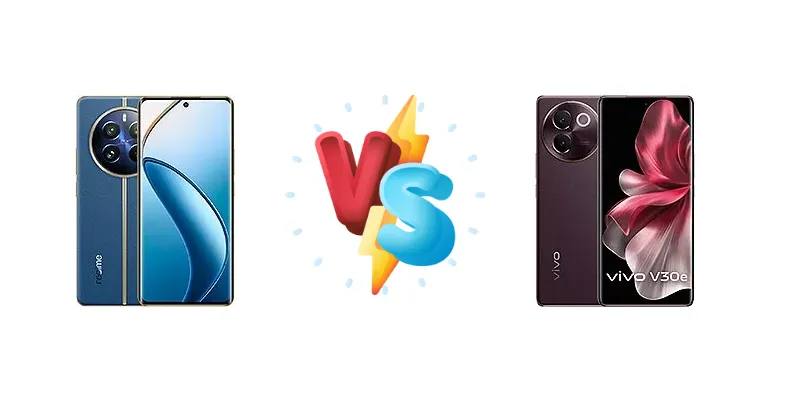
The Realme 12 Pro and vivo V30e represent a fascinating intersection in the mid-range smartphone market. Both devices leverage the Qualcomm Snapdragon 6 Gen 1, promising similar performance, but diverge significantly in charging capabilities and potentially, overall user experience. This comparison dissects these differences to determine which phone offers the most compelling package.
🏆 Quick Verdict
For the average user prioritizing rapid replenishment, the Realme 12 Pro emerges as the winner. Its 67W charging significantly reduces downtime compared to the vivo V30e’s 44W solution, despite both phones sharing the same core processing power. However, the V30e's reverse wired charging adds a unique convenience factor.
| Network |
|---|
| 2G bands | GSM 850 / 900 / 1800 / 1900 | GSM 850 / 900 / 1800 / 1900 |
| 3G bands | HSDPA 850 / 900 / 2100 | HSDPA 850 / 900 / 1700(AWS) / 1900 / 2100 - Malaysia |
| 4G bands | 1, 3, 5, 8, 28, 40, 41 | 1, 2, 3, 4, 5, 7, 8, 18, 19, 20, 26, 28, 38, 39, 40, 41 - Malaysia |
| 5G bands | 1, 3, 5, 8, 28, 40, 41, 77, 78 SA/NSA | 1, 3, 5, 7, 8, 20, 28, 38, 40, 41, 77, 78 SA/NSA - Malaysia |
| Speed | HSPA, LTE, 5G | HSPA, LTE, 5G |
| Technology | GSM / HSPA / LTE / 5G | GSM / HSPA / LTE / 5G |
| Launch |
|---|
| Announced | 2024, January 29 | 2024, May 02 |
| Status | Available. Released 2024, January 29 | Available. Released 2024, May 09 |
| Body |
|---|
| Build | - | Glass front, plastic frame, glass back or plastic back |
| Dimensions | 161.5 x 74 x 8.8 mm (6.36 x 2.91 x 0.35 in) | 164.4 x 74.8 x 7.7 mm (6.47 x 2.94 x 0.30 in) |
| SIM | Nano-SIM + Nano-SIM | Nano-SIM + Nano-SIM |
| Weight | 190 g (6.70 oz) | 179 g or 188 g (6.31 oz) |
| Display |
|---|
| Protection | - | Schott Xensation |
| Resolution | 1080 x 2412 pixels, 20:9 ratio (~394 ppi density) | 1080 x 2400 pixels, 20:9 ratio (~388 ppi density) |
| Size | 6.7 inches, 108.0 cm2 (~90.4% screen-to-body ratio) | 6.78 inches, 111.0 cm2 (~90.3% screen-to-body ratio) |
| Type | AMOLED, 1B colors, 120Hz, 800 nits (HBM), 950 nits (peak) | AMOLED, 1B colors, 120Hz, 1300 nits (peak) |
| Platform |
|---|
| CPU | Octa-core (4x2.2 GHz Cortex-A78 & 4x1.8 GHz Cortex-A55) | Octa-core (4x2.2 GHz Cortex-A78 & 4x1.8 GHz Cortex-A55) |
| Chipset | Qualcomm SM6450 Snapdragon 6 Gen 1 (4 nm) | Qualcomm SM6450 Snapdragon 6 Gen 1 (4 nm) |
| GPU | Adreno 710 | Adreno 710 |
| OS | Android 14, Realme UI 5.0 | Android 14, Funtouch 14 |
| Memory |
|---|
| Card slot | No | microSDXC (uses shared SIM slot) |
| Internal | 128GB 8GB RAM, 256GB 8GB RAM, 256GB 12GB RAM, 512GB 12GB RAM | 128GB 8GB RAM, 256GB 8GB RAM, 256GB 12GB RAM |
| Main Camera |
|---|
| Dual | - | 50 MP, f/1.8, 26mm (wide), 1/1.95", 0.8µm, PDAF, OIS (India only)
8 MP, f/2.2, 120˚ (ultrawide), 1/4.0", 1.12µm |
| Features | LED flash, HDR, panorama | Ring-LED flash, panorama, HDR |
| Triple | 50 MP, f/1.8, 26mm (wide), 1/2.0", PDAF, OIS
32 MP, f/2.0, 47mm (telephoto), 1/2.75", PDAF, OIS, 2x optical zoom
8 MP, f/2.2, 16mm, 112˚ (ultrawide), 1/4.0", 1.12µm | - |
| Video | 4K@30fps, 1080p@30/60/120fps, gyro-EIS | 4K@30fps, 1080p@30fps |
| Selfie camera |
|---|
| Single | 16 MP, f/2.4, 24mm (wide) | 50 MP, f/2.5, 25mm (wide), AF - India
32 MP, f/2.0, 24mm (wide) - Malaysia |
| Video | 1080p@30fps | 4K@30fps (India only), 1080p@30fps |
| Sound |
|---|
| 35mm jack | No | No |
| Loudspeaker | Yes, with stereo speakers | Yes |
| Comms |
|---|
| Bluetooth | 5.2, A2DP, LE | 5.1, A2DP, LE |
| NFC | Yes (market/region dependent) | Yes (market/region dependent) |
| Positioning | GPS, GLONASS, GALILEO, BDS, QZSS | GPS, GLONASS, GALILEO, BDS, QZSS, NavIC |
| Radio | No | No |
| USB | USB Type-C 2.0 | USB Type-C 2.0, OTG |
| WLAN | Wi-Fi 802.11 a/b/g/n/ac/6, dual-band | Wi-Fi 802.11 a/b/g/n/ac, dual-band |
| Features |
|---|
| Sensors | Fingerprint (under display, optical), accelerometer, gyro, proximity, compass | Fingerprint (under display, optical), accelerometer, gyro, proximity, compass |
| Battery |
|---|
| Charging | 67W wired, 50% in 19 min | 44W wired, PD
Reverse wired |
| Type | 5000 mAh | Li-Ion 5500 mAh |
| Misc |
|---|
| Colors | Submarine Blue, Navigator Beige | Velvet Red (Coco Brown), Silk Blue, Sky Mirror |
| Models | RMX3842 | V2339 |
| Price | € 219.59 / $ 746.80 / ₹ 24,490 | ₹ 23,999 |
Realme 12 Pro
- Significantly faster 67W charging
- Potentially more aggressive pricing
- Likely vibrant and punchy display (based on Realme's brand identity)
- Lacks reverse wired charging
- Thermal performance is unknown
vivo V30e
- Convenient reverse wired charging
- PD support for faster charging with compatible adapters
- Potentially more natural color calibration (based on vivo's brand identity)
- Slower 44W charging
- Thermal performance is unknown
Display Comparison
While specific display details (resolution, panel type, peak brightness) are absent, both phones likely target a 6.67-inch FHD+ AMOLED panel, typical for this price bracket. The key differentiator will be PWM dimming frequency and color calibration. Without further data, it's reasonable to assume similar visual experiences, but Realme's history suggests a focus on vibrant colors, while vivo often aims for more natural tones. The absence of LTPO technology means neither phone will offer adaptive refresh rates for significant power savings.
Camera Comparison
Camera specifications are currently unavailable beyond the chipsets. However, given the market positioning, we can anticipate a primary sensor in the 50-64MP range on both devices. The aperture and OIS (Optical Image Stabilization) presence will be crucial differentiators. A wider aperture (e.g., f/1.7 vs f/2.0) will improve low-light performance. OIS is essential for sharper photos and smoother videos. The inclusion of a usable ultrawide lens is also a key consideration. We anticipate both phones will include a 2MP macro lens, which typically offers limited practical value.
Performance
Both the Realme 12 Pro and vivo V30e are powered by the Qualcomm SM6450 Snapdragon 6 Gen 1 (4 nm) chipset, featuring an octa-core CPU configuration (4x2.2 GHz Cortex-A78 & 4x1.8 GHz Cortex-A55). This means CPU performance will be virtually identical. The real-world performance difference will hinge on RAM configuration (LPDDR4x vs LPDDR5x, if different) and thermal management. The 4nm process node ensures relatively efficient power consumption, but sustained workloads will still generate heat, potentially leading to throttling. Without specific thermal design details, it’s difficult to predict which phone will maintain peak performance for longer.
Battery Life
The most significant difference lies in charging speed. The Realme 12 Pro boasts 67W wired charging, claiming a 50% charge in 19 minutes. The vivo V30e offers 44W wired charging with PD (Power Delivery) and reverse wired charging. While the exact battery capacity is unknown, the 67W charging on the Realme 12 Pro will demonstrably reduce charging times. The V30e’s reverse wired charging is a unique feature, allowing it to function as a power bank for other devices, a convenience the Realme 12 Pro lacks.
Buying Guide
Buy the Realme 12 Pro if you need consistently fast charging and prioritize minimizing time tethered to a wall outlet. This phone is ideal for users who are always on the go and demand quick power boosts. Buy the vivo V30e if you value the added utility of reverse wired charging – the ability to top up accessories like earbuds or smartwatches – and are less concerned about the absolute fastest charging speeds for the phone itself.
Frequently Asked Questions
❓ Will the Snapdragon 6 Gen 1 in either phone struggle with demanding games like Genshin Impact?
The Snapdragon 6 Gen 1 is a capable mid-range chip, but demanding titles like Genshin Impact will likely require reduced graphics settings to maintain a stable frame rate. Expect playable performance at medium settings, but don't anticipate a flagship-level gaming experience on either device. Thermal throttling could also impact sustained performance.
❓ Is the 44W charging on the vivo V30e slow compared to other phones?
44W charging is respectable, but it's noticeably slower than the 67W charging on the Realme 12 Pro. While it's still faster than standard 18W or 25W charging, expect a full charge to take significantly longer – potentially over an hour – compared to the Realme 12 Pro’s estimated 40-50 minutes.
❓ How useful is the reverse wired charging feature on the vivo V30e?
Reverse wired charging is a niche but valuable feature for users who frequently use wireless earbuds, smartwatches, or other small accessories. It allows you to top up these devices on the go without needing a separate power bank, offering a convenient solution for travelers or those with multiple gadgets.