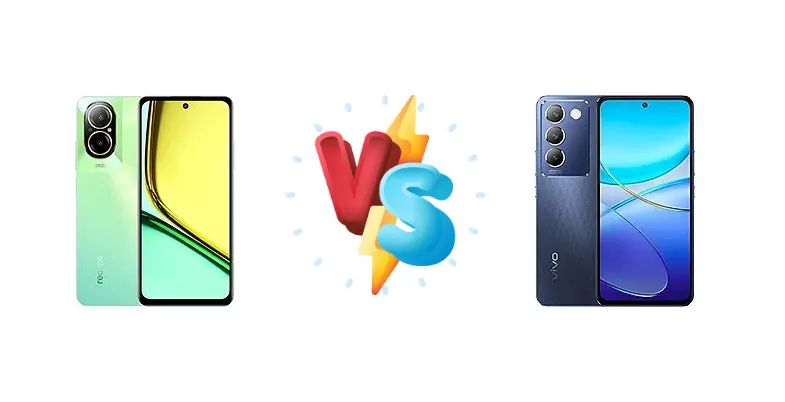
The sub-$300 smartphone market is fiercely competitive. The Realme 12 Lite and vivo V30 SE both aim to deliver a compelling experience without breaking the bank, but they take different approaches. The Realme 12 Lite relies on the established Snapdragon 685, while the vivo V30 SE opts for the newer, more efficient Snapdragon 4 Gen 2. This comparison will dissect their key differences to help you choose the right device.
🏆 Quick Verdict
For most users, the vivo V30 SE emerges as the better choice. Its Snapdragon 4 Gen 2, built on a 4nm process, offers a noticeable efficiency advantage over the Realme 12 Lite’s 6nm Snapdragon 685, translating to better sustained performance and faster 44W charging. While the Realme 12 Lite is still a capable device, the vivo V30 SE provides a more future-proof experience.
| Network |
|---|
| 2G bands | GSM 850 / 900 / 1800 / 1900 | GSM 850 / 900 / 1800 / 1900 |
| 3G bands | HSDPA 850 / 900 / 2100 | HSDPA 850 / 900 / 1700(AWS) / 1900 / 2100 |
| 4G bands | LTE | 1, 2, 3, 4, 5, 7, 8, 12, 13, 17, 18, 19, 20, 26, 28, 32, 38, 40, 41, 66 |
| 5G bands | - | 1, 2, 3, 5, 7, 8, 20, 26, 28, 38, 40, 41, 66, 75, 77, 78 SA/NSA |
| Speed | HSPA, LTE | HSPA, LTE, 5G |
| Technology | GSM / HSPA / LTE | GSM / HSPA / LTE / 5G |
| Launch |
|---|
| Announced | 2024, April 22 | 2024, May 01 |
| Status | Available. Released 2024, April 22 | Available. Released 2024, May 01 |
| Body |
|---|
| Build | - | Glass front, plastic or silicone polymer (eco leather) back |
| Dimensions | 164.6 x 75.4 x 7.6 mm (6.48 x 2.97 x 0.30 in) | 163.2 x 75.8 x 7.8 mm (6.43 x 2.98 x 0.31 in) |
| SIM | Nano-SIM + Nano-SIM | Nano-SIM + Nano-SIM |
| Weight | 185 g (6.53 oz) | 185.5 g or 191 g (6.56 oz) |
| Display |
|---|
| Resolution | 1080 x 2400 pixels, 20:9 ratio (~392 ppi density) | 1080 x 2400 pixels, 20:9 ratio (~395 ppi density) |
| Size | 6.72 inches, 109.0 cm2 (~87.8% screen-to-body ratio) | 6.67 inches, 107.4 cm2 (~86.8% screen-to-body ratio) |
| Type | IPS LCD, 90Hz, 800 nits (typ), 950 nits (HBM) | AMOLED, 120Hz, 1200 nits (HBM), 1800 nits (peak) |
| Platform |
|---|
| CPU | Octa-core (4x2.8 GHz Cortex-A73 & 4x1.9 GHz Cortex-A53) | Octa-core (2x2.2 GHz Cortex-A78 & 6x1.95 GHz Cortex-A55) |
| Chipset | Qualcomm SM6225 Snapdragon 685 (6 nm) | Qualcomm SM4450 Snapdragon 4 Gen 2 (4 nm) |
| GPU | Adreno 610 | Adreno 613 |
| OS | Android 14, Realme UI | Android 14, Funtouch 14 |
| Memory |
|---|
| Card slot | microSDXC (dedicated slot) | microSDXC (uses shared SIM slot) |
| Internal | 128GB 6GB RAM, 256GB 8GB RAM | 256GB 8GB RAM |
| Main Camera |
|---|
| Dual | 108 MP, f/1.8, (wide), PDAF
Auxiliary lens | - |
| Features | LED flash, HDR, panorama | LED flash, panorama, HDR |
| Triple | - | 50 MP, f/1.8, 26mm (wide), PDAF
8 MP, f/2.2, (ultrawide)
2 MP (macro) |
| Video | 1080p@30fps, gyro-EIS | 1080p@30fps |
| Selfie camera |
|---|
| Single | 8 MP, f/2.1, (wide) | 16 MP, f/2.0, (wide) |
| Video | 1080p@30fps | 1080p@30fps |
| Sound |
|---|
| 35mm jack | Yes | No |
| Loudspeaker | Yes, with stereo speakers | Yes, with stereo speakers |
| Comms |
|---|
| Bluetooth | 5.0, A2DP, LE | 5.0, A2DP, LE |
| NFC | Yes | No |
| Positioning | GPS, GALILEO, GLONASS, QZSS, BDS | GPS, GLONASS, GALILEO, BDS, QZSS |
| Radio | Unspecified | No |
| USB | USB Type-C 2.0 | USB Type-C 2.0, OTG |
| WLAN | Wi-Fi 802.11 a/b/g/n/ac, dual-band | Wi-Fi 802.11 a/b/g/n/ac, dual-band |
| Features |
|---|
| Sensors | Fingerprint (side-mounted), accelerometer, gyro, proximity, compass | Fingerprint (under display, optical), accelerometer, gyro, proximity, compass |
| Battery |
|---|
| Charging | 33W wired | 44W wired, 50% in 25 min |
| Type | 5000 mAh | Li-Ion 5000 mAh |
| Misc |
|---|
| Colors | Sunny Oasis, Black Rock | Crystal Black, Leather Purple |
| Price | About 300 EUR | About 250 EUR |
Realme 12 Lite
- Slightly higher clocked CPU cores for potentially snappier initial response.
- Established Snapdragon 685 chipset with known performance characteristics.
- Potentially lower price point depending on retailer.
- Less efficient 6nm manufacturing process.
- Slower 33W charging.
- Older chipset architecture.
vivo V30 SE
- More efficient 4nm Snapdragon 4 Gen 2 chipset.
- Faster 44W charging with 50% in 25 minutes.
- Modern CPU architecture with Cortex-A78 cores.
- Likely better long-term software support.
- Potentially slightly lower peak CPU clock speed.
- May be marginally more expensive.
Display Comparison
Neither device boasts a standout display. Both likely utilize LCD panels, a common cost-saving measure in this segment. The focus here isn't on peak brightness or color accuracy, but rather on usability. Without specific display specs, we can assume both offer adequate viewing angles and clarity for everyday use. The absence of high refresh rates is expected at this price point.
Camera Comparison
Without detailed camera specs, it’s difficult to make a definitive judgment. However, the focus in this segment is typically on the main sensor. We can assume both phones feature a primary camera capable of decent daylight photography. The image processing algorithms will likely be the differentiating factor, with vivo historically leaning towards more vibrant, social media-friendly images. The presence of a 2MP macro camera on either device is largely a marketing gimmick and shouldn't heavily influence your decision.
Performance
The core difference lies in the chipsets. The vivo V30 SE’s Snapdragon 4 Gen 2 (4nm) is a significant upgrade over the Realme 12 Lite’s Snapdragon 685 (6nm). The 4nm process inherently provides better power efficiency, meaning the vivo V30 SE will run cooler and potentially sustain peak performance for longer periods. While the Realme 12 Lite’s CPU has higher clocked Cortex-A73 cores (2.8 GHz vs 2.2 GHz on the V30 SE), the Snapdragon 4 Gen 2’s newer Cortex-A78 cores offer superior IPC (Instructions Per Clock), resulting in better overall performance. The V30 SE’s CPU configuration (2x2.2 GHz Cortex-A78 & 6x1.95 GHz Cortex-A55) is more balanced for multitasking than the 12 Lite’s (4x2.8 GHz Cortex-A73 & 4x1.9 GHz Cortex-A53).
Battery Life
The vivo V30 SE’s 44W charging is a clear advantage over the Realme 12 Lite’s 33W. vivo claims a 50% charge in 25 minutes, which is a substantial time saving. While battery capacity isn’t specified, the Snapdragon 4 Gen 2’s efficiency will likely translate to longer battery life on the V30 SE, even with a similar capacity to the Realme 12 Lite. The faster charging also mitigates any potential capacity differences.
Buying Guide
Buy the Realme 12 Lite if you prioritize a proven chipset with a slightly higher clocked CPU core for immediate responsiveness in everyday tasks and are comfortable with slower charging speeds. Buy the vivo V30 SE if you value long-term efficiency, faster charging (44W vs 33W), and a more modern chipset architecture that will likely receive software updates for a longer period.
Frequently Asked Questions
❓ Will the Snapdragon 4 Gen 2 in the vivo V30 SE handle demanding games like PUBG Mobile?
The Snapdragon 4 Gen 2 is capable of running PUBG Mobile, but you'll likely need to lower the graphics settings to medium or low for a smooth experience. It's not a gaming powerhouse, but it's a significant step up from the Snapdragon 685 in terms of sustained performance, reducing the likelihood of frame drops during extended gaming sessions.
❓ How much faster is the 44W charging on the vivo V30 SE compared to the 33W charging on the Realme 12 Lite in real-world use?
The 44W charging on the vivo V30 SE will noticeably reduce charging times. While a full 0-100% time isn't specified, the claimed 50% charge in 25 minutes is approximately 20-30% faster than what you'd expect from the Realme 12 Lite's 33W charging. This is particularly beneficial for users who frequently need to top up their battery quickly.
❓ Does the Snapdragon 685 in the Realme 12 Lite get hot during prolonged use, like video recording or gaming?
The Snapdragon 685 is known to run warmer than more modern chipsets. During prolonged use, such as video recording or gaming, the Realme 12 Lite is likely to experience some thermal throttling, which can lead to reduced performance. The vivo V30 SE’s 4nm Snapdragon 4 Gen 2 will generally run cooler and maintain performance for longer.