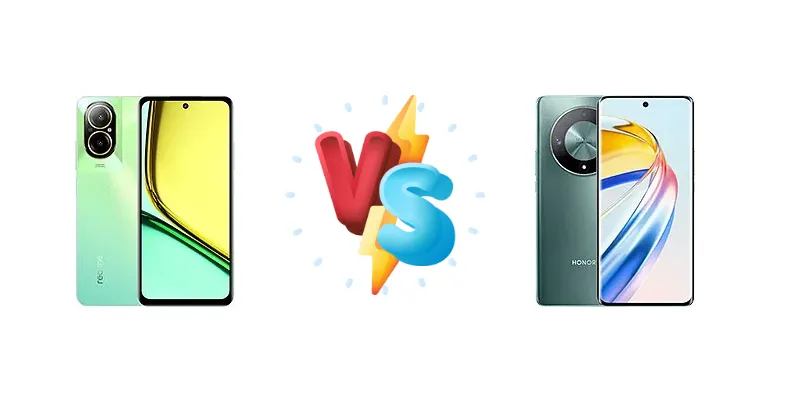
The Realme 12 Lite and Honor X9b represent a fascinating clash in the competitive mid-range smartphone market. Both devices target budget-conscious consumers, but they take different approaches to achieving a compelling user experience. The Realme 12 Lite relies on the established Snapdragon 685, while the Honor X9b debuts with the newer Snapdragon 6 Gen 1. This comparison will dissect the key differences, focusing on performance, efficiency, and overall value.
🏆 Quick Verdict
For the average user prioritizing sustained performance and future-proofing, the Honor X9b emerges as the stronger contender. Its Snapdragon 6 Gen 1, built on a 4nm process, delivers a noticeable performance uplift and improved efficiency compared to the Realme 12 Lite’s Snapdragon 685. While the Realme 12 Lite offers a competitive price, the X9b’s chipset advantage justifies the potential price premium.
| Network |
|---|
| 2G bands | GSM 850 / 900 / 1800 / 1900 | GSM 850 / 900 / 1800 / 1900 |
| 3G bands | HSDPA 850 / 900 / 2100 | HSDPA 850 / 900 / 1900 / 2100 |
| 4G bands | LTE | 1, 2, 3, 4, 5, 7, 8, 20, 28, 32, 38, 40, 41 |
| 5G bands | - | 1, 3, 7, 8, 20, 28, 38, 40, 41, 77, 78 SA/NSA |
| Speed | HSPA, LTE | HSPA, LTE, 5G |
| Technology | GSM / HSPA / LTE | GSM / HSPA / LTE / 5G |
| Launch |
|---|
| Announced | 2024, April 22 | 2023, October 18 |
| Status | Available. Released 2024, April 22 | Available. Released 2023, October |
| Body |
|---|
| Dimensions | 164.6 x 75.4 x 7.6 mm (6.48 x 2.97 x 0.30 in) | 163.6 x 75.5 x 8 mm (6.44 x 2.97 x 0.31 in) |
| SIM | Nano-SIM + Nano-SIM | Nano-SIM + Nano-SIM |
| Weight | 185 g (6.53 oz) | 185 g (6.53 oz) |
| Display |
|---|
| Resolution | 1080 x 2400 pixels, 20:9 ratio (~392 ppi density) | 1220 x 2652 pixels, 19.5:9 ratio (~431 ppi density) |
| Size | 6.72 inches, 109.0 cm2 (~87.8% screen-to-body ratio) | 6.78 inches, 112.6 cm2 (~91.2% screen-to-body ratio) |
| Type | IPS LCD, 90Hz, 800 nits (typ), 950 nits (HBM) | AMOLED, 1B colors, 120Hz, 1200 nits (peak) |
| Platform |
|---|
| CPU | Octa-core (4x2.8 GHz Cortex-A73 & 4x1.9 GHz Cortex-A53) | Octa-core (4x2.2 GHz Cortex-A78 & 4x1.8 GHz Cortex-A55) |
| Chipset | Qualcomm SM6225 Snapdragon 685 (6 nm) | Qualcomm SM6450 Snapdragon 6 Gen 1 (4 nm) |
| GPU | Adreno 610 | Adreno 710 |
| OS | Android 14, Realme UI | Android 13, Magic OS 7.2 |
| Memory |
|---|
| Card slot | microSDXC (dedicated slot) | No |
| Internal | 128GB 6GB RAM, 256GB 8GB RAM | 256GB 8GB RAM, 256GB 12GB RAM, 512GB 8GB RAM, 512GB 12GB RAM |
| Main Camera |
|---|
| Dual | 108 MP, f/1.8, (wide), PDAF
Auxiliary lens | - |
| Features | LED flash, HDR, panorama | LED flash, panorama, HDR |
| Triple | - | 108 MP, f/1.8, (wide), 1/1.67", PDAF
5 MP, f/2.2, (ultrawide)
2 MP (macro) |
| Video | 1080p@30fps, gyro-EIS | 4K@30fps, 1080p@30fps |
| Selfie camera |
|---|
| Single | 8 MP, f/2.1, (wide) | 16 MP, f/2.5, (wide) |
| Video | 1080p@30fps | 1080p@30fps |
| Sound |
|---|
| 35mm jack | Yes | No |
| Loudspeaker | Yes, with stereo speakers | Yes |
| Comms |
|---|
| Bluetooth | 5.0, A2DP, LE | 5.1, A2DP, LE |
| Infrared port | - | Yes |
| NFC | Yes | Yes (market/region dependent) |
| Positioning | GPS, GALILEO, GLONASS, QZSS, BDS | GPS, GLONASS, GALILEO, BDS |
| Radio | Unspecified | No |
| USB | USB Type-C 2.0 | USB Type-C 2.0, OTG |
| WLAN | Wi-Fi 802.11 a/b/g/n/ac, dual-band | Wi-Fi 802.11 a/b/g/n/ac, dual-band, Wi-Fi Direct |
| Features |
|---|
| Sensors | Fingerprint (side-mounted), accelerometer, gyro, proximity, compass | Fingerprint (under display, optical), accelerometer, gyro, proximity, compass |
| Battery |
|---|
| Charging | 33W wired | 35W wired
Reverse wired |
| Type | 5000 mAh | Li-Po 5800 mAh |
| Misc |
|---|
| Colors | Sunny Oasis, Black Rock | Sunrise Orange, Midnight Black, Emerald Green |
| Models | - | ALI-NX1 |
| Price | About 300 EUR | About 970 EUR |
Realme 12 Lite
- Potentially lower price point
- Reliable Snapdragon 685 performance for basic tasks
- Established platform with wide software support
- Less efficient 6nm chipset
- Older CPU architecture
- Slower charging speed
Honor X9b
- More efficient 4nm Snapdragon 6 Gen 1 chipset
- Faster 35W charging with reverse wired charging
- Improved CPU architecture for smoother performance
- Potentially higher price
- Newer chipset may have initial software quirks
- Long-term software support remains to be seen
Display Comparison
Neither device’s display specifications are provided, so a direct comparison is limited. However, given the price bracket, both likely utilize LCD panels. The Honor X9b, being a newer release, *may* benefit from slightly improved color calibration and viewing angles. The absence of high refresh rate information suggests both are likely capped at 60Hz. Bezels are expected to be comparable, focusing on maximizing screen real estate within the budget constraints.
Camera Comparison
Without detailed camera specifications, a comprehensive comparison is impossible. However, it’s reasonable to assume both phones will feature a multi-camera setup with a primary sensor, ultrawide, and potentially a macro lens. The image processing capabilities of the Snapdragon 6 Gen 1 in the Honor X9b *could* offer slightly better dynamic range and noise reduction, particularly in low-light conditions. The absence of OIS information suggests neither phone will have optical image stabilization, relying on software stabilization instead.
Performance
The core difference lies in the chipsets. The Honor X9b’s Snapdragon 6 Gen 1 (4nm) represents a significant architectural leap over the Realme 12 Lite’s Snapdragon 685 (6nm). The 4nm process inherently offers better power efficiency, translating to less heat generation and potentially reduced throttling during prolonged use. The X9b’s CPU configuration – 4x2.2 GHz Cortex-A78 & 4x1.8 GHz Cortex-A55 – utilizes newer, more efficient cores compared to the 12 Lite’s 4x2.8 GHz Cortex-A73 & 4x1.9 GHz Cortex-A53. While the 12 Lite’s cores have a higher clock speed, the architectural improvements in the X9b’s cores provide a more substantial performance benefit in real-world scenarios. The X9b will handle multitasking and demanding apps with greater ease.
Battery Life
The Honor X9b’s 35W wired charging is a slight advantage over the Realme 12 Lite’s 33W charging. While the difference isn’t massive, it translates to a faster 0-100% charge time. The X9b also features reverse wired charging, a convenient feature for topping up accessories. The actual battery capacity of both devices is unknown, but the more efficient Snapdragon 6 Gen 1 in the X9b will likely result in comparable or slightly better real-world battery life, despite potentially having a similar or smaller battery capacity.
Buying Guide
Buy the Realme 12 Lite if you need a reliably functional smartphone for basic tasks like calling, texting, social media, and light web browsing, and are prioritizing the absolute lowest price point. Buy the Honor X9b if you prefer a smoother, more responsive experience for multitasking, moderate gaming, and content creation, and value the benefits of a more modern and efficient chipset.
Frequently Asked Questions
❓ Will the Snapdragon 6 Gen 1 in the Honor X9b handle demanding games like PUBG Mobile smoothly?
The Snapdragon 6 Gen 1 is a capable chipset for moderate gaming. PUBG Mobile should be playable at medium settings with stable frame rates. However, don't expect the same performance as flagship-level chipsets; you may need to lower graphics settings for optimal smoothness.
❓ Does the Realme 12 Lite suffer from significant throttling during extended gaming sessions?
The Snapdragon 685, built on a 6nm process, is prone to some throttling under sustained load. While it won't shut down completely, you may experience a noticeable drop in performance after 30-45 minutes of intensive gaming. The Honor X9b’s 4nm chipset will manage heat more effectively.
❓ Is the reverse wired charging feature on the Honor X9b useful in everyday scenarios?
Yes, reverse wired charging is a convenient feature for topping up accessories like wireless earbuds or smartwatches when you're away from a power outlet. It's not a fast charging solution, but it can be a lifesaver in a pinch.