
Realme 11 vs Xiaomi Redmi Note 12 Pro 4G: A Deep Dive into Mid-Range Performance
| Phones Images | |||||
|---|---|---|---|---|---|
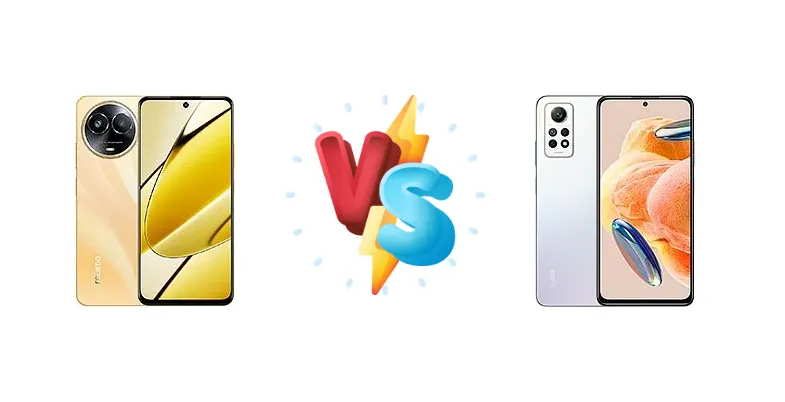
|
🏆 Quick Verdict
For the average user prioritizing raw processing power and potentially longer software support, the Realme 11 emerges as the winner. Its Dimensity 6100+ chipset, built on a more efficient 6nm process, offers a noticeable performance edge over the Snapdragon 732G. While both phones share 67W charging, the Realme 11’s newer architecture provides a slight advantage in overall efficiency.
| PHONES | ||
|---|---|---|
| Phone Names | Realme 11 | Xiaomi Redmi Note 12 Pro 4G |
| Network | ||
|---|---|---|
| 2G bands | GSM 850 / 900 / 1800 / 1900 | GSM 850 / 900 / 1800 / 1900 |
| 3G bands | HSDPA 800 / 850 / 900 / 1700(AWS) / 1900 / 2100 - International | HSDPA 850 / 900 / 1700(AWS) / 1900 / 2100 |
| 4G bands | 1, 2, 3, 4, 5, 7, 8, 12, 13, 17, 18, 19, 20, 26, 28, 38, 39, 40, 41, 66 - International | 1, 2, 3, 4, 5, 7, 8, 20, 28, 38, 40, 41, 66 |
| 5G bands | 1, 3, 5, 7, 8, 20, 28, 38, 40, 41, 66, 77, 78 SA/NSA - International | - |
| Speed | HSPA, LTE, 5G | HSPA, LTE |
| Technology | GSM / HSPA / LTE / 5G | GSM / HSPA / LTE |
| CDMA2000 1x | - | |
| Launch | ||
|---|---|---|
| Announced | 2023, July 31 | 2023, March 03 |
| Status | Available. Released 2023, July 31 | Available. Released 2023, April 11 |
| Body | ||
|---|---|---|
| Build | Glass front, aluminum frame, plastic back | - |
| Dimensions | 165.7 x 76 x 8.1 mm (6.52 x 2.99 x 0.32 in) | 164.2 x 76.1 x 8.1 mm (6.46 x 3.00 x 0.32 in) |
| SIM | Nano-SIM + Nano-SIM | Nano-SIM + Nano-SIM |
| Weight | 190 g (6.70 oz) | 201.8 g (7.13 oz) |
| Display | ||
|---|---|---|
| Resolution | 1080 x 2400 pixels, 20:9 ratio (~392 ppi density) | 1080 x 2400 pixels, 20:9 ratio (~395 ppi density) |
| Size | 6.72 inches, 109.0 cm2 (~86.6% screen-to-body ratio) | 6.67 inches, 107.4 cm2 (~86.0% screen-to-body ratio) |
| Type | IPS LCD, 120Hz, 550 nits (typ), 680 nits (HBM) | AMOLED, 120Hz, Dolby Vision, 700 nits (HBM), 1100 nits (peak) |
| Platform | ||
|---|---|---|
| CPU | Octa-core (2x2.2 GHz Cortex-A76 & 6x2.0 GHz Cortex-A55) | Octa-core (2x2.2 GHz Kryo 470 Gold & 6x1.8 GHz Kryo 470 Silver) |
| Chipset | Mediatek Dimensity 6100+ (6 nm) | Qualcomm SM7150 Snapdragon 732G (8 nm) |
| GPU | Mali-G57 MC2 | Adreno 618 |
| OS | Android 13, Realme UI 4.0 | Android 11, MIUI 13 |
| Memory | ||
|---|---|---|
| Card slot | microSDXC (dedicated slot) | microSDXC (uses shared SIM slot) |
| Internal | 128GB 8GB RAM, 256GB 8GB RAM | 128GB 6GB RAM, 128GB 8GB RAM, 256GB 8GB RAM |
| UFS 2.2 | UFS 2.2 | |
| Main Camera | ||
|---|---|---|
| Dual | 108 MP, f/1.8, 24mm (wide), 1/1.67", 0.64µm, PDAF Auxiliary lens | - |
| Features | LED flash, HDR, panorama | LED flash, HDR, panorama |
| Quad | - | 108 MP, f/1.9, (wide), 1/1.52", 0.7µm, PDAF 8 MP, 120˚, (ultrawide) 2 MP (macro) Auxiliary lens |
| Video | 1080p@30fps | 4K@30fps, 1080p@30/60fps |
| Selfie camera | ||
|---|---|---|
| Features | Panorama, HDR | - |
| Single | 16 MP, f/2.5, 23mm (wide) | 16 MP, f/2.4, (wide) |
| Video | 1080p@30fps | 1080p@30fps |
| Sound | ||
|---|---|---|
| 3.5mm jack | Yes | Yes |
| 35mm jack | Yes | Yes |
| Loudspeaker | Yes | Yes, with stereo speakers |
| 24-bit/192kHz audio | - | |
| Comms | ||
|---|---|---|
| Bluetooth | 5.2, A2DP, LE | 5.0, A2DP, LE |
| Infrared port | - | Yes |
| NFC | Yes (market/region dependent) | Yes (market/region dependent) |
| Positioning | GPS, GALILEO, GLONASS, BDS | GPS, GLONASS, GALILEO, BDS |
| Radio | No | Unspecified |
| USB | USB Type-C 2.0 | USB Type-C 2.0, OTG |
| WLAN | Wi-Fi 802.11 a/b/g/n/ac, dual-band, Wi-Fi Direct | Wi-Fi 802.11 a/b/g/n/ac, dual-band |
| Features | ||
|---|---|---|
| Sensors | Fingerprint (side-mounted), accelerometer, gyro, proximity, compass | Fingerprint (side-mounted), accelerometer, gyro, compass |
| Battery | ||
|---|---|---|
| Charging | 67W wired, 0-50% in 17 min | 67W wired |
| Type | 5000 mAh | Li-Po 5000 mAh |
| Misc | ||
|---|---|---|
| Colors | Midnight Black (Glory Black), Sunrise Gold (Glory Gold) | Star Blue, Graphite Gray, Polar White, Ice blue |
| Models | RMX3780 | 2209116AG, 2209116AG |
| Price | About 230 EUR | About 150 EUR |
Realme 11
- More powerful and efficient Dimensity 6100+ chipset
- Potentially better camera image processing
- Faster charging speeds (0-50% in 17 mins)
- Long-term software support is uncertain
- May be slightly more expensive
Xiaomi Redmi Note 12 Pro 4G
- Proven and stable Snapdragon 732G platform
- Potentially lower price point
- Reliable 67W charging
- Older chipset architecture
- Less efficient power consumption
Display Comparison
While both phones likely feature similar 6.67-inch FHD+ displays (based on market segment), the underlying technology isn't specified. However, the chipset's ISP capabilities on the Realme 11 *could* translate to slightly better image processing for display output. The lack of information on refresh rates and PWM dimming frequencies prevents a definitive display winner, but the Realme 11’s newer chipset suggests potential for more advanced display features in future iterations.
Camera Comparison
Without detailed camera specifications, a direct comparison is difficult. However, the image signal processor (ISP) within the Dimensity 6100+ likely offers more advanced features and processing capabilities than the Snapdragon 732G’s ISP. This could result in improved dynamic range, noise reduction, and overall image quality on the Realme 11. The absence of information regarding sensor size and optical image stabilization (OIS) makes a definitive judgment impossible, but the Realme 11’s newer chipset provides a foundation for a potentially superior camera experience.
Performance
The core difference lies in the chipsets. The Realme 11’s Mediatek Dimensity 6100+ (6nm) boasts a more modern architecture than the Xiaomi Redmi Note 12 Pro 4G’s Qualcomm Snapdragon 732G (8nm). The Dimensity 6100+ utilizes two Cortex-A76 cores clocked at 2.2 GHz alongside six Cortex-A55 cores at 2.0 GHz, while the Snapdragon 732G employs two Kryo 470 Gold cores at 2.2 GHz and six Kryo 470 Silver cores at 1.8 GHz. The 6nm process of the Dimensity 6100+ is more efficient, leading to better thermal management and sustained performance. This translates to smoother multitasking and a more responsive experience, particularly for users who frequently switch between apps or engage in light to moderate gaming. The Snapdragon 732G remains a capable performer, but the Dimensity 6100+ offers a clear generational advantage.
Battery Life
Both devices feature 67W wired charging, promising a rapid recharge. Realme claims 0-50% charge in 17 minutes, and the Redmi Note 12 Pro 4G likely achieves similar speeds. The Dimensity 6100+'s 6nm process contributes to better power efficiency, potentially translating to slightly longer battery life on the Realme 11, even with similar battery capacities (which are not specified). The faster charging speeds on both phones mitigate concerns about battery size, allowing for quick top-ups throughout the day.
Buying Guide
Buy the Realme 11 if you need a phone that can handle demanding apps and moderate gaming with ease, and if you value a more modern chipset with potential for future software optimizations. Buy the Xiaomi Redmi Note 12 Pro 4G if you prioritize a proven, stable platform and are less concerned with pushing the absolute limits of performance, or if you find it at a significantly lower price point.