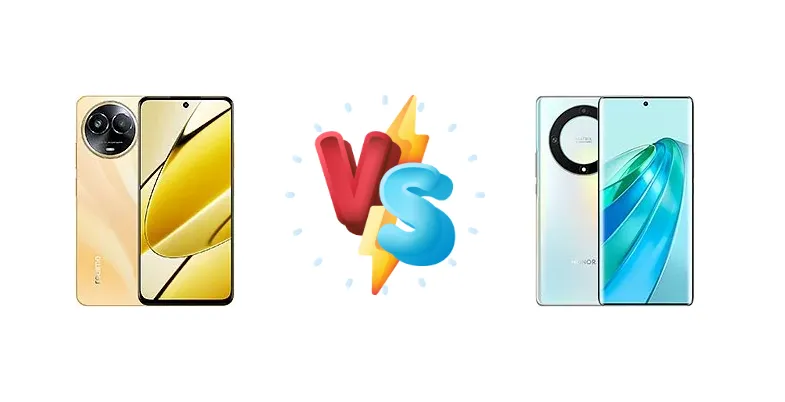
The Realme 11 and Honor X9a represent compelling options in the increasingly competitive mid-range smartphone market. Both aim to deliver 5G connectivity and a smooth user experience without breaking the bank, but they take different approaches to achieving this. The Realme 11 prioritizes charging speed and a newer chipset, while the Honor X9a focuses on a balanced feature set with Qualcomm's established Snapdragon platform.
🏆 Quick Verdict
For the average user prioritizing quick top-ups and potentially slightly better sustained performance, the Realme 11 is the stronger choice. Its 67W charging significantly outperforms the Honor X9a’s 40W, and the Dimensity 6100+ offers a slight edge in raw processing power. However, the Honor X9a remains a viable option for those valuing Qualcomm’s software optimization.
| Network |
|---|
| 2G bands | GSM 850 / 900 / 1800 / 1900 | GSM 850 / 900 / 1800 / 1900 |
| 3G bands | HSDPA 800 / 850 / 900 / 1700(AWS) / 1900 / 2100 - International | HSDPA 850 / 900 / 1900 / 2100 |
| 4G bands | 1, 2, 3, 4, 5, 7, 8, 12, 13, 17, 18, 19, 20, 26, 28, 38, 39, 40, 41, 66 - International | LTE |
| 5G bands | 1, 3, 5, 7, 8, 20, 28, 38, 40, 41, 66, 77, 78 SA/NSA - International | SA/NSA |
| Speed | HSPA, LTE, 5G | HSPA, LTE, 5G |
| Technology | GSM / HSPA / LTE / 5G | GSM / HSPA / LTE / 5G |
| | CDMA2000 1x | - |
| Launch |
|---|
| Announced | 2023, July 31 | 2023, January 04 |
| Status | Available. Released 2023, July 31 | Available. Released 2023, January 06 |
| Body |
|---|
| Build | Glass front, aluminum frame, plastic back | - |
| Dimensions | 165.7 x 76 x 8.1 mm (6.52 x 2.99 x 0.32 in) | 161.6 x 73.9 x 7.9 mm (6.36 x 2.91 x 0.31 in) |
| SIM | Nano-SIM + Nano-SIM | Nano-SIM + Nano-SIM |
| Weight | 190 g (6.70 oz) | 175 g (6.17 oz) |
| Display |
|---|
| Resolution | 1080 x 2400 pixels, 20:9 ratio (~392 ppi density) | 1080 x 2400 pixels, 20:9 ratio (~395 ppi density) |
| Size | 6.72 inches, 109.0 cm2 (~86.6% screen-to-body ratio) | 6.67 inches, 107.4 cm2 (~89.9% screen-to-body ratio) |
| Type | IPS LCD, 120Hz, 550 nits (typ), 680 nits (HBM) | AMOLED, 1B colors, 120Hz, 800 nits (HBM) |
| Platform |
|---|
| CPU | Octa-core (2x2.2 GHz Cortex-A76 & 6x2.0 GHz Cortex-A55) | Octa-core (2x2.2 GHz Kryo 660 Gold & 6x1.7 GHz Kryo 660 Silver) |
| Chipset | Mediatek Dimensity 6100+ (6 nm) | Qualcomm SM6375 Snapdragon 695 5G (6 nm) |
| GPU | Mali-G57 MC2 | Adreno 619 |
| OS | Android 13, Realme UI 4.0 | Android 12, upgradable to Android 13, MagicOS 7 |
| Memory |
|---|
| Card slot | microSDXC (dedicated slot) | No |
| Internal | 128GB 8GB RAM, 256GB 8GB RAM | 128GB 6GB RAM, 128GB 8GB RAM, 256GB 8GB RAM |
| | UFS 2.2 | - |
| Main Camera |
|---|
| Dual | 108 MP, f/1.8, 24mm (wide), 1/1.67", 0.64µm, PDAF
Auxiliary lens | 64 MP, f/1.8, (wide), PDAF
5 MP, f/2.2, (ultrawide)
2 MP (macro) |
| Features | LED flash, HDR, panorama | LED flash, panorama, HDR |
| Single | - | 16 MP, f/2.5, (wide) |
| Video | 1080p@30fps | 1080p@30fps |
| Selfie camera |
|---|
| Features | Panorama, HDR | - |
| Single | 16 MP, f/2.5, 23mm (wide) | 16 MP, f/2.5, (wide) |
| Video | 1080p@30fps | 1080p@30fps |
| Sound |
|---|
| 3.5mm jack | Yes | No |
| 35mm jack | Yes | No |
| Loudspeaker | Yes | Yes |
| | 24-bit/192kHz audio | - |
| Comms |
|---|
| Bluetooth | 5.2, A2DP, LE | 5.1, A2DP, LE, aptX HD |
| Infrared port | - | Yes |
| NFC | Yes (market/region dependent) | Yes |
| Positioning | GPS, GALILEO, GLONASS, BDS | GPS, GLONASS, GALILEO, BDS |
| Radio | No | No |
| USB | USB Type-C 2.0 | USB Type-C 2.0, OTG |
| WLAN | Wi-Fi 802.11 a/b/g/n/ac, dual-band, Wi-Fi Direct | Wi-Fi 802.11 a/b/g/n/ac, dual-band, Wi-Fi Direct |
| Features |
|---|
| Sensors | Fingerprint (side-mounted), accelerometer, gyro, proximity, compass | Fingerprint (under display, optical), accelerometer, gyro, proximity, compass |
| | - | 24-bit/192kHz audio |
| Battery |
|---|
| Charging | 67W wired, 0-50% in 17 min | 40W wired |
| Type | 5000 mAh | Li-Po 5100 mAh |
| Misc |
|---|
| Colors | Midnight Black (Glory Black), Sunrise Gold (Glory Gold) | Titanium Silver, Emerald Green, Midnight Black |
| Models | RMX3780 | RMO-NX1 |
| Price | About 230 EUR | $ 212.08 |
Realme 11
- Significantly faster 67W charging
- Potentially better CPU performance with Dimensity 6100+
- Newer chipset architecture for improved efficiency
- Brand recognition may be lower than Honor
- Camera performance details are unknown
Honor X9a
- Qualcomm Snapdragon ecosystem for potentially better software support
- Established brand reputation with Honor
- Balanced feature set
- Slower 40W charging
- CPU performance likely lags behind the Realme 11
- Older chipset architecture
Display Comparison
Neither device boasts a standout display. Both likely utilize LCD panels, common in this price bracket, and detailed specs like peak brightness and color gamut coverage are unavailable. The focus here isn't on visual fidelity, but rather functional usability. Bezels are likely comparable, and without specific data, it's difficult to declare a clear winner. Expect standard 60Hz refresh rates on both.
Camera Comparison
Without detailed sensor information, a direct camera comparison is challenging. Both phones likely feature a multi-camera setup with a primary sensor, ultrawide, and potentially a macro lens. However, the quality of the image signal processor (ISP) within each chipset will play a significant role. The Dimensity 6100+’s ISP is newer and may offer improved noise reduction and dynamic range. The presence or absence of Optical Image Stabilization (OIS) is unknown, but its inclusion on either device would be a significant advantage for low-light photography. We can safely assume the 2MP macro lenses on both devices will offer limited utility.
Performance
The core difference lies in the chipsets. The Realme 11’s Mediatek Dimensity 6100+ (6nm) features a CPU configuration of 2x2.2 GHz Cortex-A76 and 6x2.0 GHz Cortex-A55 cores. This contrasts with the Honor X9a’s Qualcomm Snapdragon 695 5G (6nm) with 2x2.2 GHz Kryo 660 Gold and 6x1.7 GHz Kryo 660 Silver cores. While both are 6nm chips, the Cortex-A76 cores in the Dimensity 6100+ generally offer a performance advantage over the Kryo 660 Gold. This translates to snappier app launches and smoother multitasking. The Realme 11 is likely to exhibit better sustained performance due to the newer architecture. RAM configurations are not specified, but LPDDR4X is probable on both, limiting the performance ceiling.
Battery Life
The Realme 11’s 67W wired charging is a clear advantage over the Honor X9a’s 40W. This allows the Realme 11 to charge from 0-50% in just 17 minutes, a substantial time saving. While battery capacity isn’t specified, the faster charging speed mitigates the impact of a potentially smaller battery. The Honor X9a will take considerably longer to fully charge, requiring more patience from the user. Real-world battery life will depend on usage patterns, but the Realme 11’s charging speed provides a significant convenience factor.
Buying Guide
Buy the Realme 11 if you need blazing-fast charging and are a power user who frequently depletes their battery. Its 67W charging will get you back up and running quickly. Buy the Honor X9a if you prefer a more established chipset ecosystem with Qualcomm’s Snapdragon 695, potentially offering wider software compatibility and a slightly more refined user experience, and aren't as concerned about charging speed.
Frequently Asked Questions
❓ Will the Dimensity 6100+ in the Realme 11 struggle with demanding games like PUBG Mobile?
While not a flagship chipset, the Dimensity 6100+ is capable of running PUBG Mobile at medium settings with stable frame rates. Expect some frame drops during intense firefights, but the overall experience should be playable. The Snapdragon 695 in the Honor X9a will offer similar performance, but may exhibit more noticeable throttling during extended gaming sessions.
❓ How much slower is the 40W charging on the Honor X9a compared to the 67W on the Realme 11?
The Realme 11’s 67W charging can take a phone from 0-50% in 17 minutes. The Honor X9a’s 40W charging will likely take over 45 minutes to reach the same level. This difference is significant for users who frequently need to quickly top up their battery throughout the day.
❓ Does either phone support expandable storage via microSD card?
This information is not provided in the specifications. However, many phones in this price range *do* offer microSD card support, so it's worth checking the official product pages for confirmation before purchasing.