
Xiaomi 13T Pro vs Realme 11 Pro: A Deep Dive into Performance and Value
| Phones Images | |||||
|---|---|---|---|---|---|
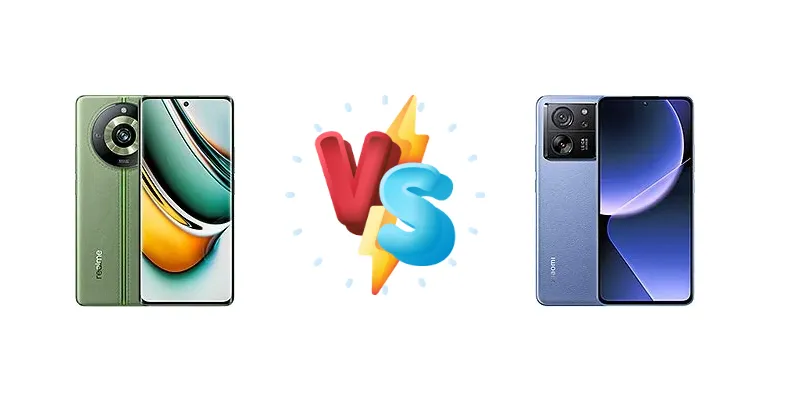
|
🏆 Quick Verdict
For most users, the Xiaomi 13T Pro is the superior choice. Its Dimensity 9200+ chipset provides a substantial performance uplift, and the 120W charging is a game-changer. While the Realme 11 Pro offers solid battery endurance, it can't match the Xiaomi's speed or processing power.
| PHONES | ||
|---|---|---|
| Phone Names | Realme 11 Pro | Xiaomi 13T Pro |
| Network | ||
|---|---|---|
| 2G bands | GSM 850 / 900 / 1800 / 1900 | GSM 850 / 900 / 1800 / 1900 |
| 3G bands | HSDPA 850 / 900 / 2100 | HSDPA 800 / 850 / 900 / 1700(AWS) / 1900 / 2100 |
| 4G bands | 1, 3, 5, 7, 8, 28, 40, 41 - International | 1, 2, 3, 4, 5, 7, 8, 12, 13, 17, 18, 19, 20, 25, 26, 28, 32, 38, 39, 40, 41, 42, 48, 66 |
| 5G bands | 1, 3, 5, 8, 28, 40, 41, 77, 78 SA/NSA - International | 1, 3, 5, 7, 8, 20, 28, 38, 40, 41, 66, 75, 77, 78 SA/NSA |
| Speed | HSPA, LTE, 5G | HSPA, LTE, 5G |
| Technology | GSM / CDMA / HSPA / CDMA2000 / LTE / 5G | GSM / HSPA / LTE / 5G |
| CDMA2000 1x | - | |
| Launch | ||
|---|---|---|
| Announced | 2023, May 10 | 2023, September 26 |
| Status | Available. Released 2023, May 15 | Available. Released 2023, September 26 |
| Body | ||
|---|---|---|
| Build | Glass front, leather or plastic back, plastic frame | Glass front (Gorilla Glass 5), glass back or silicone polymer back, plastic frame |
| Dimensions | 161.7 x 73.9 x 8.2 mm or 8.8 mm | 162.2 x 75.7 x 8.5 mm (6.39 x 2.98 x 0.33 in) |
| SIM | Nano-SIM + Nano-SIM | · Nano-SIM + eSIM· Nano-SIM + Nano-SIM |
| Weight | 183 g or 189 g (6.46 oz) | 200 g or 206 g (7.05 oz) |
| Display | ||
|---|---|---|
| Protection | - | Corning Gorilla Glass 5 |
| Resolution | 1080 x 2412 pixels, 20:9 ratio (~394 ppi density) | 1220 x 2712 pixels, 20:9 ratio (~446 ppi density) |
| Size | 6.7 inches, 108.0 cm2 (~90.4% screen-to-body ratio) | 6.67 inches, 107.4 cm2 (~87.5% screen-to-body ratio) |
| Type | AMOLED, 1B colors, HDR10+, 120Hz, 950 nits (peak) | AMOLED, 68B colors, 144Hz, Dolby Vision, HDR10+, 1200 nits (HBM), 2600 nits (peak) |
| Platform | ||
|---|---|---|
| CPU | Octa-core (2x2.6 GHz Cortex-A78 & 6x2.0 GHz Cortex-A55) | Octa-core (1x3.35 GHz Cortex-X3 & 3x3.0 GHz Cortex-A715 & 4x2.0 GHz Cortex-A510) |
| Chipset | Mediatek Dimensity 7050 (6 nm) | Mediatek Dimensity 9200+ (4 nm) |
| GPU | Mali-G68 MC4 | Immortalis-G715 MC11 |
| OS | Android 13, up to 2 major Android upgrades, Realme UI 5.0 | Android 13, up to 4 major Android upgrades, HyperOS |
| Memory | ||
|---|---|---|
| Card slot | No | No |
| Internal | 128GB 8GB RAM, 256GB 8GB RAM, 256GB 12GB RAM, 512GB 12GB RAM | 256GB 12GB RAM, 512GB 12GB RAM, 1TB 16GB RAM |
| Main Camera | ||
|---|---|---|
| Dual | 100 MP, f/1.8, 26mm (wide), PDAF, OIS Auxiliary lens | - |
| Features | LED flash, HDR, panorama | Leica lens, color spectrum sensor, LED flash, HDR, panorama |
| Triple | - | 50 MP, f/1.9, 24mm (wide), 1/1.28", 1.22µm, PDAF, OIS 50 MP, f/1.9, 50mm (telephoto), 1/2.88", 0.61µm, PDAF, 2x optical zoom 12 MP, f/2.2, 15mm (ultrawide), 1/3.06", 1.12µm |
| Video | 4K@30fps, 1080p@30/60/120/480fps, 720p@960fps, gyro-EIS | 8K@24fps, 4K@24/30/60fps, 4K/1080p@30fps HDR10+, 1080p@30/60/120/240fps; 10-bit LOG, gyro-EIS |
| Selfie camera | ||
|---|---|---|
| Features | Panorama | HDR |
| Single | 16 MP, f/2.5, 25mm (wide) | 20 MP, f/2.2, (wide), 0.8µm |
| Video | 1080p@30fps | 1080p@30fps, HDR10+ |
| Sound | ||
|---|---|---|
| 3.5mm jack | No | - |
| 35mm jack | No | No |
| Loudspeaker | Yes, with stereo speakers | Yes, with stereo speakers |
| 24-bit/192kHz audio | - | |
| Comms | ||
|---|---|---|
| Bluetooth | 5.2, A2DP, LE, aptX HD | 5.4, A2DP, LE |
| Infrared port | - | Yes |
| NFC | Yes (market/region dependent) | Yes |
| Positioning | GPS, GALILEO, GLONASS, BDS, QZSS | GPS (L1+L5), GLONASS (G1), GALILEO (E1+E5a), NavIC (L5), BDS |
| Radio | No | No |
| USB | USB Type-C 2.0 | USB Type-C 2.0, OTG |
| WLAN | Wi-Fi 802.11 a/b/g/n/ac/6, dual-band | Wi-Fi 802.11 a/b/g/n/ac/6e/7, dual/tri-band (market/region dependent), Wi-Fi Direct |
| Features | ||
|---|---|---|
| Sensors | Fingerprint (under display, optical), accelerometer, gyro, proximity, compass | Fingerprint (under display, optical), accelerometer, gyro, proximity, compass |
| Battery | ||
|---|---|---|
| Charging | 67W wired | 120W wired, PD3.0, QC4, 100% in 19 min |
| Type | 5000 mAh | Li-Po 5000 mAh |
| Misc | ||
|---|---|---|
| Colors | Astral Black, Sunrise Beige, Oasis Green | Alpine Blue, Meadow Green, Black |
| Models | RMX3771 | 23078PND5G |
| Price | € 294.90 / ₹ 21,999 | $ 370.00 / £ 482.55 / € 301.99 |
| SAR EU | - | 1.00 W/kg (head) 0.99 W/kg (body) |
Realme 11 Pro
- Excellent battery endurance (112h)
- Potentially lower price point
- Respectable performance for everyday tasks
- Significantly slower charging (67W)
- Less powerful chipset (Dimensity 7050)
- Dimmer display (790 nits)
Xiaomi 13T Pro
- Blazing-fast 120W charging (19 minutes to 100%)
- Flagship-level performance (Dimensity 9200+)
- Brighter display (1094 nits)
- Shorter battery life compared to Realme 11 Pro
- Potentially higher price
- May run warmer under heavy load
Display Comparison
The Xiaomi 13T Pro boasts a significantly brighter display, reaching a measured 1094 nits compared to the Realme 11 Pro’s 790 nits. This translates to superior visibility outdoors under direct sunlight. While both devices likely utilize AMOLED panels, the Xiaomi’s higher peak brightness and potentially better color calibration (though not specified) provide a more immersive viewing experience. The Realme 11 Pro’s display, while adequate, will appear comparatively dim in bright environments. We lack data on refresh rate or panel technology (LTPO), but the brightness difference is a clear win for the Xiaomi.
Camera Comparison
Both phones are listed as having Photo/Video capabilities, but without specific sensor details, a detailed comparison is difficult. However, given the Xiaomi 13T Pro’s positioning as a higher-end device, it’s reasonable to assume it features a more sophisticated camera system, potentially with a larger main sensor and more advanced image processing algorithms. The absence of information regarding OIS (Optical Image Stabilization) on either device makes it impossible to assess low-light performance or video stabilization capabilities. We can safely assume that both phones will include a suite of software features to enhance image quality, but the Xiaomi likely has an edge in raw hardware capabilities.
Performance
The performance gap between these two phones is substantial. The Xiaomi 13T Pro’s Mediatek Dimensity 9200+ (4nm) is a flagship-level chipset, featuring a Cortex-X3 prime core clocked at 3.35 GHz, while the Realme 11 Pro utilizes the Dimensity 7050 (6nm). The 4nm process node of the 9200+ offers significantly improved power efficiency and thermal performance compared to the 6nm 7050. This means the Xiaomi is less likely to throttle under sustained load, making it the better choice for demanding games and applications. The CPU architecture also favors the Xiaomi, with the X3 core providing a significant single-core performance boost. The Realme 11 Pro’s Cortex-A78 cores are older generation and less efficient.
Battery Life
The Realme 11 Pro achieves an active use score of 13:14h and an endurance rating of 112h, indicating strong battery life. However, the Xiaomi 13T Pro, despite a lower active use score of 11:50h and endurance rating of 102h, compensates with its blazing-fast 120W wired charging. This allows it to reach 100% charge in just 19 minutes, a massive advantage over the Realme 11 Pro’s 67W charging. The Xiaomi’s charging also supports PD3.0 and QC4 standards, offering broader compatibility. While the Realme 11 Pro offers longer runtimes on a single charge, the Xiaomi’s rapid charging minimizes downtime.
Buying Guide
Buy the Realme 11 Pro if you prioritize long battery life and are comfortable with a more moderate performance level, potentially at a lower price point. It's ideal for everyday users who don't heavily game or engage in demanding tasks. Buy the Xiaomi 13T Pro if you demand the fastest possible charging, top-tier performance for gaming and multitasking, and a brighter, more vibrant display. This phone is geared towards power users and those who value speed above all else.