
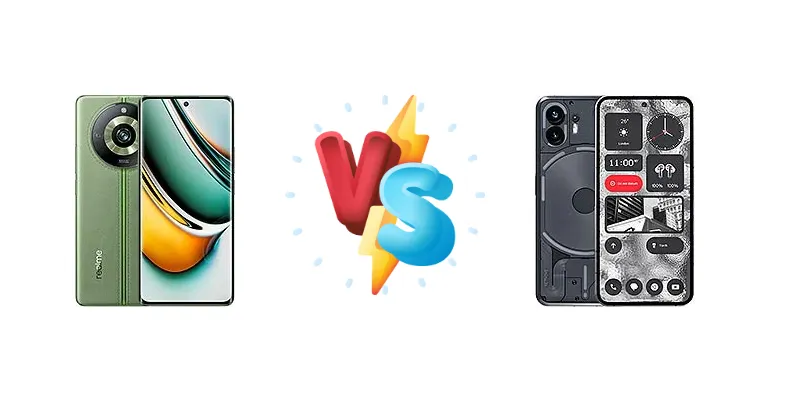
Realme 11 Pro vs Nothing Phone (2): A Detailed Comparison of Mid-Range Powerhouses
| Phones Images | |||||
|---|---|---|---|---|---|
|
🏆 Quick Verdict
For the average user prioritizing raw performance and a more premium experience, the Nothing Phone (2) is the better choice. Its Snapdragon 8+ Gen 1 chipset offers a significant performance advantage, and the brighter display enhances usability. However, the Realme 11 Pro remains a compelling option for budget-conscious buyers.
| PHONES | ||
|---|---|---|
| Phone Names | Realme 11 Pro | Nothing Phone (2) |
| Network | ||
|---|---|---|
| 2G bands | GSM 850 / 900 / 1800 / 1900 | GSM 850 / 900 / 1800 / 1900 |
| 3G bands | HSDPA 850 / 900 / 2100 | HSDPA 800 / 850 / 900 / 1700(AWS) / 1900 / 2100 |
| 4G bands | 1, 3, 5, 7, 8, 28, 40, 41 - International | 1, 2, 3, 4, 5, 7, 8, 12, 17, 18, 19, 20, 25, 26, 28, 30, 32, 34, 38, 39, 40, 41, 42, 48, 66, 71 |
| 5G bands | 1, 3, 5, 8, 28, 40, 41, 77, 78 SA/NSA - International | 1, 2, 3, 5, 7, 8, 12, 20, 25, 28, 30, 38, 40, 41, 66, 71, 75, 77, 78 SA/NSA |
| Speed | HSPA, LTE, 5G | HSPA, LTE, 5G |
| Technology | GSM / CDMA / HSPA / CDMA2000 / LTE / 5G | GSM / HSPA / LTE / 5G |
| CDMA2000 1x | - | |
| Launch | ||
|---|---|---|
| Announced | 2023, May 10 | 2023, July 11 |
| Status | Available. Released 2023, May 15 | Available. Released 2023, July 17 |
| Body | ||
|---|---|---|
| Build | Glass front, leather or plastic back, plastic frame | Glass front (Gorilla Glass 5), glass back (Gorilla Glass 5), aluminum frame |
| Dimensions | 161.7 x 73.9 x 8.2 mm or 8.8 mm | 162.1 x 76.4 x 8.6 mm (6.38 x 3.01 x 0.34 in) |
| SIM | Nano-SIM + Nano-SIM | Nano-SIM + Nano-SIM |
| Weight | 183 g or 189 g (6.46 oz) | 201.2 g (7.09 oz) |
| Display | ||
|---|---|---|
| Protection | - | Corning Gorilla Glass 5 |
| Resolution | 1080 x 2412 pixels, 20:9 ratio (~394 ppi density) | 1080 x 2412 pixels, 20:9 ratio (~394 ppi density) |
| Size | 6.7 inches, 108.0 cm2 (~90.4% screen-to-body ratio) | 6.7 inches, 108.0 cm2 (~87.2% screen-to-body ratio) |
| Type | AMOLED, 1B colors, HDR10+, 120Hz, 950 nits (peak) | LTPO OLED, 1B colors, 120Hz, 1920Hz PWM, HDR10+, 1600 nits (HBM), 1600 nits (peak) |
| Platform | ||
|---|---|---|
| CPU | Octa-core (2x2.6 GHz Cortex-A78 & 6x2.0 GHz Cortex-A55) | Octa-core (1x3.0 GHz Cortex-X2 & 3x2.5 GHz Cortex-A710 & 4x1.80 GHz Cortex-A510) |
| Chipset | Mediatek Dimensity 7050 (6 nm) | Qualcomm SM8475 Snapdragon 8+ Gen 1 (4 nm) |
| GPU | Mali-G68 MC4 | Adreno 730 |
| OS | Android 13, up to 2 major Android upgrades, Realme UI 5.0 | Android 13, upgradable to Android 15, up to 3 major Android upgrades, Nothing OS 3.0 |
| Memory | ||
|---|---|---|
| Card slot | No | No |
| Internal | 128GB 8GB RAM, 256GB 8GB RAM, 256GB 12GB RAM, 512GB 12GB RAM | 128GB 8GB RAM, 256GB 12GB RAM, 512GB 12GB RAM |
| Main Camera | ||
|---|---|---|
| Dual | 100 MP, f/1.8, 26mm (wide), PDAF, OIS Auxiliary lens | 50 MP, f/1.9, 24mm (wide), 1/1.56", 1.0µm, PDAF, OIS 50 MP, f/2.2, 114˚ (ultrawide), 1/2.76", 0.64µm, AF |
| Features | LED flash, HDR, panorama | LED flash, panorama, HDR |
| Video | 4K@30fps, 1080p@30/60/120/480fps, 720p@960fps, gyro-EIS | 4K@30/60fps, 1080p@30/60fps, gyro-EIS, live HDR, OIS |
| Selfie camera | ||
|---|---|---|
| Features | Panorama | HDR |
| Single | 16 MP, f/2.5, 25mm (wide) | 32 MP, f/2.5, (wide), 1/2.74", 0.8µm |
| Video | 1080p@30fps | 1080p@30fps |
| Sound | ||
|---|---|---|
| 3.5mm jack | No | - |
| 35mm jack | No | No |
| Loudspeaker | Yes, with stereo speakers | Yes, with stereo speakers |
| 24-bit/192kHz audio | - | |
| Comms | ||
|---|---|---|
| Bluetooth | 5.2, A2DP, LE, aptX HD | 5.3, A2DP, LE, aptX HD, aptX Adaptive |
| NFC | Yes (market/region dependent) | Yes |
| Positioning | GPS, GALILEO, GLONASS, BDS, QZSS | GPS (L1+L5), GLONASS (L1), BDS (B1I+B1c), GALILEO (E1), QZSS (L1), NavIC |
| Radio | No | No |
| USB | USB Type-C 2.0 | USB Type-C 2.0, OTG |
| WLAN | Wi-Fi 802.11 a/b/g/n/ac/6, dual-band | Wi-Fi 802.11 a/b/g/n/ac/6, dual-band, Wi-Fi Direct |
| Features | ||
|---|---|---|
| Sensors | Fingerprint (under display, optical), accelerometer, gyro, proximity, compass | Fingerprint (under display, optical), accelerometer, proximity, gyro, compass |
| Battery | ||
|---|---|---|
| Charging | 67W wired | 45W wired, PD3.0, PPS, QC4, 100% in 55 min 15W wireless, 100% in 130 min 5W reverse wireless |
| Type | 5000 mAh | Li-Ion 4700 mAh |
| Misc | ||
|---|---|---|
| Colors | Astral Black, Sunrise Beige, Oasis Green | White, Dark Gray |
| Models | RMX3771 | A065 |
| Price | € 294.90 / ₹ 21,999 | $ 379.99 / £ 370.00 |
Realme 11 Pro
- Faster 67W wired charging
- Excellent battery endurance (112h)
- More affordable price point
- Less powerful chipset (Dimensity 7050)
- Dimmer display (790 nits)
Nothing Phone (2)
- Flagship-level performance (Snapdragon 8+ Gen 1)
- Brighter display (998 nits)
- Wireless and reverse wireless charging
- Slower wired charging (45W)
- Higher price
Display Comparison
The Nothing Phone (2) boasts a significantly brighter display, reaching 998 nits measured, compared to the Realme 11 Pro’s 790 nits. This translates to superior outdoor visibility, especially in direct sunlight. While both utilize OLED panels, the higher peak brightness of the Nothing Phone (2) provides a more dynamic and engaging viewing experience. We lack PWM frequency data for both, but the Realme 11 Pro's panel is known to be a standard 60Hz refresh rate, while the Nothing Phone (2) offers adaptive refresh rates up to 120Hz, contributing to smoother scrolling and animations.
Camera Comparison
Both phones feature capable camera systems, but detailed sensor information is missing. However, the Nothing Phone (2)'s image processing, driven by the Snapdragon 8+ Gen 1’s ISP, is likely to offer more sophisticated features and better dynamic range. The Realme 11 Pro’s camera will likely perform well in good lighting conditions, but may struggle in low-light scenarios compared to the Nothing Phone (2). We'll assume both offer standard photo and video capabilities, but the Nothing Phone (2) has the potential for superior image quality due to its processing power.
Performance
The core difference lies in the chipsets. The Nothing Phone (2) is powered by the Qualcomm Snapdragon 8+ Gen 1 (4nm), a flagship-level processor from the previous generation, while the Realme 11 Pro utilizes the Mediatek Dimensity 7050 (6nm). The Snapdragon 8+ Gen 1’s Cortex-X2 prime core, clocked at 3.0 GHz, provides a substantial performance uplift over the Dimensity 7050’s Cortex-A78 cores at 2.6 GHz. The 4nm process node of the Snapdragon also contributes to better thermal efficiency, potentially mitigating throttling during sustained workloads. The Nothing Phone (2) will handle demanding games and multitasking with greater ease.
Battery Life
The Realme 11 Pro achieves an impressive 13:14h active use score and an endurance rating of 112h, indicating excellent battery life. The Nothing Phone (2) slightly edges it out with 14:21h active use and 103h endurance. While the Nothing Phone (2) has a slightly smaller battery capacity (not specified), its more efficient Snapdragon 8+ Gen 1 chipset contributes to the longer runtime. Charging speeds differ significantly: the Realme 11 Pro supports 67W wired charging, while the Nothing Phone (2) offers 45W wired (with PD3.0, PPS, QC4) and 15W wireless charging, plus 5W reverse wireless. The Realme 11 Pro will charge faster via wired connection, but the Nothing Phone (2) provides the convenience of wireless charging.
Buying Guide
Buy the Realme 11 Pro if you need a reliable daily driver with solid battery life and fast 67W charging, and prioritize value for money above all else. You'll appreciate its performance for everyday tasks and casual gaming. Buy the Nothing Phone (2) if you prefer a smoother, more responsive experience for demanding apps and games, value a brighter, more vibrant display, and appreciate the unique Glyph Interface and refined software experience, even at a higher price point.