
Realme 11 Pro vs Google Pixel 7a: A Deep Dive into Mid-Range Champions
| Phones Images | |||||
|---|---|---|---|---|---|
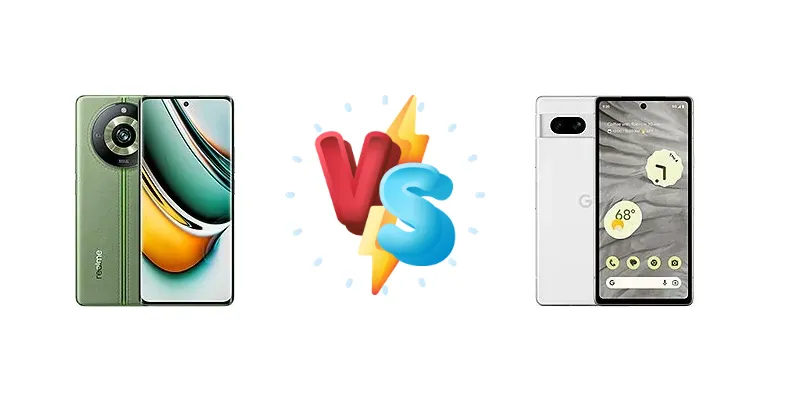
|
🏆 Quick Verdict
For the average user prioritizing camera quality and software experience, the Google Pixel 7a is the superior choice. However, the Realme 11 Pro offers significantly longer battery life and faster charging, making it ideal for users who prioritize endurance and dislike frequent top-ups.
| PHONES | ||
|---|---|---|
| Phone Names | Realme 11 Pro | Google Pixel 7a |
| Network | ||
|---|---|---|
| 2G bands | GSM 850 / 900 / 1800 / 1900 | GSM 850 / 900 / 1800 / 1900 |
| 3G bands | HSDPA 850 / 900 / 2100 | HSDPA 800 / 850 / 900 / 1700(AWS) / 1900 / 2100 |
| 4G bands | 1, 3, 5, 7, 8, 28, 40, 41 - International | 1, 2, 3, 4, 5, 7, 8, 12, 13, 14, 17, 20, 25, 26, 28, 29, 30, 38, 40, 41, 48, 66, 71 - GWKK3, G0DZQ |
| 5G bands | 1, 3, 5, 8, 28, 40, 41, 77, 78 SA/NSA - International | 1, 2, 3, 5, 7, 8, 12, 14, 20, 25, 28, 30, 38, 41, 48, 66, 71, 77, 78 SA/NSA/Sub6 - GWKK3 |
| Speed | HSPA, LTE, 5G | HSPA, LTE, 5G |
| Technology | GSM / CDMA / HSPA / CDMA2000 / LTE / 5G | GSM / HSPA / LTE / 5G |
| CDMA2000 1x | 1, 2, 3, 5, 7, 8, 12, 20, 25, 28, 38, 40, 41, 66, 75, 76, 77, 78, 79 SA/NSA/Sub6 - GHL1X, G82U8 | |
| Launch | ||
|---|---|---|
| Announced | 2023, May 10 | 2023, May 10 |
| Status | Available. Released 2023, May 15 | Available. Released 2023, May 10 |
| Body | ||
|---|---|---|
| Build | Glass front, leather or plastic back, plastic frame | Glass front (Gorilla Glass 3), aluminum frame, plastic back |
| Dimensions | 161.7 x 73.9 x 8.2 mm or 8.8 mm | 152 x 72.9 x 9 mm (5.98 x 2.87 x 0.35 in) |
| SIM | Nano-SIM + Nano-SIM | Nano-SIM + eSIM |
| Weight | 183 g or 189 g (6.46 oz) | 193.5 g (6.84 oz) |
| - | IP67 dust/water resistant (up to 1m for 30 min) | |
| Display | ||
|---|---|---|
| Protection | - | Corning Gorilla Glass 3 |
| Resolution | 1080 x 2412 pixels, 20:9 ratio (~394 ppi density) | 1080 x 2400 pixels, 20:9 ratio (~429 ppi density) |
| Size | 6.7 inches, 108.0 cm2 (~90.4% screen-to-body ratio) | 6.1 inches, 90.7 cm2 (~81.8% screen-to-body ratio) |
| Type | AMOLED, 1B colors, HDR10+, 120Hz, 950 nits (peak) | OLED, HDR, 90Hz |
| - | Always-on display | |
| Platform | ||
|---|---|---|
| CPU | Octa-core (2x2.6 GHz Cortex-A78 & 6x2.0 GHz Cortex-A55) | Octa-core (2x2.85 GHz Cortex-X1 & 2x2.35 GHz Cortex-A78 & 4x1.80 GHz Cortex-A55) |
| Chipset | Mediatek Dimensity 7050 (6 nm) | Google Tensor G2 (5 nm) |
| GPU | Mali-G68 MC4 | Mali-G710 MP7 |
| OS | Android 13, up to 2 major Android upgrades, Realme UI 5.0 | Android 13, upgradable to Android 15, up to 5 major Android upgrades |
| Memory | ||
|---|---|---|
| Card slot | No | No |
| Internal | 128GB 8GB RAM, 256GB 8GB RAM, 256GB 12GB RAM, 512GB 12GB RAM | 128GB 8GB RAM |
| - | UFS 3.1 | |
| Main Camera | ||
|---|---|---|
| Dual | 100 MP, f/1.8, 26mm (wide), PDAF, OIS Auxiliary lens | 64 MP, f/1.9, 26mm (wide), 1/1.73", 0.8µm, dual pixel PDAF, OIS 13 MP, f/2.2, 120˚ (ultrawide), 1.12µm |
| Features | LED flash, HDR, panorama | Dual-LED flash, Pixel Shift, Auto-HDR, panorama |
| Video | 4K@30fps, 1080p@30/60/120/480fps, 720p@960fps, gyro-EIS | 4K@30/60fps, 1080p@30/60/120/240fps, OIS |
| Selfie camera | ||
|---|---|---|
| Features | Panorama | HDR, panorama |
| Single | 16 MP, f/2.5, 25mm (wide) | 13 MP, f/2.2, 20mm (ultrawide), 1.12µm |
| Video | 1080p@30fps | 4K@30fps, 1080p@30fps |
| Sound | ||
|---|---|---|
| 3.5mm jack | No | No |
| 35mm jack | No | No |
| Loudspeaker | Yes, with stereo speakers | Yes, with stereo speakers |
| 24-bit/192kHz audio | - | |
| Comms | ||
|---|---|---|
| Bluetooth | 5.2, A2DP, LE, aptX HD | 5.3, A2DP, LE |
| NFC | Yes (market/region dependent) | Yes |
| Positioning | GPS, GALILEO, GLONASS, BDS, QZSS | GPS, GLONASS, GALILEO, BDS, QZSS, NavIC |
| Radio | No | No |
| USB | USB Type-C 2.0 | USB Type-C 3.2 |
| WLAN | Wi-Fi 802.11 a/b/g/n/ac/6, dual-band | Wi-Fi 802.11 a/b/g/n/ac/6e, tri-band |
| Features | ||
|---|---|---|
| Sensors | Fingerprint (under display, optical), accelerometer, gyro, proximity, compass | Fingerprint (under display, optical), accelerometer, gyro, proximity, compass, barometer |
| Battery | ||
|---|---|---|
| Charging | 67W wired | 18W wired, PD3.0 7.5W wireless |
| Type | 5000 mAh | Li-Po 4385 mAh |
| Misc | ||
|---|---|---|
| Colors | Astral Black, Sunrise Beige, Oasis Green | Charcoal, Snow, Sea, Coral |
| Models | RMX3771 | GWKK3, GHL1X, G0DZQ, G82U8 |
| Price | € 294.90 / ₹ 21,999 | € 179.90 / $ 150.00 / £ 170.00 / ₹ 25,980 |
Realme 11 Pro
- Exceptional battery life (112h endurance)
- Ultra-fast 67W wired charging
- Competitive price point
- Less powerful chipset than Pixel 7a
- Display not as bright as Pixel 7a
Google Pixel 7a
- Superior camera quality and image processing
- Brighter and more vibrant display (1070 nits)
- Google Tensor G2 chip for AI features
- Significantly shorter battery life
- Slower 18W wired charging
Display Comparison
The Pixel 7a boasts a significantly brighter display, reaching 1070 nits compared to the Realme 11 Pro’s 790 nits. This translates to superior visibility outdoors under direct sunlight. While both feature OLED panels, the Pixel 7a’s higher peak brightness and likely superior color calibration (though not specified in the data) provide a more vibrant and accurate viewing experience. The Realme 11 Pro’s display, while still good, will appear comparatively dimmer in bright environments. We lack PWM frequency data, but both are likely adequate for most users.
Camera Comparison
Both phones are capable of capturing high-quality photos and videos, but the Pixel 7a is expected to excel due to Google’s renowned computational photography. While sensor sizes and apertures aren’t provided, the Pixel 7a’s Tensor G2 chip plays a crucial role in image processing, delivering superior dynamic range, detail, and low-light performance. The Realme 11 Pro’s camera system is likely competent, but it won’t match the Pixel 7a’s software-driven enhancements. Ignoring the likely low-resolution macro lenses on both devices, the Pixel’s image processing pipeline is the key differentiator.
Performance
The Google Pixel 7a’s Tensor G2 (5nm) chipset, with its Cortex-X1 prime core clocked at 2.85 GHz, offers a performance advantage over the Realme 11 Pro’s Dimensity 7050 (6nm). The Tensor G2’s architecture is designed for AI and machine learning tasks, enhancing features like voice recognition and image processing. While the Dimensity 7050 is a capable chip, the Tensor G2’s more advanced node and core configuration provide a noticeable edge in demanding applications and multitasking. The Pixel 7a’s CPU configuration (2x2.85GHz Cortex-X1, 2x2.35GHz Cortex-A78, 4x1.80GHz Cortex-A55) is more balanced for sustained performance than the Realme’s (2x2.6GHz Cortex-A78, 6x2.0GHz Cortex-A55).
Battery Life
The Realme 11 Pro shines in battery endurance, achieving an active use score of 13:14h and an older endurance rating of 112h. This is significantly better than the Pixel 7a’s 76h endurance rating. The Realme 11 Pro also boasts 67W wired charging, allowing for a full charge in under an hour, while the Pixel 7a is limited to 18W wired charging and slower wireless charging. This difference in charging speed is substantial, making the Realme 11 Pro a more convenient option for users who need to quickly top up their battery.
Buying Guide
Buy the Realme 11 Pro if you need all-day battery life and incredibly fast 67W charging, and are comfortable with Realme UI. It’s a strong pick for power users and travelers. Buy the Google Pixel 7a if you prioritize a best-in-class camera experience, clean Android software with guaranteed updates, and the benefits of Google’s AI-powered features, even if it means sacrificing some battery endurance.