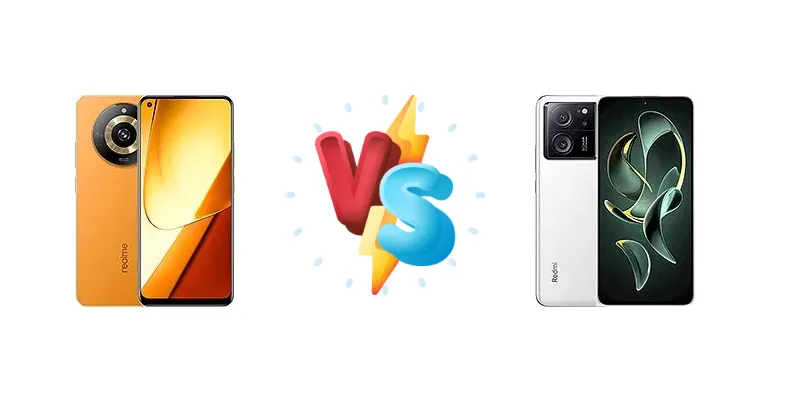
The Realme 11 (China) represents a budget-conscious approach to the mid-range, while the Xiaomi Redmi K60 Ultra aims for near-flagship performance at a competitive price. This comparison dissects the core differences – primarily in chipset and charging technology – to determine which device delivers the best value for your money.
🏆 Quick Verdict
For most users, the Xiaomi Redmi K60 Ultra is the clear winner. Its Dimensity 9200+ chipset provides a substantial performance leap over the Realme 11’s Dimensity 6020, and the 120W charging is a game-changer. While the Realme 11 offers affordability, the K60 Ultra’s speed and efficiency justify the price difference.
| Network |
|---|
| 2G bands | GSM 850 / 900 / 1800 / 1900 | GSM 850 / 900 / 1800 / 1900 |
| 3G bands | HSDPA 850 / 900 / 2100 | HSDPA 800 / 850 / 900 / 1700(AWS) / 2100 |
| 4G bands | 1, 3, 5, 7, 8, 28, 34, 38, 39, 40, 41 | 1, 3, 4, 5, 8, 18, 19, 26, 34, 38, 39, 40, 41, 42, 66 |
| 5G bands | 1, 5, 8, 28, 41, 77, 78 SA/NSA | 1, 3, 5, 8, 28, 38, 41, 66, 77, 78 SA/NSA |
| Speed | HSPA, LTE, 5G | HSPA, LTE, 5G |
| Technology | GSM / CDMA / HSPA / CDMA2000 / LTE / 5G | GSM / CDMA / HSPA / CDMA2000 / LTE / 5G |
| Launch |
|---|
| Announced | 2023, May 10 | 2023, August 15 |
| Status | Available. Released 2023, June 01 | Available. Released 2023, August 15 |
| Body |
|---|
| Dimensions | 159.8 x 72.9 x 7.9 mm (6.29 x 2.87 x 0.31 in) | 162.2 x 75.7 x 8.5 mm (6.39 x 2.98 x 0.33 in) |
| SIM | Nano-SIM + Nano-SIM | Nano-SIM + Nano-SIM |
| Weight | 182 g (6.42 oz) | 204 g (7.20 oz) |
| Display |
|---|
| Protection | - | Unspecified |
| Resolution | 1080 x 2400 pixels, 20:9 ratio (~409 ppi density) | 1220 x 2712 pixels, 20:9 ratio (~446 ppi density) |
| Size | 6.43 inches, 99.8 cm2 (~85.7% screen-to-body ratio) | 6.67 inches, 107.4 cm2 (~87.5% screen-to-body ratio) |
| Type | Super AMOLED, 90Hz, 1000 nits (peak) | OLED, 68B colors, 144Hz, Dolby Vision, HDR10+, 2600 nits (peak) |
| Platform |
|---|
| CPU | Octa-core (2x2.2 GHz Cortex-A76 & 6x2.0 GHz Cortex-A55) | Octa-core (1x3.35 GHz Cortex-X3 & 3x3.0 GHz Cortex-A715 & 4x2.0 GHz Cortex-A510) |
| Chipset | Mediatek Dimensity 6020 (7 nm) | Mediatek Dimensity 9200+ (4 nm) |
| GPU | Mali-G57 MC2 | Immortalis-G715 MC11 |
| OS | Android 13, Realme UI 4.0 | Android 13, MIUI 14 |
| Memory |
|---|
| Card slot | microSDXC | No |
| Internal | 128GB 8GB RAM, 128GB 12GB RAM, 256GB 8GB RAM, 256GB 12GB RAM | 256GB 12GB RAM, 256GB 16GB RAM, 512GB 16GB RAM, 1TB 16GB RAM, 1TB 24GB RAM |
| Main Camera |
|---|
| Dual | 64 MP, f/1.8, 25mm (wide), 1/2.0", 0.7µm, PDAF
Auxiliary lens | - |
| Features | LED flash, HDR, panorama | Color spectrum sensor, Dual-LED dual-tone flash, HDR, panorama |
| Triple | - | 50 MP, f/1.7, (wide), 1/1.49", 1.0µm, PDAF, OIS
8 MP, 119˚ (ultrawide), 1/4.0", 1.12µm
2 MP (macro) |
| Video | 1080p@30fps | 8K@24fps, 4K@30/60fps, 1080p@30/60/120/240/960fps, gyro-EIS, HDR10+, 10-bit |
| Selfie camera |
|---|
| Features | Panorama, HDR | HDR |
| Single | 8 MP, f/2.1, 24mm (wide) | 20 MP, (wide), 1/2.0", 0.8µm |
| Video | 1080p@30fps | 1080p@30/120fps |
| Sound |
|---|
| 35mm jack | Yes | No |
| Loudspeaker | Yes | Yes, with stereo speakers |
| Comms |
|---|
| Bluetooth | Yes | 5.4, A2DP, LE |
| Infrared port | - | Yes |
| NFC | Yes | Yes |
| Positioning | GPS, GALILEO, GLONASS, BDS, QZSS | GPS (L1+L5), GLONASS (G1), BDS (B1I+B1C+B2a+B2b), GALILEO (E1+E5a), QZSS (L1+L5), NavIC |
| Radio | No | Unspecified |
| USB | USB Type-C 2.0 | USB Type-C, OTG |
| WLAN | Yes | Wi-Fi 802.11 a/b/g/n/ac/6e, dual-band, Wi-Fi Direct |
| Features |
|---|
| Sensors | Fingerprint (under display, optical), accelerometer, proximity, compass | Fingerprint (under display, optical), accelerometer, gyro, proximity, compass |
| Battery |
|---|
| Charging | 33W wired, 50% in 29 min | 120W wired, PD3.0, 100% in 19 min |
| Type | 5000 mAh | Li-Po 5000 mAh |
| Misc |
|---|
| Colors | Black, Orange | Black, White, Green |
| Models | RMX3751 | 23078RKD5C |
| Price | About 260 EUR | About 330 EUR |
Realme 11 (China)
- More affordable price point
- Decent performance for everyday tasks
- Reliable brand reputation
- Significantly slower charging
- Less powerful chipset
- Likely inferior camera performance
Xiaomi Redmi K60 Ultra
- Flagship-level Dimensity 9200+ performance
- Ultra-fast 120W charging
- Likely superior camera system
- Higher price tag
- Potentially more heat generation under sustained load (though mitigated by 4nm process)
- May be larger and heavier than the Realme 11
Display Comparison
Neither device's display specifications are provided, so a direct comparison is limited. However, given the K60 Ultra's positioning, it likely features a higher-quality panel with a higher refresh rate and potentially better color accuracy. Realme typically focuses on value, so the 11's display is likely adequate but not exceptional. Bezels are expected to be similar, reflecting the mid-range nature of both devices.
Camera Comparison
Without specific camera sensor details, analysis is limited. However, the K60 Ultra, being a more premium device, likely incorporates a larger main sensor and more sophisticated image processing algorithms. The Realme 11 will likely rely on software optimization to compensate for a potentially less capable sensor. The presence or absence of Optical Image Stabilization (OIS) on the K60 Ultra would be a key advantage, enabling sharper images and smoother video recording. We can assume both devices will include standard wide and ultrawide lenses, but the K60 Ultra is expected to deliver superior image quality overall.
Performance
The performance gap is the most significant differentiator. The Xiaomi Redmi K60 Ultra’s Dimensity 9200+ (4nm) is a flagship-level chipset featuring a Cortex-X3 prime core clocked at 3.35 GHz, compared to the Realme 11’s Dimensity 6020 (7nm) with its Cortex-A76 cores at 2.2 GHz. The 4nm process node of the 9200+ offers superior power efficiency and thermal management, translating to sustained performance during demanding tasks. The K60 Ultra’s CPU architecture is also more modern, with Cortex-A715 cores versus the A76 in the Realme 11, further widening the performance advantage. This benefits gamers, video editors, and anyone running resource-intensive applications.
Battery Life
The Redmi K60 Ultra’s 120W wired charging is a standout feature, capable of fully charging the device in just 19 minutes. This is a massive advantage over the Realme 11’s 33W charging, which takes 29 minutes to reach 50%. While battery capacity isn’t specified, the faster charging of the K60 Ultra effectively mitigates any potential difference in mAh. The K60 Ultra also supports PD3.0, offering wider compatibility with chargers and accessories.
Buying Guide
Buy the Realme 11 (China) if you prioritize extreme affordability and basic smartphone functionality, and don't require demanding performance for gaming or intensive tasks. Buy the Xiaomi Redmi K60 Ultra if you value speed, responsiveness, and fast charging, and are willing to spend a bit more for a significantly enhanced user experience, particularly for gaming and content creation.
Frequently Asked Questions
❓ Does the Dimensity 9200+ in the Redmi K60 Ultra get excessively hot during prolonged gaming sessions?
While the Dimensity 9200+ is a powerful chip, the 4nm manufacturing process and Xiaomi’s thermal management solutions are designed to mitigate heat. Expect some warmth, but not to the point of significant throttling or discomfort during typical gaming sessions. The Realme 11’s Dimensity 6020 will likely run cooler, but at the cost of performance.
❓ Is the 33W charging on the Realme 11 slow enough to be a major inconvenience in daily use?
Yes, 33W charging is considerably slower than the 120W charging on the Redmi K60 Ultra. While it's not unusable, it requires significantly more time to top up the battery, especially if you're a heavy user. The K60 Ultra’s ability to fully charge in under 20 minutes is a substantial convenience factor.
❓ How much of a real-world performance difference will I notice between the Dimensity 6020 and the Dimensity 9200+?
The difference is substantial. The Dimensity 9200+ offers a significantly smoother experience in demanding applications, faster app loading times, and much higher frame rates in games. The Realme 11 will be adequate for basic tasks, but the K60 Ultra provides a noticeably more responsive and fluid user experience.