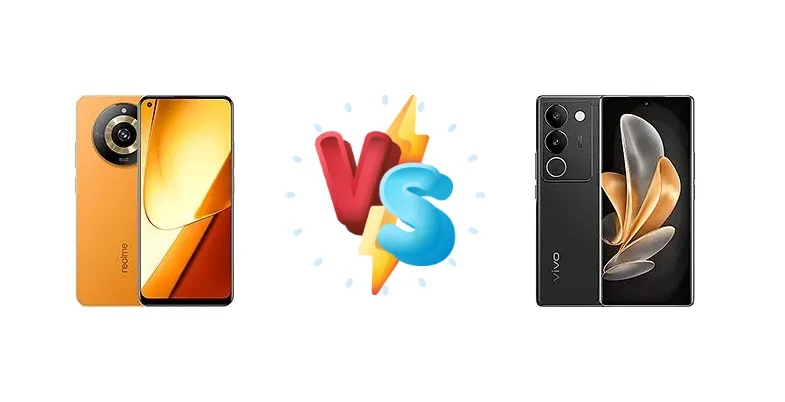
The Realme 11 (China) and vivo S17t represent compelling options in the competitive mid-range smartphone market. While both devices target budget-conscious consumers, they diverge significantly in their core specifications, particularly in chipset and charging capabilities. This comparison dissects these differences to determine which phone offers the best overall experience.
🏆 Quick Verdict
For users prioritizing raw performance and significantly faster charging, the vivo S17t is the clear winner. Its Dimensity 8050 chipset and 80W charging provide a noticeable advantage over the Realme 11’s Dimensity 6020 and 33W charging. However, the Realme 11 remains a viable option for those on a tighter budget.
| Network |
|---|
| 2G bands | GSM 850 / 900 / 1800 / 1900 | GSM 850 / 900 / 1800 / 1900 |
| 3G bands | HSDPA 850 / 900 / 2100 | HSDPA 850 / 900 / 1700(AWS) / 1900 / 2100 |
| 4G bands | 1, 3, 5, 7, 8, 28, 34, 38, 39, 40, 41 | 1, 3, 4, 5, 8, 28, 34, 38, 39, 40, 41 |
| 5G bands | 1, 5, 8, 28, 41, 77, 78 SA/NSA | 1, 3, 5, 8, 28, 38, 40, 41, 77, 78 SA/NSA |
| Speed | HSPA, LTE, 5G | HSPA, LTE, 5G |
| Technology | GSM / CDMA / HSPA / CDMA2000 / LTE / 5G | GSM / CDMA / HSPA / CDMA2000 / LTE / 5G |
| Launch |
|---|
| Announced | 2023, May 10 | 2023, May 31 |
| Status | Available. Released 2023, June 01 | Available. Released 2023, June 08 |
| Body |
|---|
| Dimensions | 159.8 x 72.9 x 7.9 mm (6.29 x 2.87 x 0.31 in) | 164.2 x 74.4 x 7.5 mm (6.46 x 2.93 x 0.30 in) |
| SIM | Nano-SIM + Nano-SIM | Nano-SIM + Nano-SIM |
| Weight | 182 g (6.42 oz) | 186 g (6.56 oz) |
| Display |
|---|
| Resolution | 1080 x 2400 pixels, 20:9 ratio (~409 ppi density) | 1260 x 2800 pixels, 20:9 ratio (~453 ppi density) |
| Size | 6.43 inches, 99.8 cm2 (~85.7% screen-to-body ratio) | 6.78 inches, 111.0 cm2 (~90.8% screen-to-body ratio) |
| Type | Super AMOLED, 90Hz, 1000 nits (peak) | AMOLED, 1B colors, 120Hz, HDR10+, 1300 nits (peak) |
| Platform |
|---|
| CPU | Octa-core (2x2.2 GHz Cortex-A76 & 6x2.0 GHz Cortex-A55) | Octa-core (1x3.0 GHz Cortex-A78 & 3x2.6 GHz Cortex-A78 & 4x2.0 GHz Cortex-A55) |
| Chipset | Mediatek Dimensity 6020 (7 nm) | Mediatek Dimensity 8050 (6 nm) |
| GPU | Mali-G57 MC2 | Mali-G77 MC9 |
| OS | Android 13, Realme UI 4.0 | Android 13, OriginOS 3 |
| Memory |
|---|
| Card slot | microSDXC | No |
| Internal | 128GB 8GB RAM, 128GB 12GB RAM, 256GB 8GB RAM, 256GB 12GB RAM | 512GB 12GB RAM |
| Main Camera |
|---|
| Dual | 64 MP, f/1.8, 25mm (wide), 1/2.0", 0.7µm, PDAF
Auxiliary lens | 50 MP, f/1.9, (wide), 1/1.56", 1.0µm, PDAF, OIS
8 MP, f/2.2, (ultrawide) |
| Features | LED flash, HDR, panorama | Color spectrum sensor, Ring-LED flash, panorama, HDR |
| Video | 1080p@30fps | 4K@30fps, 1080p@30fps |
| Selfie camera |
|---|
| Features | Panorama, HDR | Dual-LED flash, HDR |
| Single | 8 MP, f/2.1, 24mm (wide) | 50 MP, f/2.0, 22mm (wide), AF |
| Video | 1080p@30fps | 1080p@30fps |
| Sound |
|---|
| 35mm jack | Yes | No |
| Loudspeaker | Yes | Yes |
| Comms |
|---|
| Bluetooth | Yes | 5.2, A2DP, LE, aptX HD |
| NFC | Yes | Yes |
| Positioning | GPS, GALILEO, GLONASS, BDS, QZSS | GPS (L1), GLONASS (G1), BDS (B1I), GALILEO (E1), QZSS (L1) |
| Radio | No | No |
| USB | USB Type-C 2.0 | USB Type-C 2.0, OTG |
| WLAN | Yes | Wi-Fi 802.11 a/b/g/n/ac/6, dual-band, Wi-Fi Direct |
| Features |
|---|
| Sensors | Fingerprint (under display, optical), accelerometer, proximity, compass | Fingerprint (under display, optical), accelerometer, gyro, proximity, compass |
| Battery |
|---|
| Charging | 33W wired, 50% in 29 min | 80W wired, 70% in 30 min |
| Type | 5000 mAh | 4600 mAh |
| Misc |
|---|
| Colors | Black, Orange | Black, Blue, Pink |
| Models | RMX3751 | - |
| Price | About 260 EUR | About 400 EUR |
Realme 11 (China)
- More affordable price point
- Decent performance for everyday tasks
- Reliable Mediatek Dimensity 6020 chipset
- Slower 33W charging
- Less powerful chipset compared to the vivo S17t
- Likely inferior camera performance
vivo S17t
- Significantly faster 80W charging
- More powerful Dimensity 8050 chipset
- Potentially superior camera system
- Higher price tag
- May experience more heat under sustained load (though 6nm helps)
- Potentially larger physical size
Display Comparison
Neither device’s display specifications are provided, so a direct comparison is limited. However, given the market positioning, we can infer both likely utilize AMOLED panels. The vivo S17t, being positioned slightly higher, may benefit from a higher peak brightness and potentially a more refined color calibration. The absence of LTPO technology on either device suggests standard refresh rates, likely 60Hz or 90Hz, impacting smoothness during scrolling and animations.
Camera Comparison
Without specific camera sensor details, a detailed comparison is challenging. However, the vivo S-series historically emphasizes camera capabilities. It’s reasonable to assume the S17t will feature a more sophisticated camera system, potentially with a larger main sensor and improved image processing algorithms. The Realme 11, while likely offering a capable camera for everyday use, will likely fall short in low-light performance and dynamic range compared to the vivo S17t. The absence of information regarding OIS (Optical Image Stabilization) makes it difficult to assess video recording quality.
Performance
The core difference lies in the chipsets. The vivo S17t’s Dimensity 8050, fabricated on a 6nm process, represents a substantial upgrade over the Realme 11’s Dimensity 6020 (7nm). The 8050 features a more powerful CPU configuration – a 1x3.0 GHz Cortex-A78 core alongside 3x2.6 GHz Cortex-A78 cores, compared to the 6020’s 2x2.2 GHz Cortex-A76 and 6x2.0 GHz Cortex-A55. This translates to significantly faster application loading times, smoother multitasking, and improved gaming performance on the vivo S17t. The 6nm node also contributes to better thermal efficiency, potentially reducing throttling during sustained workloads. While both phones likely utilize LPDDR4X RAM, the chipset difference will be the dominant factor in real-world performance.
Battery Life
The charging speed is a defining factor. The vivo S17t’s 80W wired charging is a game-changer, capable of reaching 70% charge in just 30 minutes. This is a significant advantage over the Realme 11’s 33W charging, which takes 29 minutes to reach 50%. While battery capacity isn’t specified, the faster charging of the S17t effectively mitigates any potential disadvantage from a smaller battery size. Users who frequently find themselves needing to quickly top up their phone will greatly benefit from the S17t’s charging capabilities.
Buying Guide
Buy the Realme 11 (China) if you need a functional, everyday smartphone with decent performance for basic tasks and are highly sensitive to price. It’s ideal for users who prioritize affordability over cutting-edge features. Buy the vivo S17t if you prefer a smoother, more responsive experience, especially when multitasking or gaming, and value the convenience of incredibly fast charging – making it perfect for users constantly on the go.
Frequently Asked Questions
❓ Will the Dimensity 8050 in the vivo S17t handle demanding games like Genshin Impact at high settings?
Yes, the Dimensity 8050 is a capable chipset that should handle Genshin Impact and other demanding games at high settings with playable frame rates. The 6nm process and improved CPU/GPU architecture provide a significant performance boost over the Dimensity 6020, reducing the likelihood of significant frame drops.
❓ How much faster is the 80W charging on the vivo S17t compared to the 33W charging on the Realme 11 in a typical use case?
In a typical use case, the 80W charging on the vivo S17t will allow you to go from 0% to a usable charge (e.g., 50-60%) in approximately 15-20 minutes, whereas the Realme 11 will take around 45-60 minutes to reach the same level. This difference is particularly noticeable for users who frequently need to quickly top up their battery.
❓ Does the Dimensity 8050 in the vivo S17t generate significantly more heat than the Dimensity 6020 during prolonged gaming sessions?
While the Dimensity 8050 is more powerful, it's also fabricated on a more efficient 6nm process. This helps mitigate heat generation. However, it's still likely to get warmer than the Dimensity 6020 during extended gaming. The vivo S17t likely incorporates thermal management solutions to address this, but some throttling may still occur.