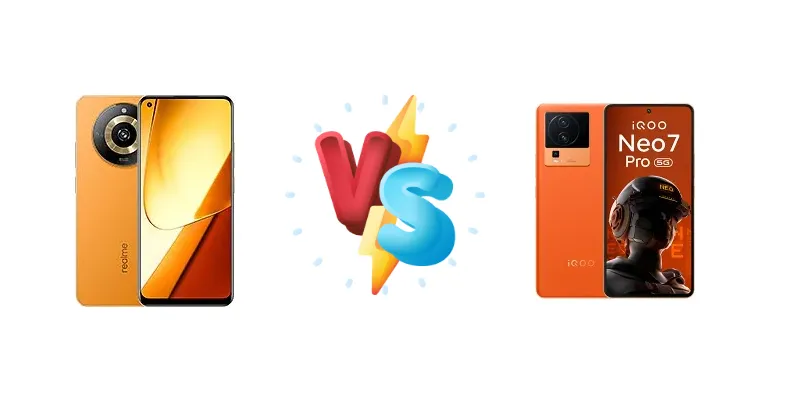
The Realme 11 (China) and vivo iQOO Neo 7 Pro represent distinct approaches to the mid-range smartphone market. The Realme 11 focuses on delivering a balanced experience at a competitive price, while the iQOO Neo 7 Pro prioritizes raw performance with flagship-level silicon. This comparison dissects their key differences to determine which device best suits your needs.
🏆 Quick Verdict
For the average user prioritizing speed and responsiveness, the vivo iQOO Neo 7 Pro is the clear winner. Its Snapdragon 8+ Gen 1 chipset offers significantly higher performance. However, the Realme 11 (China) provides a compelling alternative for budget-conscious users who value efficiency and don't require top-tier gaming capabilities.
| Network |
|---|
| 2G bands | GSM 850 / 900 / 1800 / 1900 | GSM 850 / 900 / 1800 / 1900 |
| 3G bands | HSDPA 850 / 900 / 2100 | HSDPA 800 / 850 / 900 / 1700(AWS) / 1900 / 2100 |
| 4G bands | 1, 3, 5, 7, 8, 28, 34, 38, 39, 40, 41 | 1, 2, 3, 4, 5, 8, 28, 34, 38, 39, 40, 41 |
| 5G bands | 1, 5, 8, 28, 41, 77, 78 SA/NSA | 1, 3, 5, 8, 28, 40, 77, 78 SA/NSA |
| Speed | HSPA, LTE, 5G | HSPA, LTE, 5G |
| Technology | GSM / CDMA / HSPA / CDMA2000 / LTE / 5G | GSM / HSPA / LTE / 5G |
| Launch |
|---|
| Announced | 2023, May 10 | 2023, July 04 |
| Status | Available. Released 2023, June 01 | Available. Released 2023, July 15 |
| Body |
|---|
| Build | - | Glass front, plastic frame, glass or leather back |
| Dimensions | 159.8 x 72.9 x 7.9 mm (6.29 x 2.87 x 0.31 in) | 164.8 x 76.9 x 8.5 mm or 8.9 mm |
| SIM | Nano-SIM + Nano-SIM | Nano-SIM + Nano-SIM |
| Weight | 182 g (6.42 oz) | 197 g or 202 g (6.95 oz) |
| Display |
|---|
| Resolution | 1080 x 2400 pixels, 20:9 ratio (~409 ppi density) | 1080 x 2400 pixels, 20:9 ratio (~388 ppi density) |
| Size | 6.43 inches, 99.8 cm2 (~85.7% screen-to-body ratio) | 6.78 inches, 111.0 cm2 (~87.6% screen-to-body ratio) |
| Type | Super AMOLED, 90Hz, 1000 nits (peak) | AMOLED, 1B colors, 120Hz, HDR10+, 1300 nits (peak) |
| Platform |
|---|
| CPU | Octa-core (2x2.2 GHz Cortex-A76 & 6x2.0 GHz Cortex-A55) | Octa-core (1x3.19 GHz Cortex-X2 & 3x2.75 GHz Cortex-A710 & 4x2.0 GHz Cortex-A510) |
| Chipset | Mediatek Dimensity 6020 (7 nm) | Qualcomm SM8475 Snapdragon 8+ Gen 1 (4 nm) |
| GPU | Mali-G57 MC2 | Adreno 730 |
| OS | Android 13, Realme UI 4.0 | Android 13, Funtouch 13 |
| Memory |
|---|
| Card slot | microSDXC | No |
| Internal | 128GB 8GB RAM, 128GB 12GB RAM, 256GB 8GB RAM, 256GB 12GB RAM | 128GB 8GB RAM, 256GB 12GB RAM |
| Main Camera |
|---|
| Dual | 64 MP, f/1.8, 25mm (wide), 1/2.0", 0.7µm, PDAF
Auxiliary lens | - |
| Features | LED flash, HDR, panorama | LED flash, HDR, panorama |
| Triple | - | 50 MP, f/1.9, 24mm (wide), 1/1.57", 1.0µm, PDAF, OIS
8 MP, f/2.2, 16mm (ultrawide), 1/4.0", 1.12µm
2 MP (macro) |
| Video | 1080p@30fps | 4K@30fps, 1080p@30fps |
| Selfie camera |
|---|
| Features | Panorama, HDR | HDR |
| Single | 8 MP, f/2.1, 24mm (wide) | 16 MP, f/2.5, (wide), 1/3.1", 1.0µm |
| Video | 1080p@30fps | 1080p@30fps |
| Sound |
|---|
| 35mm jack | Yes | No |
| Loudspeaker | Yes | Yes, with stereo speakers |
| Comms |
|---|
| Bluetooth | Yes | 5.3, A2DP, LE, aptX HD, aptX Adaptive |
| Infrared port | - | Yes |
| NFC | Yes | No |
| Positioning | GPS, GALILEO, GLONASS, BDS, QZSS | GPS, GLONASS, GALILEO, BDS, QZSS, NavIC |
| Radio | No | No |
| USB | USB Type-C 2.0 | USB Type-C 2.0, OTG |
| WLAN | Yes | Wi-Fi 802.11 a/b/g/n/ac/6, dual-band, Wi-Fi Direct |
| Features |
|---|
| Sensors | Fingerprint (under display, optical), accelerometer, proximity, compass | Fingerprint (under display, optical), accelerometer, gyro, proximity, compass |
| Battery |
|---|
| Charging | 33W wired, 50% in 29 min | 120W wired, 50% in 8 min |
| Type | 5000 mAh | 5000 mAh |
| Misc |
|---|
| Colors | Black, Orange | Fearless Flame, Dark Storm |
| Models | RMX3751 | I2217 |
| Price | About 260 EUR | About 380 EUR |
Realme 11 (China)
- More affordable price point
- Good battery efficiency
- Reliable performance for everyday tasks
- Significantly slower charging speed
- Less powerful processor for demanding games
vivo iQOO Neo 7 Pro
- Flagship-level Snapdragon 8+ Gen 1 performance
- Ultra-fast 120W charging
- Likely superior display quality
- Higher price tag
- Potentially more thermal throttling under sustained load
Display Comparison
While display specifications aren't provided, both phones likely feature AMOLED panels common in this price bracket. However, the iQOO Neo 7 Pro, given its flagship aspirations, likely boasts a higher peak brightness and potentially a 120Hz refresh rate compared to the Realme 11. The Realme 11's display will likely focus on color accuracy and power efficiency, while the iQOO Neo 7 Pro will prioritize a smoother, more vibrant visual experience. Bezels are expected to be minimal on both, but the iQOO Neo 7 Pro may have a slight edge in screen-to-body ratio.
Camera Comparison
Without detailed camera specs, it's difficult to make a definitive judgment. However, the iQOO Neo 7 Pro, positioned as a performance-focused device, likely incorporates a more advanced camera system with a larger sensor and optical image stabilization (OIS). The Realme 11 will likely focus on providing a versatile camera experience with a primary sensor capable of capturing detailed images in good lighting conditions. Image processing will likely differ, with the iQOO Neo 7 Pro aiming for more vibrant and detailed photos, while the Realme 11 may prioritize a more natural look. The presence of a 2MP macro camera on either device is unlikely to significantly impact image quality.
Performance
The performance disparity is the most significant difference. The iQOO Neo 7 Pro’s Qualcomm Snapdragon 8+ Gen 1 (4nm) is a substantial upgrade over the Realme 11’s MediaTek Dimensity 6020 (7nm). The Snapdragon 8+ Gen 1 features a Cortex-X2 prime core clocked at 3.19 GHz, offering significantly faster single-core performance crucial for responsive app launches and smooth multitasking. The Dimensity 6020, while capable, relies on Cortex-A76 cores, which are older and less efficient. The 4nm process node of the Snapdragon 8+ Gen 1 also translates to better thermal efficiency, reducing the likelihood of throttling during extended gaming sessions. The iQOO Neo 7 Pro will excel in graphically intensive games and demanding applications, while the Realme 11 will handle everyday tasks and moderate gaming adequately.
Battery Life
The Realme 11 features 33W wired charging, achieving 50% charge in 29 minutes. The iQOO Neo 7 Pro, however, boasts a blazing-fast 120W wired charging, reaching 50% in just 8 minutes. This difference is substantial and caters to users who prioritize minimal downtime. While battery capacity isn't specified, the iQOO Neo 7 Pro's faster charging effectively mitigates the impact of a potentially smaller battery. The Realme 11 will offer reasonable battery life for a full day of moderate use, but the iQOO Neo 7 Pro provides the convenience of quickly topping up the battery whenever needed.
Buying Guide
Buy the Realme 11 (China) if you need a reliable daily driver with decent performance for everyday tasks, prioritize battery efficiency, and are on a tight budget. Buy the vivo iQOO Neo 7 Pro if you prefer a phone capable of handling demanding games and applications, value incredibly fast charging, and are willing to pay a premium for flagship-level processing power.
Frequently Asked Questions
❓ Will the Snapdragon 8+ Gen 1 in the iQOO Neo 7 Pro overheat during prolonged gaming sessions?
While the Snapdragon 8+ Gen 1 is a powerful chip, it can generate heat under sustained load. However, the iQOO Neo 7 Pro likely incorporates advanced cooling solutions, such as vapor chamber cooling, to mitigate thermal throttling. Expect some performance reduction after extended gaming, but it should remain playable.
❓ Is the 33W charging on the Realme 11 slow compared to other phones in its price range?
Yes, 33W charging is relatively slow compared to the 65W or 80W charging offered by some competitors. It will take considerably longer to fully charge the Realme 11, making it less convenient for users who frequently need to top up their battery.
❓ Does the Dimensity 6020 in the Realme 11 support 5G connectivity?
Yes, the MediaTek Dimensity 6020 does support 5G connectivity, allowing you to take advantage of faster mobile data speeds where available. However, the 5G performance may not be as robust as that offered by the Snapdragon 8+ Gen 1 in the iQOO Neo 7 Pro.
❓ What kind of gaming performance can I expect from the Realme 11?
The Realme 11 can handle most popular mobile games at medium settings without significant issues. However, demanding titles like Genshin Impact may require lower graphics settings to maintain a smooth frame rate. It's not designed for hardcore mobile gaming.