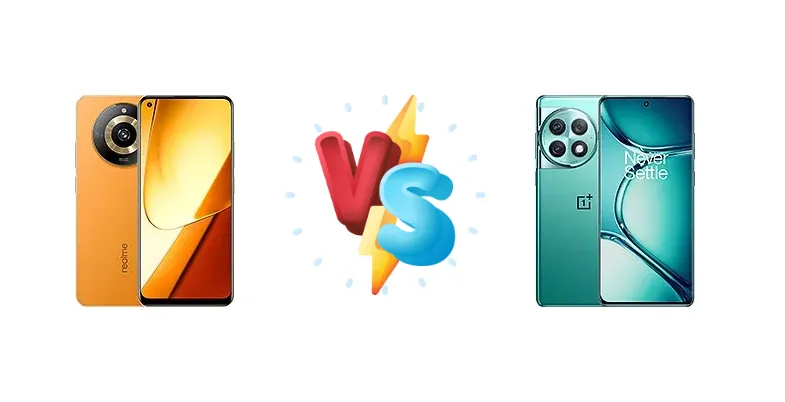
The Realme 11 (China) and OnePlus Ace 2 Pro represent distinct approaches to the Android smartphone market. The Realme 11 aims for affordability with a capable mid-range chipset, while the Ace 2 Pro throws down a flagship gauntlet with Qualcomm’s top-tier Snapdragon 8 Gen 2. This comparison dissects the core differences, focusing on performance, charging speed, and ultimately, which phone delivers the best value for your money.
🏆 Quick Verdict
For the average user prioritizing raw performance and blazing-fast charging, the OnePlus Ace 2 Pro is the clear winner. Its Snapdragon 8 Gen 2 chipset offers a substantial leap in processing power and gaming capabilities compared to the Realme 11’s Dimensity 6020. However, the Realme 11 remains a compelling option for budget-conscious buyers who don't need top-end performance.
| Network |
|---|
| 2G bands | GSM 850 / 900 / 1800 / 1900 | GSM 850 / 900 / 1800 / 1900 |
| 3G bands | HSDPA 850 / 900 / 2100 | HSDPA 850 / 900 / 1700(AWS) / 2100 |
| 4G bands | 1, 3, 5, 7, 8, 28, 34, 38, 39, 40, 41 | 1, 3, 4, 5, 7, 8, 18, 19, 26, 28, 34, 38, 39, 40, 41 |
| 5G bands | 1, 5, 8, 28, 41, 77, 78 SA/NSA | 1, 3, 5, 8, 28, 41, 77, 78 SA/NSA |
| Speed | HSPA, LTE, 5G | HSPA, LTE, 5G |
| Technology | GSM / CDMA / HSPA / CDMA2000 / LTE / 5G | GSM / CDMA / HSPA / LTE / 5G |
| Launch |
|---|
| Announced | 2023, May 10 | 2023, August 16 |
| Status | Available. Released 2023, June 01 | Available. Released 2023, August 23 |
| Body |
|---|
| Build | - | Glass front (Asahi Glass), plastic frame, glass back (Gorilla Glass 5) |
| Dimensions | 159.8 x 72.9 x 7.9 mm (6.29 x 2.87 x 0.31 in) | 163.1 x 74.2 x 9 mm (6.42 x 2.92 x 0.35 in) |
| SIM | Nano-SIM + Nano-SIM | Nano-SIM + Nano-SIM |
| Weight | 182 g (6.42 oz) | 210 g (7.41 oz) |
| Display |
|---|
| Protection | - | Asahi Glass |
| Resolution | 1080 x 2400 pixels, 20:9 ratio (~409 ppi density) | 1240 x 2772 pixels, 20:9 ratio (~451 ppi density) |
| Size | 6.43 inches, 99.8 cm2 (~85.7% screen-to-body ratio) | 6.74 inches, 109.2 cm2 (~90.3% screen-to-body ratio) |
| Type | Super AMOLED, 90Hz, 1000 nits (peak) | AMOLED, 1B colors, 120Hz, HDR10+, 550 nits (typ), 1200 nits (HBM), 1600 nits (peak) |
| Platform |
|---|
| CPU | Octa-core (2x2.2 GHz Cortex-A76 & 6x2.0 GHz Cortex-A55) | Octa-core (1x3.2 GHz Cortex-X3 & 2x2.8 GHz Cortex-A715 & 2x2.8 GHz Cortex-A710 & 3x2.0 GHz Cortex-A510) |
| Chipset | Mediatek Dimensity 6020 (7 nm) | Qualcomm SM8550-AB Snapdragon 8 Gen 2 (4 nm) |
| GPU | Mali-G57 MC2 | Adreno 740 |
| OS | Android 13, Realme UI 4.0 | Android 13, ColorOS 13.1 |
| Memory |
|---|
| Card slot | microSDXC | No |
| Internal | 128GB 8GB RAM, 128GB 12GB RAM, 256GB 8GB RAM, 256GB 12GB RAM | 256GB 12GB RAM, 512GB 16GB RAM, 1TB 24GB RAM |
| Main Camera |
|---|
| Dual | 64 MP, f/1.8, 25mm (wide), 1/2.0", 0.7µm, PDAF
Auxiliary lens | - |
| Features | LED flash, HDR, panorama | Color spectrum sensor, LED flash, HDR, panorama |
| Triple | - | 50 MP, f/1.8, 24mm (wide), 1/1.56", 1.0µm, PDAF, OIS
8 MP, f/2.2, 16mm, 112˚ (ultrawide), 1/4.0", 1.12µm
2 MP (macro) |
| Video | 1080p@30fps | 4K@30/60fps, 1080p@30/60/120/240fps, gyro-EIS, OIS |
| Selfie camera |
|---|
| Features | Panorama, HDR | HDR |
| Single | 8 MP, f/2.1, 24mm (wide) | 16 MP, f/2.4, 26mm (wide), 1/3.09", 1.0µm |
| Video | 1080p@30fps | 1080p@30fps |
| Sound |
|---|
| 35mm jack | Yes | No |
| Loudspeaker | Yes | Yes, with stereo speakers |
| Comms |
|---|
| Bluetooth | Yes | 5.3, A2DP, LE, aptX HD |
| Infrared port | - | Yes |
| NFC | Yes | Yes |
| Positioning | GPS, GALILEO, GLONASS, BDS, QZSS | GPS (L1+L5), GLONASS (G1), BDS (B1I+B1c+B2a), GALILEO (E1+E5a), QZSS (L1+L5) |
| Radio | No | No |
| USB | USB Type-C 2.0 | USB Type-C 2.0 |
| WLAN | Yes | Wi-Fi 802.11 a/b/g/n/ac/6/7, dual-band |
| Features |
|---|
| Sensors | Fingerprint (under display, optical), accelerometer, proximity, compass | Fingerprint (under display, optical), accelerometer, gyro, proximity, compass |
| Battery |
|---|
| Charging | 33W wired, 50% in 29 min | 150W wired |
| Type | 5000 mAh | Li-Po 5000 mAh |
| Misc |
|---|
| Colors | Black, Orange | Aurora Green, Titanium Gray |
| Models | RMX3751 | PJA110 |
| Price | About 260 EUR | About 380 EUR |
Realme 11 (China)
- More affordable price point
- Efficient Dimensity 6020 chipset for daily tasks
- Decent 33W charging speed
- Significantly lower performance than the Ace 2 Pro
- Likely a less advanced camera system
- May exhibit throttling under sustained load
OnePlus Ace 2 Pro
- Exceptional performance with Snapdragon 8 Gen 2
- Blazing-fast 150W wired charging
- Likely a superior camera system with OIS
- Higher price tag
- Potentially higher power consumption
- May run warmer under heavy load (though thermal management is improved with the 4nm process)
Display Comparison
While display specifications aren't provided for the Realme 11, it's likely to feature a standard LCD or AMOLED panel. The OnePlus Ace 2 Pro, given its flagship positioning, is expected to have a high-refresh-rate AMOLED display, potentially with LTPO technology for adaptive refresh rates. This would translate to smoother scrolling and animations, and improved power efficiency. The Ace 2 Pro's panel will likely boast higher peak brightness, making it more visible outdoors. Bezels are also expected to be slimmer on the Ace 2 Pro, contributing to a more immersive viewing experience.
Camera Comparison
Without specific camera details for the Realme 11, it’s reasonable to assume a standard camera setup focused on everyday photography. The OnePlus Ace 2 Pro, being a flagship, is expected to feature a more sophisticated camera system with a larger sensor, optical image stabilization (OIS), and advanced image processing algorithms. A larger sensor captures more light, resulting in better low-light performance and dynamic range. OIS minimizes blur caused by hand shake, leading to sharper images and videos. The Ace 2 Pro’s image processing will likely prioritize detail and color accuracy, while the Realme 11 may lean towards more saturated colors.
Performance
The core difference lies in the chipsets. The Realme 11’s Mediatek Dimensity 6020 (7nm) is a capable processor for everyday tasks, utilizing an octa-core configuration with Cortex-A76 and A55 cores. However, it’s significantly outmatched by the OnePlus Ace 2 Pro’s Qualcomm Snapdragon 8 Gen 2 (4nm). The Snapdragon 8 Gen 2 features a more advanced architecture – Cortex-X3, A715, and A710 cores – delivering substantially higher CPU and GPU performance. The 4nm process node of the Snapdragon 8 Gen 2 also provides superior thermal efficiency, meaning the Ace 2 Pro will sustain peak performance for longer periods without throttling. Gamers and power users will overwhelmingly benefit from the Ace 2 Pro’s superior processing capabilities.
Battery Life
The Realme 11 offers 33W wired charging, capable of reaching 50% charge in 29 minutes. This is a respectable charging speed, but the OnePlus Ace 2 Pro’s 150W wired charging is in a different league. 150W charging can replenish the battery from 0-100% in a matter of minutes, significantly reducing downtime. While the Realme 11 may have a slightly larger battery capacity (spec not provided), the Ace 2 Pro’s dramatically faster charging speed effectively mitigates any capacity difference. Users who frequently find themselves needing a quick top-up will greatly appreciate the Ace 2 Pro’s charging capabilities.
Buying Guide
Buy the Realme 11 (China) if you need a reliable daily driver for basic tasks, social media, and light gaming, and prioritize affordability above all else. You'll appreciate its efficient chipset and decent battery life. Buy the OnePlus Ace 2 Pro if you demand uncompromising performance for demanding games, content creation, and multitasking, and are willing to pay a premium for the fastest charging speeds available and a flagship-level experience.
Frequently Asked Questions
❓ Will the Dimensity 6020 in the Realme 11 struggle with graphically demanding games like Genshin Impact?
Yes, the Dimensity 6020 is a mid-range chipset and will likely require significant graphics settings reductions to achieve playable frame rates in demanding titles like Genshin Impact. The OnePlus Ace 2 Pro’s Snapdragon 8 Gen 2 will handle these games with ease at maximum settings.
❓ How long does a full charge actually take on the OnePlus Ace 2 Pro with its 150W charging?
While exact times vary based on battery level and temperature, the OnePlus Ace 2 Pro can typically charge from 0-100% in around 25-30 minutes. This is significantly faster than the Realme 11’s 33W charging, which takes closer to an hour and a half.
❓ Is the difference in performance between the two phones noticeable for everyday tasks like browsing and social media?
For basic tasks, the difference won't be dramatically noticeable. Both phones will handle browsing, social media, and messaging smoothly. However, the Ace 2 Pro will feel snappier and more responsive when multitasking or switching between apps.