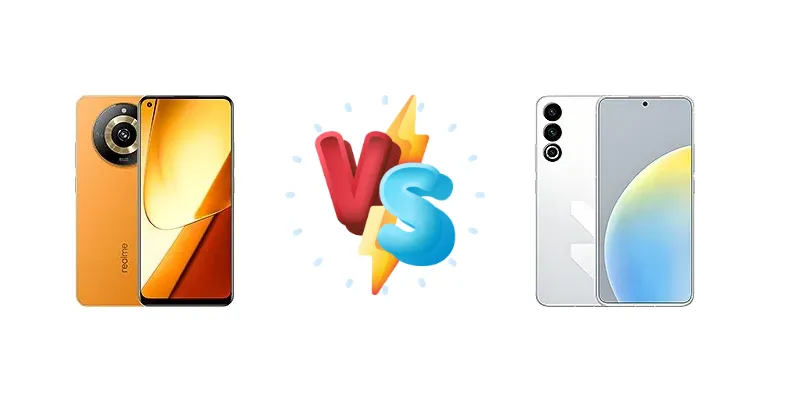
The Meizu 20 Classic and Realme 11 represent distinct approaches to the Android market. The Meizu aims for a premium experience with a flagship Snapdragon processor, while the Realme 11 focuses on delivering solid performance and features at a more accessible price point. This comparison dissects their key differences to help you determine which device best suits your needs.
🏆 Quick Verdict
For the average user prioritizing raw performance and fast charging, the Meizu 20 Classic is the clear winner. Its Snapdragon 8 Gen 2 chipset offers a substantial leap in processing power and efficiency compared to the Realme 11’s Dimensity 6020. However, the Realme 11 remains a compelling option for budget-conscious buyers.
| Network |
|---|
| 2G bands | GSM 850 / 900 / 1800 / 1900 | GSM 850 / 900 / 1800 / 1900 |
| 3G bands | HSDPA 850 / 900 / 2100 | HSDPA 800 / 850 / 900 / 1900 / 2100 |
| 4G bands | 1, 3, 5, 7, 8, 28, 34, 38, 39, 40, 41 | 1, 2, 3, 4, 5, 7, 8, 12, 28, 34, 38, 39, 40, 41 |
| 5G bands | 1, 5, 8, 28, 41, 77, 78 SA/NSA | 1, 3, 5, 8, 28, 38, 41, 77, 78 SA/NSA |
| Speed | HSPA, LTE, 5G | HSPA, LTE, 5G |
| Technology | GSM / CDMA / HSPA / CDMA2000 / LTE / 5G | GSM / HSPA / LTE / 5G |
| Launch |
|---|
| Announced | 2023, May 10 | 2023, October 19 |
| Status | Available. Released 2023, June 01 | Available. Released 2023, October 31 |
| Body |
|---|
| Dimensions | 159.8 x 72.9 x 7.9 mm (6.29 x 2.87 x 0.31 in) | 157.9 x 73.5 x 8 mm (6.22 x 2.89 x 0.31 in) |
| SIM | Nano-SIM + Nano-SIM | Nano-SIM + Nano-SIM |
| Weight | 182 g (6.42 oz) | 190 g (6.70 oz) |
| Display |
|---|
| Resolution | 1080 x 2400 pixels, 20:9 ratio (~409 ppi density) | 1080 x 2400 pixels, 20:9 ratio (~402 ppi density) |
| Size | 6.43 inches, 99.8 cm2 (~85.7% screen-to-body ratio) | 6.55 inches, 103.6 cm2 (~89.2% screen-to-body ratio) |
| Type | Super AMOLED, 90Hz, 1000 nits (peak) | OLED, 1B colors, 144Hz, 500 nits (typ), 800 nits (HBM) |
| Platform |
|---|
| CPU | Octa-core (2x2.2 GHz Cortex-A76 & 6x2.0 GHz Cortex-A55) | Octa-core (1x3.2 GHz Cortex-X3 & 2x2.8 GHz Cortex-A715 & 2x2.8 GHz Cortex-A710 & 3x2.0 GHz Cortex-A510) |
| Chipset | Mediatek Dimensity 6020 (7 nm) | Qualcomm SM8550-AB Snapdragon 8 Gen 2 (4 nm) |
| GPU | Mali-G57 MC2 | Adreno 740 |
| OS | Android 13, Realme UI 4.0 | Android 13, Flyme 10 |
| Memory |
|---|
| Card slot | microSDXC | No |
| Internal | 128GB 8GB RAM, 128GB 12GB RAM, 256GB 8GB RAM, 256GB 12GB RAM | 256GB 16GB RAM, 512GB 16GB RAM |
| Main Camera |
|---|
| Dual | 64 MP, f/1.8, 25mm (wide), 1/2.0", 0.7µm, PDAF
Auxiliary lens | - |
| Features | LED flash, HDR, panorama | Ring-LED flash, panorama, HDR |
| Triple | - | 50 MP, f/1.9, 24mm (wide), 1/1.56", PDAF, OIS
16 MP, f/2.4, 16mm, 122˚ (ultrawide)
5 MP, f/2.4 |
| Video | 1080p@30fps | 8K, 4K, 1080p; gyro-EIS |
| Selfie camera |
|---|
| Features | Panorama, HDR | HDR |
| Single | 8 MP, f/2.1, 24mm (wide) | 32 MP, f/2.5, (wide) |
| Video | 1080p@30fps | Yes |
| Sound |
|---|
| 35mm jack | Yes | No |
| Loudspeaker | Yes | Yes, with stereo speakers |
| Comms |
|---|
| Bluetooth | Yes | 5.3, A2DP, LE |
| NFC | Yes | Yes |
| Positioning | GPS, GALILEO, GLONASS, BDS, QZSS | GPS (L1+L5), GLONASS, BDS (B1I+B1c+B2a), GALILEO, QZSS |
| Radio | No | No |
| USB | USB Type-C 2.0 | USB Type-C, OTG |
| WLAN | Yes | Wi-Fi 802.11 а/b/g/n/ac/6e/7, dual-band |
| Features |
|---|
| Sensors | Fingerprint (under display, optical), accelerometer, proximity, compass | Fingerprint (under display, ultrasonic), accelerometer, gyro, proximity, compass |
| Battery |
|---|
| Charging | 33W wired, 50% in 29 min | 67W wired, PD3 PPS, QC4+ |
| Type | 5000 mAh | Li-Po 4700 mAh |
| Misc |
|---|
| Colors | Black, Orange | Gray, Silver, Green |
| Models | RMX3751 | - |
| Price | About 260 EUR | About 400 EUR |
Realme 11 (China)
- Superior performance with Snapdragon 8 Gen 2
- Faster 67W charging with advanced protocols
- Likely better camera image quality
- More efficient processor for longer battery life
- Higher price point
- Potentially less readily available (Meizu distribution)
Meizu 20 Classic
- More affordable price
- Decent performance for everyday tasks
- Widely available through Realme channels
- Reliable Mediatek chipset
- Significantly slower charging speed
- Lower performance compared to Snapdragon 8 Gen 2
- Potentially inferior camera performance
Display Comparison
While display specifications aren't provided, the Meizu 20 Classic, positioned as a 'Classic' model, likely prioritizes color accuracy and viewing angles. The Realme 11, targeting a broader market, may lean towards maximizing screen size within its budget. The absence of LTPO technology in either device suggests both will rely on adaptive refresh rates to balance smoothness and power consumption. Bezels are likely minimal on the Meizu, reflecting its flagship status, while the Realme 11 may have slightly larger bezels to reduce production costs.
Camera Comparison
Without detailed camera specs, it’s difficult to make a definitive comparison. However, the Meizu 20 Classic, as a flagship, is expected to feature a larger main sensor and more sophisticated image processing algorithms. The Snapdragon 8 Gen 2’s ISP (Image Signal Processor) is also significantly more advanced than the Dimensity 6020’s, resulting in better dynamic range, noise reduction, and overall image quality. The Realme 11 likely relies on software enhancements to compensate for a potentially less capable sensor, but will likely fall short of the Meizu’s capabilities in challenging lighting conditions. We can assume both phones will include standard features like HDR and night mode.
Performance
The core difference lies in the chipsets. The Meizu 20 Classic’s Snapdragon 8 Gen 2 (4nm) is a powerhouse, featuring a Cortex-X3 prime core clocked at 3.2 GHz, designed for peak performance. This contrasts sharply with the Realme 11’s Dimensity 6020 (7nm). The Snapdragon 8 Gen 2’s 4nm process node provides superior thermal efficiency, meaning sustained performance under load will be significantly better, reducing throttling during extended gaming sessions. The CPU architecture also favors the Meizu; the Snapdragon’s newer Cortex-X3 and A715 cores offer substantial improvements over the Dimensity’s Cortex-A76 and A55. While both phones likely utilize LPDDR5x RAM, the Snapdragon’s superior processing capabilities will allow it to fully leverage the memory bandwidth.
Battery Life
The Meizu 20 Classic’s 67W wired charging with PD3 PPS and QC4+ support is a major advantage. This allows for significantly faster charging times compared to the Realme 11’s 33W charging – a 50% charge in 29 minutes for the Realme 11 is considerably slower than what the Meizu can achieve. While battery capacity isn’t specified, the Snapdragon 8 Gen 2’s superior efficiency means the Meizu 20 Classic can likely deliver comparable or even better battery life despite potentially having a smaller battery than the Realme 11. The advanced charging protocols on the Meizu also ensure compatibility with a wider range of chargers and optimized charging speeds.
Buying Guide
Buy the Realme 11 (China) if you need a reliable daily driver for basic tasks, social media, and light gaming, and value affordability above all else. Buy the Meizu 20 Classic if you prioritize demanding applications like mobile gaming, video editing, or running resource-intensive apps, and are willing to pay a premium for a flagship-level experience and significantly faster charging.
Frequently Asked Questions
❓ Will the Dimensity 6020 in the Realme 11 struggle with graphically demanding games like Genshin Impact?
The Dimensity 6020 is capable of running Genshin Impact, but you'll likely need to lower the graphics settings to medium or low to maintain a stable frame rate. The Snapdragon 8 Gen 2 in the Meizu 20 Classic will handle Genshin Impact at maximum settings with ease.
❓ How much faster is the 67W charging on the Meizu 20 Classic compared to the 33W charging on the Realme 11 in real-world use?
The Meizu 20 Classic can significantly reduce charging times. While the Realme 11 takes approximately 29 minutes to reach 50%, the Meizu 20 Classic can likely achieve a full charge in under 40 minutes, offering a much quicker top-up when you're short on time.
❓ Is the difference in performance between the two phones noticeable for everyday tasks like browsing and social media?
For basic tasks, the difference won't be dramatically noticeable. However, the Meizu 20 Classic will feel snappier and more responsive when multitasking or switching between apps due to its more powerful processor and faster memory access.
❓ Does the Meizu 20 Classic's Snapdragon 8 Gen 2 generate significantly more heat during prolonged gaming sessions?
Despite being a more powerful chip, the Snapdragon 8 Gen 2's 4nm process is more efficient than the Dimensity 6020's 7nm process. This means the Meizu 20 Classic is likely to manage heat better and experience less throttling during extended gaming, providing more consistent performance.