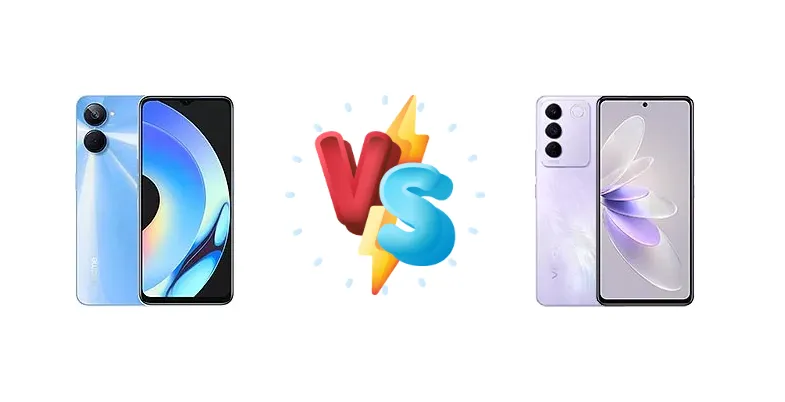
The Realme 10s and Vivo V27e represent compelling options in the crowded budget smartphone market. Both devices leverage Mediatek chipsets, but diverge significantly in charging speed and overall performance tuning. This comparison dissects these differences to help you determine which phone best suits your needs.
🏆 Quick Verdict
For the average user prioritizing rapid charging and a slightly more refined experience, the vivo V27e emerges as the winner. Its 66W charging significantly reduces downtime, offsetting the marginally lower CPU clock speed compared to the Realme 10s. However, the Realme 10s remains a strong contender for those focused on maximizing raw processing power within a tight budget.
| Network |
|---|
| 2G bands | GSM 850 / 900 / 1800 / 1900 | GSM 850 / 900 / 1800 / 1900 |
| 3G bands | HSDPA 800 / 850 / 900 / 1700(AWS) / 1900 / 2100 | HSDPA 850 / 900 / 2100 |
| 4G bands | 1, 2, 3, 4, 5, 7, 8, 19, 20, 28, 34, 38, 39, 40, 41 | 1, 3, 5, 7, 8, 20, 28, 38, 40, 41 |
| 5G bands | 1, 5, 8, 28, 41, 77, 78 SA/NSA | - |
| Speed | HSPA, LTE, 5G | HSPA, LTE |
| Technology | GSM / CDMA / HSPA / LTE / 5G | GSM / HSPA / LTE |
| | CDMA 800 | - |
| Launch |
|---|
| Announced | 2022, December 16 | 2023, March 01 |
| Status | Available. Released 2022, December 20 | Available. Released 2023, March 01 |
| Body |
|---|
| Build | - | Glass front, plastic frame, plastic back |
| Dimensions | 164.4 x 75.1 x 8.1 mm (6.47 x 2.96 x 0.32 in) | 162.5 x 75.8 x 7.7 mm (6.40 x 2.98 x 0.30 in) |
| SIM | Nano-SIM + Nano-SIM | Nano-SIM + Nano-SIM |
| Weight | 191 g (6.74 oz) | 185 g (6.53 oz) |
| | - | IP54, dust and water resistant
|
| Display |
|---|
| Resolution | 1080 x 2408 pixels, 20:9 ratio (~400 ppi density) | 1080 x 2400 pixels, 20:9 ratio (~398 ppi density) |
| Size | 6.6 inches, 104.9 cm2 (~85.0% screen-to-body ratio) | 6.62 inches, 105.8 cm2 (~85.9% screen-to-body ratio) |
| Type | IPS LCD, 90Hz, 400 nits (typ) | AMOLED, 120Hz |
| Platform |
|---|
| CPU | Octa-core (2x2.4 GHz Cortex-A76 & 6x2.0 GHz Cortex-A55) | Octa-core (2x2.2 GHz Cortex-A76 & 6x2.0 GHz Cortex-A55) |
| Chipset | Mediatek Dimensity 810 (6 nm) | Mediatek Helio G99 (6 nm) |
| GPU | Mali-G57 MC2 | Mali-G57 MC2 |
| OS | Android 12, Realme UI 3.0 | Android 13, Funtouch 13 |
| Memory |
|---|
| Card slot | microSDXC (dedicated slot) | microSDXC (uses shared SIM slot) |
| Internal | 128GB 8GB RAM, 256GB 8GB RAM | 128GB 8GB RAM, 256GB 8GB RAM, 256GB 12GB RAM |
| | UFS 2.2 | - |
| Main Camera |
|---|
| Dual | 50 MP, f/1.8, (wide), PDAF
Auxiliary lens | - |
| Features | LED flash, HDR, panorama | Ring-LED flash, panorama, HDR |
| Single | 8 MP, f/2.0, 27mm (wide) | 32 MP, f/2.5, (wide) |
| Triple | - | 64 MP, f/1.8, (wide), PDAF, OIS
2 MP (macro)
Auxiliary lens |
| Video | 1080p@30fps | 4K@30/60fps, 1080p@30fps, gyro-EIS |
| Selfie camera |
|---|
| Features | HDR, panorama | HDR |
| Single | 8 MP, f/2.0, 27mm (wide) | 32 MP, f/2.5, (wide) |
| Video | 1080p@30fps | 1080p@30fps |
| Sound |
|---|
| 3.5mm jack | Yes | No |
| 35mm jack | Yes | No |
| Loudspeaker | Yes | Yes |
| | 24-bit/192kHz audio | - |
| Comms |
|---|
| Bluetooth | 5.2, A2DP, LE | 5.2, A2DP, LE |
| NFC | No | Yes |
| Positioning | GPS, GLONASS, BDS | GPS, GLONASS, GALILEO, BDS, QZSS |
| Radio | No | Unspecified |
| USB | USB Type-C 2.0, OTG | USB Type-C 2.0, OTG |
| WLAN | Wi-Fi 802.11 a/b/g/n/ac, dual-band | Wi-Fi 802.11 a/b/g/n/ac, dual-band, Wi-Fi Direct |
| Features |
|---|
| Sensors | Fingerprint (side-mounted), accelerometer, proximity, compass | Fingerprint (under display, optical), accelerometer, gyro, proximity, compass |
| Battery |
|---|
| Charging | 33W wired, 50% in 33 min | 66W wired, 50% in 19 min |
| Type | 5000 mAh | 4600 mAh |
| Misc |
|---|
| Colors | Black, Blue | Glory Black, Lavender Purple, Lively Green |
| Models | - | V2237 |
| Price | About 150 EUR | About 270 EUR |
Realme 10s
- Slightly higher CPU clock speed for potentially faster processing.
- Competitive price point for the performance offered.
- Mediatek Dimensity 810 offers good all-around performance.
- Slower 33W charging compared to the vivo V27e.
- Likely less refined software experience compared to vivo.
vivo V27e
- Significantly faster 66W charging for reduced downtime.
- Potentially better sustained performance due to the Helio G99's efficiency.
- Vivo's Funtouch OS often provides a smoother user experience.
- Slightly lower CPU clock speed compared to the Realme 10s.
- May be marginally more expensive than the Realme 10s.
Display Comparison
Neither device boasts a standout display. Both likely utilize LCD panels, common in this price bracket. While specific display specs are missing, the focus here is on internal performance. Bezels are expected to be similar, and color accuracy will likely be tuned for vibrant, rather than color-accurate, visuals. The absence of high refresh rates on either device suggests a focus on power efficiency.
Camera Comparison
Without detailed camera specifications, a direct comparison is difficult. However, both phones likely feature a primary camera around the 50MP mark. The image processing style will likely differ – Realme often leans towards more saturated colors, while vivo tends towards a more natural look. The presence of a 2MP macro camera on both devices is largely a marketing tactic, offering limited practical benefit due to the small sensor size and lack of optical image stabilization (OIS).
Performance
The Realme 10s features the Mediatek Dimensity 810, built on a 6nm process, with a CPU configuration of 2x2.4 GHz Cortex-A76 cores and 6x2.0 GHz Cortex-A55 cores. The vivo V27e utilizes the Helio G99, also 6nm, but with a slightly lower CPU clock speed of 2x2.2 GHz Cortex-A76 and 6x2.0 GHz Cortex-A55. While the Dimensity 810 has a slight clock speed advantage, the real-world difference will be minimal for most users. The G99 is known for its efficiency, potentially leading to better sustained performance under load. Both phones will likely pair their chipsets with 6GB or 8GB of RAM, impacting multitasking capabilities.
Battery Life
The vivo V27e’s 66W wired charging is the standout feature here, promising a 50% charge in just 19 minutes. The Realme 10s, with its 33W charging, takes 33 minutes to reach 50%. This difference in charging speed is substantial and directly impacts user convenience. While battery capacity isn't specified, the faster charging of the V27e effectively mitigates any potential disadvantage from a slightly smaller battery size. The 6nm process of both chipsets contributes to reasonable power efficiency, but the V27e’s charging advantage is the key differentiator.
Buying Guide
Buy the Realme 10s if you need a phone that prioritizes sustained CPU performance for tasks like multitasking and light gaming, and you're willing to trade off faster charging. Buy the vivo V27e if you prefer a phone that minimizes downtime with its significantly faster 66W charging, and you value a more streamlined user experience, even if it means a slight compromise in peak CPU performance.
Frequently Asked Questions
❓ Will the Helio G99 in the vivo V27e struggle with demanding games like PUBG or Call of Duty?
The Helio G99 is a capable chipset for gaming at medium settings. While it won't deliver flagship-level performance, it should provide a playable experience in popular titles like PUBG and Call of Duty. The efficiency of the 6nm process also helps to minimize thermal throttling during extended gaming sessions.
❓ How much faster is the 66W charging on the vivo V27e compared to the 33W charging on the Realme 10s in real-world use?
The difference is substantial. While both phones reach 50% charge in a specified time, the V27e's 66W charging will fully charge the device significantly faster than the 10s. Expect a 0-100% charge to take around 45-60 minutes on the V27e, compared to potentially 90+ minutes on the Realme 10s.
❓ Are the software experiences on Realme and vivo significantly different?
Yes. Realme UI is known for its customization options and sometimes aggressive battery management. Vivo's Funtouch OS (now OriginOS in some regions) generally offers a cleaner, more streamlined experience with a focus on usability. User preference plays a large role here, but many find Funtouch OS to be less cluttered.