
Nothing Phone (2) vs. Realme 10 Pro+: A Deep Dive into Mid-Range Champions
| Phones Images | |||||
|---|---|---|---|---|---|
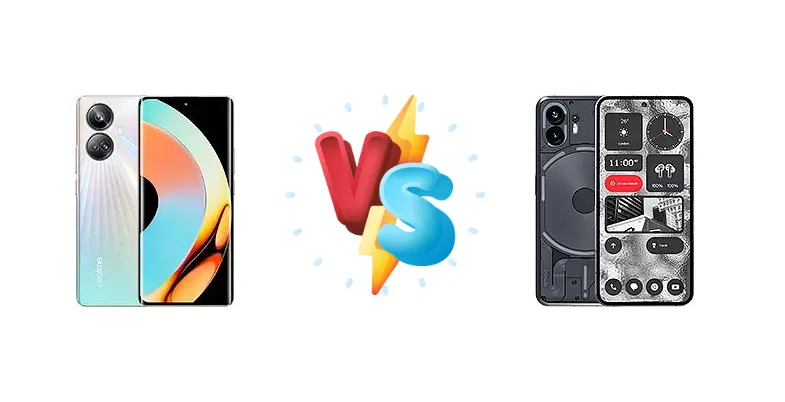
|
🏆 Quick Verdict
For users prioritizing raw performance and a unique software experience, the Nothing Phone (2) is the clear winner. However, the Realme 10 Pro+ offers a compelling package with faster wired charging and respectable battery life, making it a strong choice for budget-conscious buyers.
| PHONES | ||
|---|---|---|
| Phone Names | Realme 10 Pro+ | Nothing Phone (2) |
| Network | ||
|---|---|---|
| 2G bands | GSM 850 / 900 / 1800 / 1900 | GSM 850 / 900 / 1800 / 1900 |
| 3G bands | HSDPA 800 / 850 / 900 / 1700(AWS) / 1900 / 2100 | HSDPA 800 / 850 / 900 / 1700(AWS) / 1900 / 2100 |
| 4G bands | 1, 2, 3, 4, 5, 7, 8, 12, 13, 17, 18, 19, 20, 26, 28, 38, 39, 40, 41, 66 - International | 1, 2, 3, 4, 5, 7, 8, 12, 17, 18, 19, 20, 25, 26, 28, 30, 32, 34, 38, 39, 40, 41, 42, 48, 66, 71 |
| 5G bands | 1, 3, 5, 7, 8, 20, 28, 38, 40, 41, 66, 77, 78 SA/NSA - International | 1, 2, 3, 5, 7, 8, 12, 20, 25, 28, 30, 38, 40, 41, 66, 71, 75, 77, 78 SA/NSA |
| Speed | HSPA, LTE, 5G | HSPA, LTE, 5G |
| Technology | GSM / CDMA / HSPA / CDMA2000 / LTE / 5G | GSM / HSPA / LTE / 5G |
| Launch | ||
|---|---|---|
| Announced | 2022, November 17 | 2023, July 11 |
| Status | Available. Released 2022, November 24 | Available. Released 2023, July 17 |
| Body | ||
|---|---|---|
| Build | Glass front, plastic frame, plastic back | Glass front (Gorilla Glass 5), glass back (Gorilla Glass 5), aluminum frame |
| Dimensions | 161.5 x 73.9 x 7.8 mm or 8 mm | 162.1 x 76.4 x 8.6 mm (6.38 x 3.01 x 0.34 in) |
| SIM | Nano-SIM + Nano-SIM | Nano-SIM + Nano-SIM |
| Weight | 173 g / 175 g (6.10 oz) | 201.2 g (7.09 oz) |
| Display | ||
|---|---|---|
| Protection | - | Corning Gorilla Glass 5 |
| Resolution | 1080 x 2412 pixels, 20:9 ratio (~394 ppi density) | 1080 x 2412 pixels, 20:9 ratio (~394 ppi density) |
| Size | 6.7 inches, 108.0 cm2 (~90.5% screen-to-body ratio) | 6.7 inches, 108.0 cm2 (~87.2% screen-to-body ratio) |
| Type | AMOLED, 1B colors, HDR10+, 120Hz, 800 nits | LTPO OLED, 1B colors, 120Hz, 1920Hz PWM, HDR10+, 1600 nits (HBM), 1600 nits (peak) |
| Platform | ||
|---|---|---|
| CPU | Octa-core (2x2.6 GHz Cortex-A78 & 6x2.0 GHz Cortex-A55) - version 1Octa-core (2x2.5 GHz Cortex-A78 & 6x2.0 GHz Cortex-A55) - version 2 | Octa-core (1x3.0 GHz Cortex-X2 & 3x2.5 GHz Cortex-A710 & 4x1.80 GHz Cortex-A510) |
| Chipset | Mediatek Dimensity 1080 (6 nm) - version 1Mediatek Dimensity 920 (6 nm) - version 2 | Qualcomm SM8475 Snapdragon 8+ Gen 1 (4 nm) |
| GPU | Mali-G68 MC4 - version 1Mali-G68 MC4 - version 2 | Adreno 730 |
| OS | Android 13, Realme UI 4.0 | Android 13, upgradable to Android 15, up to 3 major Android upgrades, Nothing OS 3.0 |
| Memory | ||
|---|---|---|
| Card slot | No | No |
| Internal | 128GB 6GB RAM, 128GB 8GB RAM, 256GB 8GB RAM, 256GB 12GB RAM | 128GB 8GB RAM, 256GB 12GB RAM, 512GB 12GB RAM |
| Main Camera | ||
|---|---|---|
| Dual | - | 50 MP, f/1.9, 24mm (wide), 1/1.56", 1.0µm, PDAF, OIS 50 MP, f/2.2, 114˚ (ultrawide), 1/2.76", 0.64µm, AF |
| Features | LED flash, HDR, panorama | LED flash, panorama, HDR |
| Triple | 108 MP, f/1.8, 24mm (wide), 1/1.67", 0.64µm, PDAF 8 MP, f/2.2, 16mm, 112˚ (ultrawide) 2 MP (macro) | - |
| Video | 4K@30fps, 1080p@30/60/120/480fps, 720p@960fps, gyro-EIS | 4K@30/60fps, 1080p@30/60fps, gyro-EIS, live HDR, OIS |
| Selfie camera | ||
|---|---|---|
| Features | Panorama | HDR |
| Single | 16 MP, f/2.5, 25mm (wide) | 32 MP, f/2.5, (wide), 1/2.74", 0.8µm |
| Video | 1080p@30fps | 1080p@30fps |
| Sound | ||
|---|---|---|
| 35mm jack | No | No |
| Loudspeaker | Yes, with stereo speakers | Yes, with stereo speakers |
| Comms | ||
|---|---|---|
| Bluetooth | 5.2, A2DP, LE, aptX HD | 5.3, A2DP, LE, aptX HD, aptX Adaptive |
| NFC | Yes (market/region dependent) | Yes |
| Positioning | GPS (L1+L5), GALILEO, GLONASS, BDS, QZSS | GPS (L1+L5), GLONASS (L1), BDS (B1I+B1c), GALILEO (E1), QZSS (L1), NavIC |
| Radio | No | No |
| USB | USB Type-C 2.0 | USB Type-C 2.0, OTG |
| WLAN | Wi-Fi 802.11 a/b/g/n/ac/6, dual-band | Wi-Fi 802.11 a/b/g/n/ac/6, dual-band, Wi-Fi Direct |
| Features | ||
|---|---|---|
| Sensors | Fingerprint (under display, optical), accelerometer, gyro, proximity, compass | Fingerprint (under display, optical), accelerometer, proximity, gyro, compass |
| Battery | ||
|---|---|---|
| Charging | 67W wired, PD3.0, 50% in 17 min | 45W wired, PD3.0, PPS, QC4, 100% in 55 min 15W wireless, 100% in 130 min 5W reverse wireless |
| Type | 5000 mAh | Li-Ion 4700 mAh |
| Misc | ||
|---|---|---|
| Colors | Dark Matter Black, Nebula Blue, Hyperspace | White, Dark Gray |
| Models | RMX3687, RMX3686 | A065 |
| Price | About 650 EUR | $ 379.99 / £ 370.00 |
Realme 10 Pro+
- Faster 67W wired charging
- Potentially longer battery endurance (based on older rating)
- More affordable price point
- Less powerful processor (Dimensity 1080)
- Lower peak display brightness
- Limited charging options (no wireless)
Nothing Phone (2)
- Flagship-level Snapdragon 8+ Gen 1 performance
- Brighter display for outdoor visibility
- Wireless and reverse wireless charging
- Slower wired charging compared to Realme
- Higher price
- Potentially shorter battery life under heavy load
Display Comparison
The Nothing Phone (2) boasts a brighter display, reaching 998 nits measured, compared to the Realme 10 Pro+'s 809 nits. This translates to better outdoor visibility for the Nothing Phone (2). While both utilize OLED panels, Nothing doesn't specify PWM dimming frequency, a crucial factor for users sensitive to flicker. Realme doesn't publish this data either, making it difficult to assess which is better for eye comfort. Both displays are likely to offer vibrant colors and deep blacks, but the Nothing Phone (2)'s higher peak brightness provides a tangible advantage in bright conditions.
Camera Comparison
Both phones feature capable camera systems, but detailed sensor information is lacking in the provided data. Both are advertised as capable in Photo and Video. The Nothing Phone (2)'s Snapdragon ISP benefits from advanced image processing capabilities, potentially leading to better dynamic range and low-light performance. Without specific sensor size or aperture details, it's difficult to definitively declare a winner. However, the Nothing Phone (2)'s more powerful processor provides a computational advantage in post-processing, which is increasingly important for smartphone photography.
Performance
The core difference lies in the chipsets. The Nothing Phone (2) is powered by the Qualcomm Snapdragon 8+ Gen 1 (4nm), a significant leap over the Realme 10 Pro+'s Mediatek Dimensity 1080 (6nm) – or even the Dimensity 920 variant. The Snapdragon 8+ Gen 1’s Cortex-X2 prime core clocked at 3.0 GHz, coupled with its more efficient 4nm process, delivers substantially higher CPU and GPU performance. The Realme 10 Pro+’s Dimensity 1080, with its Cortex-A78 cores peaking at 2.6 GHz (or 2.5 GHz in the variant 2), is capable for everyday tasks, but will struggle with sustained gaming at high settings. The Nothing Phone (2)'s superior thermal efficiency, thanks to the 4nm node, also minimizes throttling during prolonged intensive use.
Battery Life
The Realme 10 Pro+ boasts a 149-hour endurance rating, while the Nothing Phone (2) achieves 14:21h of active use and a 103-hour endurance rating. While the endurance rating seems higher for the Realme, the active use score provides a more realistic picture of real-world performance. The Nothing Phone (2) compensates for its potentially smaller battery capacity with the Snapdragon 8+ Gen 1’s improved power efficiency. Furthermore, the Nothing Phone (2) offers 45W wired charging, 15W wireless charging, and 5W reverse wireless charging, providing greater versatility, while the Realme 10 Pro+ is limited to 67W wired charging. The Realme 10 Pro+ charges to 50% in 17 minutes, while the Nothing Phone (2) takes 55 minutes for a full charge.
Buying Guide
Buy the Realme 10 Pro+ if you need exceptionally fast 67W wired charging and prioritize maximizing battery endurance with a focus on value. Buy the Nothing Phone (2) if you prefer a premium build, a more powerful Snapdragon 8+ Gen 1 processor for demanding tasks, and the distinctive Glyph Interface for notifications and customization.