
Realme 10 Pro+ vs Google Pixel 7a: Which Mid-Range Phone Delivers More?
| Phones Images | |||||
|---|---|---|---|---|---|
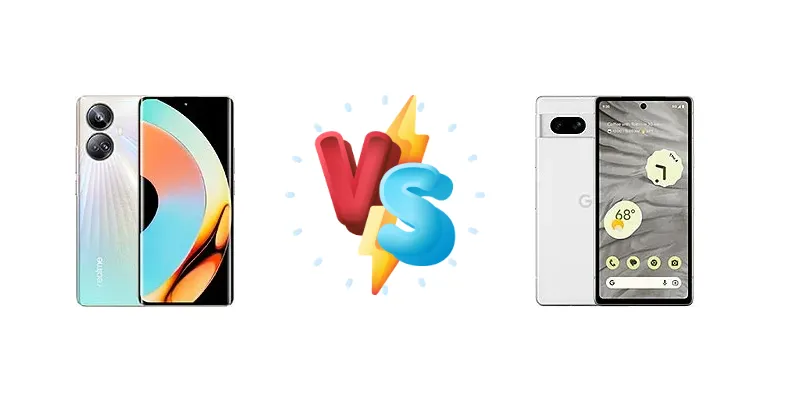
|
🏆 Quick Verdict
For the average user prioritizing camera quality and software support, the Google Pixel 7a is the clear winner. Its Tensor G2 chip and Google’s image processing deliver consistently excellent photos and videos. However, the Realme 10 Pro+ offers significantly faster charging and potentially better raw performance with the Dimensity 1080 (version 1) making it a strong contender for power users.
| PHONES | ||
|---|---|---|
| Phone Names | Realme 10 Pro+ | Google Pixel 7a |
| Network | ||
|---|---|---|
| 2G bands | GSM 850 / 900 / 1800 / 1900 | GSM 850 / 900 / 1800 / 1900 |
| 3G bands | HSDPA 800 / 850 / 900 / 1700(AWS) / 1900 / 2100 | HSDPA 800 / 850 / 900 / 1700(AWS) / 1900 / 2100 |
| 4G bands | 1, 2, 3, 4, 5, 7, 8, 12, 13, 17, 18, 19, 20, 26, 28, 38, 39, 40, 41, 66 - International | 1, 2, 3, 4, 5, 7, 8, 12, 13, 14, 17, 20, 25, 26, 28, 29, 30, 38, 40, 41, 48, 66, 71 - GWKK3, G0DZQ |
| 5G bands | 1, 3, 5, 7, 8, 20, 28, 38, 40, 41, 66, 77, 78 SA/NSA - International | 1, 2, 3, 5, 7, 8, 12, 14, 20, 25, 28, 30, 38, 41, 48, 66, 71, 77, 78 SA/NSA/Sub6 - GWKK3 |
| Speed | HSPA, LTE, 5G | HSPA, LTE, 5G |
| Technology | GSM / CDMA / HSPA / CDMA2000 / LTE / 5G | GSM / HSPA / LTE / 5G |
| - | 1, 2, 3, 5, 7, 8, 12, 20, 25, 28, 38, 40, 41, 66, 75, 76, 77, 78, 79 SA/NSA/Sub6 - GHL1X, G82U8 | |
| Launch | ||
|---|---|---|
| Announced | 2022, November 17 | 2023, May 10 |
| Status | Available. Released 2022, November 24 | Available. Released 2023, May 10 |
| Body | ||
|---|---|---|
| Build | Glass front, plastic frame, plastic back | Glass front (Gorilla Glass 3), aluminum frame, plastic back |
| Dimensions | 161.5 x 73.9 x 7.8 mm or 8 mm | 152 x 72.9 x 9 mm (5.98 x 2.87 x 0.35 in) |
| SIM | Nano-SIM + Nano-SIM | Nano-SIM + eSIM |
| Weight | 173 g / 175 g (6.10 oz) | 193.5 g (6.84 oz) |
| - | IP67 dust/water resistant (up to 1m for 30 min) | |
| Display | ||
|---|---|---|
| Protection | - | Corning Gorilla Glass 3 |
| Resolution | 1080 x 2412 pixels, 20:9 ratio (~394 ppi density) | 1080 x 2400 pixels, 20:9 ratio (~429 ppi density) |
| Size | 6.7 inches, 108.0 cm2 (~90.5% screen-to-body ratio) | 6.1 inches, 90.7 cm2 (~81.8% screen-to-body ratio) |
| Type | AMOLED, 1B colors, HDR10+, 120Hz, 800 nits | OLED, HDR, 90Hz |
| - | Always-on display | |
| Platform | ||
|---|---|---|
| CPU | Octa-core (2x2.6 GHz Cortex-A78 & 6x2.0 GHz Cortex-A55) - version 1Octa-core (2x2.5 GHz Cortex-A78 & 6x2.0 GHz Cortex-A55) - version 2 | Octa-core (2x2.85 GHz Cortex-X1 & 2x2.35 GHz Cortex-A78 & 4x1.80 GHz Cortex-A55) |
| Chipset | Mediatek Dimensity 1080 (6 nm) - version 1Mediatek Dimensity 920 (6 nm) - version 2 | Google Tensor G2 (5 nm) |
| GPU | Mali-G68 MC4 - version 1Mali-G68 MC4 - version 2 | Mali-G710 MP7 |
| OS | Android 13, Realme UI 4.0 | Android 13, upgradable to Android 15, up to 5 major Android upgrades |
| Memory | ||
|---|---|---|
| Card slot | No | No |
| Internal | 128GB 6GB RAM, 128GB 8GB RAM, 256GB 8GB RAM, 256GB 12GB RAM | 128GB 8GB RAM |
| - | UFS 3.1 | |
| Main Camera | ||
|---|---|---|
| Dual | - | 64 MP, f/1.9, 26mm (wide), 1/1.73", 0.8µm, dual pixel PDAF, OIS 13 MP, f/2.2, 120˚ (ultrawide), 1.12µm |
| Features | LED flash, HDR, panorama | Dual-LED flash, Pixel Shift, Auto-HDR, panorama |
| Triple | 108 MP, f/1.8, 24mm (wide), 1/1.67", 0.64µm, PDAF 8 MP, f/2.2, 16mm, 112˚ (ultrawide) 2 MP (macro) | - |
| Video | 4K@30fps, 1080p@30/60/120/480fps, 720p@960fps, gyro-EIS | 4K@30/60fps, 1080p@30/60/120/240fps, OIS |
| Selfie camera | ||
|---|---|---|
| Features | Panorama | HDR, panorama |
| Single | 16 MP, f/2.5, 25mm (wide) | 13 MP, f/2.2, 20mm (ultrawide), 1.12µm |
| Video | 1080p@30fps | 4K@30fps, 1080p@30fps |
| Sound | ||
|---|---|---|
| 3.5mm jack | - | No |
| 35mm jack | No | No |
| Loudspeaker | Yes, with stereo speakers | Yes, with stereo speakers |
| Comms | ||
|---|---|---|
| Bluetooth | 5.2, A2DP, LE, aptX HD | 5.3, A2DP, LE |
| NFC | Yes (market/region dependent) | Yes |
| Positioning | GPS (L1+L5), GALILEO, GLONASS, BDS, QZSS | GPS, GLONASS, GALILEO, BDS, QZSS, NavIC |
| Radio | No | No |
| USB | USB Type-C 2.0 | USB Type-C 3.2 |
| WLAN | Wi-Fi 802.11 a/b/g/n/ac/6, dual-band | Wi-Fi 802.11 a/b/g/n/ac/6e, tri-band |
| Features | ||
|---|---|---|
| Sensors | Fingerprint (under display, optical), accelerometer, gyro, proximity, compass | Fingerprint (under display, optical), accelerometer, gyro, proximity, compass, barometer |
| Battery | ||
|---|---|---|
| Charging | 67W wired, PD3.0, 50% in 17 min | 18W wired, PD3.0 7.5W wireless |
| Type | 5000 mAh | Li-Po 4385 mAh |
| Misc | ||
|---|---|---|
| Colors | Dark Matter Black, Nebula Blue, Hyperspace | Charcoal, Snow, Sea, Coral |
| Models | RMX3687, RMX3686 | GWKK3, GHL1X, G0DZQ, G82U8 |
| Price | About 650 EUR | € 179.90 / $ 150.00 / £ 170.00 / ₹ 25,980 |
Realme 10 Pro+
- Significantly faster 67W charging
- Potentially higher raw processing power (Dimensity 1080 version)
- Longer battery endurance rating
- Realme UI may not appeal to all users
- Camera performance likely trails the Pixel 7a
Google Pixel 7a
- Superior camera quality and image processing
- Clean and consistently updated Android experience
- Google Tensor G2 excels in AI and machine learning
- Slow 18W charging
- Lower battery endurance rating
Display Comparison
Both phones feature capable displays, but the Pixel 7a edges out the Realme 10 Pro+ in peak brightness, reaching 1070 nits compared to the Realme’s 809 nits. This translates to better visibility under direct sunlight. While both likely utilize OLED panels, the Pixel 7a’s higher brightness and Google’s color calibration likely result in a more vibrant and accurate viewing experience. The Realme 10 Pro+’s display is still perfectly usable, but lacks the extra punch of the Pixel.
Camera Comparison
Google’s strength lies in its computational photography, and the Pixel 7a is no exception. While both phones offer photo and video capabilities, the Pixel 7a’s Tensor G2 chip enables features like Magic Eraser and Photo Unblur, significantly enhancing image editing. The Pixel 7a’s image processing excels in dynamic range and low-light performance. While the Realme 10 Pro+ may have a higher megapixel count on its main sensor (spec not provided, but likely higher than the Pixel 7a), sensor size and Google’s software algorithms are more critical for image quality. The Realme’s camera is likely capable, but won’t match the Pixel’s consistency and advanced features.
Performance
The chipset is where the biggest difference lies. The Google Pixel 7a’s Tensor G2, fabricated on a 5nm process, prioritizes AI and machine learning tasks, enhancing camera performance and features like voice recognition. The Realme 10 Pro+ comes in two versions: one with the Dimensity 1080 (6nm) and another with the Dimensity 920 (6nm). While the Dimensity 1080 (version 1) offers a slight CPU clock speed advantage (2.6 GHz vs 2.85 GHz on the X1 cores of the Tensor G2), the Tensor G2’s architecture, with its Cortex-X1 prime core, is designed for sustained performance. The 5nm process also contributes to better thermal efficiency, potentially reducing throttling during extended gaming sessions. The Dimensity 920 (version 2) is a step down in performance. The Pixel 7a’s RAM configuration is also likely faster, contributing to smoother multitasking.
Battery Life
The Realme 10 Pro+ boasts a significant advantage in charging speed with its 67W wired charging, capable of reaching 50% charge in just 17 minutes. The Pixel 7a’s 18W charging is considerably slower. However, the Pixel 7a’s endurance rating of 76 hours is significantly lower than the Realme 10 Pro+’s 149 hours, suggesting a smaller battery capacity. While faster charging is convenient, the Realme 10 Pro+’s larger battery capacity is crucial for all-day use, especially for power users. The Pixel 7a’s 7.5W wireless charging is a bonus, but doesn’t compensate for the slower wired charging.
Buying Guide
Buy the Realme 10 Pro+ if you need blazing-fast 67W charging, prioritize raw processing power for demanding apps, and are comfortable with Realme UI. Buy the Google Pixel 7a if you value a superior camera experience, a clean and consistently updated Android experience, and seamless integration with Google’s ecosystem. The Pixel 7a is the better choice for photography enthusiasts and those seeking long-term software support.