
Realme 10 Pro vs. Nothing Phone (2): A Detailed Comparison of Mid-Range Powerhouses
| Phones Images | |||||
|---|---|---|---|---|---|
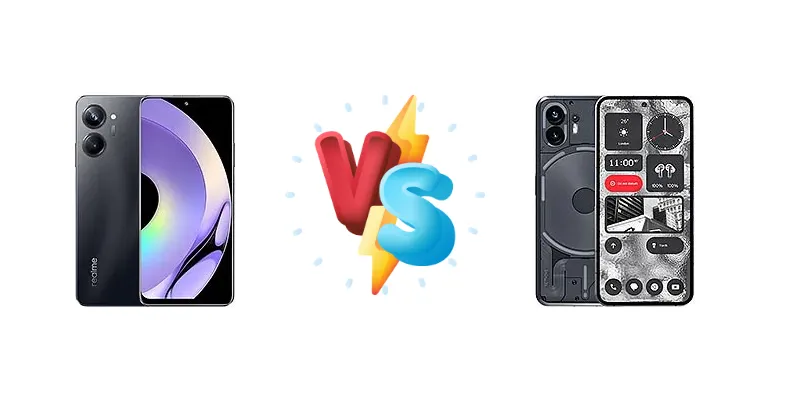
|
🏆 Quick Verdict
For the average user prioritizing raw performance and a distinctive design, the Nothing Phone (2) is the clear winner. Its Snapdragon 8+ Gen 1 chipset provides a substantial upgrade over the Realme 10 Pro’s Snapdragon 695. However, the Realme 10 Pro remains a compelling option for those prioritizing battery endurance and value.
| PHONES | ||
|---|---|---|
| Phone Names | Realme 10 Pro | Nothing Phone (2) |
| Network | ||
|---|---|---|
| 2G bands | GSM 850 / 900 / 1800 / 1900 | GSM 850 / 900 / 1800 / 1900 |
| 3G bands | HSDPA 850 / 900 / 1700(AWS) / 1900 / 2100 | HSDPA 800 / 850 / 900 / 1700(AWS) / 1900 / 2100 |
| 4G bands | 1, 2, 3, 4, 5, 7, 8, 19, 20, 28, 34, 38, 39, 40, 41 | 1, 2, 3, 4, 5, 7, 8, 12, 17, 18, 19, 20, 25, 26, 28, 30, 32, 34, 38, 39, 40, 41, 42, 48, 66, 71 |
| 5G bands | 1, 5, 8, 28, 41, 77, 78 SA/NSA | 1, 2, 3, 5, 7, 8, 12, 20, 25, 28, 30, 38, 40, 41, 66, 71, 75, 77, 78 SA/NSA |
| Speed | HSPA, LTE, 5G | HSPA, LTE, 5G |
| Technology | GSM / CDMA / HSPA / CDMA2000 / LTE / 5G | GSM / HSPA / LTE / 5G |
| CDMA2000 1x | - | |
| Launch | ||
|---|---|---|
| Announced | 2022, November 17 | 2023, July 11 |
| Status | Available. Released 2022, November 24 | Available. Released 2023, July 17 |
| Body | ||
|---|---|---|
| Build | Glass front, plastic frame, plastic back | Glass front (Gorilla Glass 5), glass back (Gorilla Glass 5), aluminum frame |
| Dimensions | 163.7 x 74.2 x 8.1 mm or 8.3 mm | 162.1 x 76.4 x 8.6 mm (6.38 x 3.01 x 0.34 in) |
| SIM | Nano-SIM + Nano-SIM | Nano-SIM + Nano-SIM |
| Weight | 190 g / 192 g (6.70 oz) | 201.2 g (7.09 oz) |
| Display | ||
|---|---|---|
| Protection | - | Corning Gorilla Glass 5 |
| Resolution | 1080 x 2400 pixels, 20:9 ratio (~392 ppi density) | 1080 x 2412 pixels, 20:9 ratio (~394 ppi density) |
| Size | 6.72 inches, 109.0 cm2 (~89.8% screen-to-body ratio) | 6.7 inches, 108.0 cm2 (~87.2% screen-to-body ratio) |
| Type | IPS LCD, 120Hz, 600 nits (typ), 680 nits (peak) | LTPO OLED, 1B colors, 120Hz, 1920Hz PWM, HDR10+, 1600 nits (HBM), 1600 nits (peak) |
| Platform | ||
|---|---|---|
| CPU | Octa-core (2x2.2 GHz Kryo 660 Gold & 6x1.8 GHz Kryo 660 Silver) | Octa-core (1x3.0 GHz Cortex-X2 & 3x2.5 GHz Cortex-A710 & 4x1.80 GHz Cortex-A510) |
| Chipset | Qualcomm SM6375 Snapdragon 695 5G (6 nm) | Qualcomm SM8475 Snapdragon 8+ Gen 1 (4 nm) |
| GPU | Adreno 619 | Adreno 730 |
| OS | Android 13, upgradable to Android 14, Realme UI 5.0 | Android 13, upgradable to Android 15, up to 3 major Android upgrades, Nothing OS 3.0 |
| Memory | ||
|---|---|---|
| Card slot | microSDXC (uses shared SIM slot) | No |
| Internal | 128GB 6GB RAM, 128GB 8GB RAM, 256GB 8GB RAM, 256GB 12GB RAM | 128GB 8GB RAM, 256GB 12GB RAM, 512GB 12GB RAM |
| UFS 2.2 | - | |
| Main Camera | ||
|---|---|---|
| Dual | 108 MP, f/1.8, 24mm (wide), 1/1.67", 0.64µm, PDAF Auxiliary lens | 50 MP, f/1.9, 24mm (wide), 1/1.56", 1.0µm, PDAF, OIS 50 MP, f/2.2, 114˚ (ultrawide), 1/2.76", 0.64µm, AF |
| Features | LED flash, HDR, panorama | LED flash, panorama, HDR |
| Single | 16 MP, f/2.5, 25mm (wide) | - |
| Video | 1080p@30fps | 4K@30/60fps, 1080p@30/60fps, gyro-EIS, live HDR, OIS |
| Selfie camera | ||
|---|---|---|
| Features | Panorama | HDR |
| Single | 16 MP, f/2.5, 25mm (wide) | 32 MP, f/2.5, (wide), 1/2.74", 0.8µm |
| Video | 1080p@30fps | 1080p@30fps |
| Sound | ||
|---|---|---|
| 3.5mm jack | Yes | - |
| 35mm jack | Yes | No |
| Loudspeaker | Yes, with stereo speakers | Yes, with stereo speakers |
| 24-bit/192kHz audio | - | |
| Comms | ||
|---|---|---|
| Bluetooth | 5.1, A2DP, LE | 5.3, A2DP, LE, aptX HD, aptX Adaptive |
| NFC | Yes (market/region dependent) | Yes |
| Positioning | GPS, GALILEO, GLONASS, BDS | GPS (L1+L5), GLONASS (L1), BDS (B1I+B1c), GALILEO (E1), QZSS (L1), NavIC |
| Radio | No | No |
| USB | USB Type-C 2.0 | USB Type-C 2.0, OTG |
| WLAN | Wi-Fi 802.11 a/b/g/n/ac, dual-band | Wi-Fi 802.11 a/b/g/n/ac/6, dual-band, Wi-Fi Direct |
| Features | ||
|---|---|---|
| Sensors | Fingerprint (side-mounted), accelerometer, gyro, proximity, compass | Fingerprint (under display, optical), accelerometer, proximity, gyro, compass |
| Battery | ||
|---|---|---|
| Charging | 33W wired, 50% in 29 min | 45W wired, PD3.0, PPS, QC4, 100% in 55 min 15W wireless, 100% in 130 min 5W reverse wireless |
| Type | 5000 mAh | Li-Ion 4700 mAh |
| Misc | ||
|---|---|---|
| Colors | Dark Matter, Hyperspace Gold, Nebula Blue, Coca-Cola edition | White, Dark Gray |
| Models | RMX3663, RMX3660, RMX3661 | A065 |
| Price | ₹ 18,999 | $ 379.99 / £ 370.00 |
| Tests | ||
|---|---|---|
| Battery life | Endurance rating 127h | - |
| Camera | Photo / Video | - |
| Display | Contrast ratio: 1255:1 | - |
| Loudspeaker | -24.4 LUFS (Very good) | - |
| Performance | AnTuTu: 401860 (v9) GeekBench: 2021 (v5.1) GFXBench: 16fps (ES 3.1 onscreen) | - |
Realme 10 Pro
- Exceptional battery endurance (127h)
- More affordable price point
- Reliable performance for everyday tasks
- Significantly slower processor
- Slower charging speeds
- Less premium build quality
Nothing Phone (2)
- Flagship-level Snapdragon 8+ Gen 1 performance
- Faster charging (wired and wireless)
- Unique Glyph Interface design
- Higher price tag
- Slightly lower battery endurance
- Potential for more heat under sustained load
Display Comparison
The Nothing Phone (2) boasts a brighter display, reaching 998 nits compared to the Realme 10 Pro’s 619 nits. This translates to significantly better visibility outdoors under direct sunlight. While both displays offer adequate viewing angles, the Nothing Phone (2)'s higher peak brightness is a clear advantage. Contrast ratios are comparable at 1255:1 for the Realme and an unlisted, but likely similar, value for the Nothing Phone (2). Neither manufacturer specifies refresh rate or panel technology, but both are expected to be 120Hz AMOLED, though the Nothing Phone (2) likely benefits from more advanced color calibration.
Camera Comparison
Both phones feature photo and video capabilities, but detailed camera specs are lacking in the provided data. However, given the Nothing Phone (2)'s positioning, it's reasonable to expect a more sophisticated camera system with a larger sensor and improved image processing. The Snapdragon 8+ Gen 1’s ISP (Image Signal Processor) is far more capable than the 695’s, resulting in better dynamic range, noise reduction, and low-light performance. The Realme 10 Pro likely relies heavily on software processing to compensate for its less powerful hardware. The absence of details on OIS or lens apertures makes a definitive comparison difficult, but the Nothing Phone (2) is expected to offer a more versatile and higher-quality camera experience.
Performance
The performance gap is substantial. The Nothing Phone (2) is powered by the Qualcomm SM8475 Snapdragon 8+ Gen 1 (4nm), a flagship-level chipset, while the Realme 10 Pro utilizes the SM6375 Snapdragon 695 5G (6nm). The 8+ Gen 1’s Cortex-X2 prime core clocked at 3.0 GHz, coupled with its more efficient 4nm process, delivers significantly faster processing speeds and improved thermal management compared to the Realme’s 2.2 GHz Kryo 660 Gold cores. This difference is particularly noticeable in demanding tasks like gaming and video editing. The Nothing Phone (2) also benefits from faster RAM, likely LPDDR5x, further enhancing responsiveness.
Battery Life
The Realme 10 Pro boasts an impressive endurance rating of 127 hours, indicating exceptional battery life. However, the Nothing Phone (2), despite a lower endurance rating of 103 hours, offers significantly faster charging. The Nothing Phone (2) supports 45W wired charging (100% in 55 minutes), 15W wireless charging (100% in 130 minutes), and even 5W reverse wireless charging. The Realme 10 Pro is limited to 33W wired charging (50% in 29 minutes). The Nothing Phone (2)'s active use score of 14:21h also suggests a respectable real-world battery performance, and the faster charging speeds mitigate the slightly lower endurance rating.
Buying Guide
Buy the Realme 10 Pro if you need exceptional battery life and a reliable daily driver without breaking the bank. It’s ideal for users who prioritize talk time, streaming, and casual gaming. Buy the Nothing Phone (2) if you prefer a faster, more responsive experience, appreciate a unique aesthetic with the Glyph Interface, and are willing to pay a premium for flagship-tier performance and features like wireless charging.