
Realme 10 Pro vs Google Pixel 7a: A Deep Dive into Mid-Range Contenders
| Phones Images | |||||
|---|---|---|---|---|---|
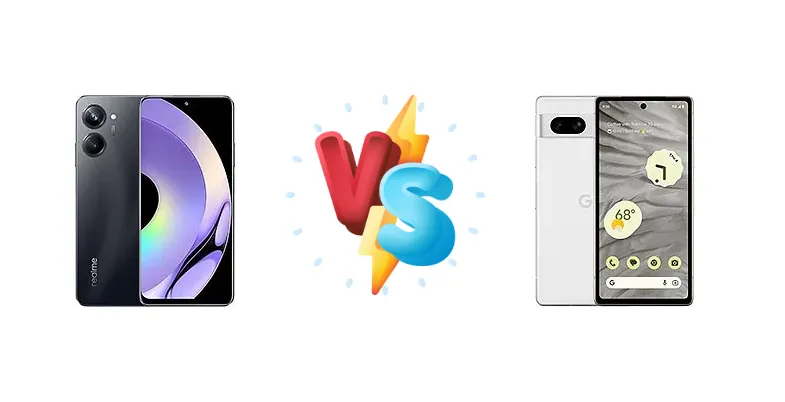
|
🏆 Quick Verdict
For the average user prioritizing battery life and value, the Realme 10 Pro emerges as the winner. Its significantly longer endurance rating (127h vs 76h) and lower price point offer compelling advantages. However, the Pixel 7a’s superior processing power and camera capabilities make it a strong contender for photography enthusiasts.
| PHONES | ||
|---|---|---|
| Phone Names | Realme 10 Pro | Google Pixel 7a |
| Network | ||
|---|---|---|
| 2G bands | GSM 850 / 900 / 1800 / 1900 | GSM 850 / 900 / 1800 / 1900 |
| 3G bands | HSDPA 850 / 900 / 1700(AWS) / 1900 / 2100 | HSDPA 800 / 850 / 900 / 1700(AWS) / 1900 / 2100 |
| 4G bands | 1, 2, 3, 4, 5, 7, 8, 19, 20, 28, 34, 38, 39, 40, 41 | 1, 2, 3, 4, 5, 7, 8, 12, 13, 14, 17, 20, 25, 26, 28, 29, 30, 38, 40, 41, 48, 66, 71 - GWKK3, G0DZQ |
| 5G bands | 1, 5, 8, 28, 41, 77, 78 SA/NSA | 1, 2, 3, 5, 7, 8, 12, 14, 20, 25, 28, 30, 38, 41, 48, 66, 71, 77, 78 SA/NSA/Sub6 - GWKK3 |
| Speed | HSPA, LTE, 5G | HSPA, LTE, 5G |
| Technology | GSM / CDMA / HSPA / CDMA2000 / LTE / 5G | GSM / HSPA / LTE / 5G |
| CDMA2000 1x | 1, 2, 3, 5, 7, 8, 12, 20, 25, 28, 38, 40, 41, 66, 75, 76, 77, 78, 79 SA/NSA/Sub6 - GHL1X, G82U8 | |
| Launch | ||
|---|---|---|
| Announced | 2022, November 17 | 2023, May 10 |
| Status | Available. Released 2022, November 24 | Available. Released 2023, May 10 |
| Body | ||
|---|---|---|
| Build | Glass front, plastic frame, plastic back | Glass front (Gorilla Glass 3), aluminum frame, plastic back |
| Dimensions | 163.7 x 74.2 x 8.1 mm or 8.3 mm | 152 x 72.9 x 9 mm (5.98 x 2.87 x 0.35 in) |
| SIM | Nano-SIM + Nano-SIM | Nano-SIM + eSIM |
| Weight | 190 g / 192 g (6.70 oz) | 193.5 g (6.84 oz) |
| - | IP67 dust/water resistant (up to 1m for 30 min) | |
| Display | ||
|---|---|---|
| Protection | - | Corning Gorilla Glass 3 |
| Resolution | 1080 x 2400 pixels, 20:9 ratio (~392 ppi density) | 1080 x 2400 pixels, 20:9 ratio (~429 ppi density) |
| Size | 6.72 inches, 109.0 cm2 (~89.8% screen-to-body ratio) | 6.1 inches, 90.7 cm2 (~81.8% screen-to-body ratio) |
| Type | IPS LCD, 120Hz, 600 nits (typ), 680 nits (peak) | OLED, HDR, 90Hz |
| - | Always-on display | |
| Platform | ||
|---|---|---|
| CPU | Octa-core (2x2.2 GHz Kryo 660 Gold & 6x1.8 GHz Kryo 660 Silver) | Octa-core (2x2.85 GHz Cortex-X1 & 2x2.35 GHz Cortex-A78 & 4x1.80 GHz Cortex-A55) |
| Chipset | Qualcomm SM6375 Snapdragon 695 5G (6 nm) | Google Tensor G2 (5 nm) |
| GPU | Adreno 619 | Mali-G710 MP7 |
| OS | Android 13, upgradable to Android 14, Realme UI 5.0 | Android 13, upgradable to Android 15, up to 5 major Android upgrades |
| Memory | ||
|---|---|---|
| Card slot | microSDXC (uses shared SIM slot) | No |
| Internal | 128GB 6GB RAM, 128GB 8GB RAM, 256GB 8GB RAM, 256GB 12GB RAM | 128GB 8GB RAM |
| UFS 2.2 | UFS 3.1 | |
| Main Camera | ||
|---|---|---|
| Dual | 108 MP, f/1.8, 24mm (wide), 1/1.67", 0.64µm, PDAF Auxiliary lens | 64 MP, f/1.9, 26mm (wide), 1/1.73", 0.8µm, dual pixel PDAF, OIS 13 MP, f/2.2, 120˚ (ultrawide), 1.12µm |
| Features | LED flash, HDR, panorama | Dual-LED flash, Pixel Shift, Auto-HDR, panorama |
| Single | 16 MP, f/2.5, 25mm (wide) | - |
| Video | 1080p@30fps | 4K@30/60fps, 1080p@30/60/120/240fps, OIS |
| Selfie camera | ||
|---|---|---|
| Features | Panorama | HDR, panorama |
| Single | 16 MP, f/2.5, 25mm (wide) | 13 MP, f/2.2, 20mm (ultrawide), 1.12µm |
| Video | 1080p@30fps | 4K@30fps, 1080p@30fps |
| Sound | ||
|---|---|---|
| 3.5mm jack | Yes | No |
| 35mm jack | Yes | No |
| Loudspeaker | Yes, with stereo speakers | Yes, with stereo speakers |
| 24-bit/192kHz audio | - | |
| Comms | ||
|---|---|---|
| Bluetooth | 5.1, A2DP, LE | 5.3, A2DP, LE |
| NFC | Yes (market/region dependent) | Yes |
| Positioning | GPS, GALILEO, GLONASS, BDS | GPS, GLONASS, GALILEO, BDS, QZSS, NavIC |
| Radio | No | No |
| USB | USB Type-C 2.0 | USB Type-C 3.2 |
| WLAN | Wi-Fi 802.11 a/b/g/n/ac, dual-band | Wi-Fi 802.11 a/b/g/n/ac/6e, tri-band |
| Features | ||
|---|---|---|
| Sensors | Fingerprint (side-mounted), accelerometer, gyro, proximity, compass | Fingerprint (under display, optical), accelerometer, gyro, proximity, compass, barometer |
| Battery | ||
|---|---|---|
| Charging | 33W wired, 50% in 29 min | 18W wired, PD3.0 7.5W wireless |
| Type | 5000 mAh | Li-Po 4385 mAh |
| Misc | ||
|---|---|---|
| Colors | Dark Matter, Hyperspace Gold, Nebula Blue, Coca-Cola edition | Charcoal, Snow, Sea, Coral |
| Models | RMX3663, RMX3660, RMX3661 | GWKK3, GHL1X, G0DZQ, G82U8 |
| Price | ₹ 18,999 | € 179.90 / $ 150.00 / £ 170.00 / ₹ 25,980 |
| Tests | ||
|---|---|---|
| Battery life | Endurance rating 127h | - |
| Camera | Photo / Video | - |
| Display | Contrast ratio: 1255:1 | - |
| Loudspeaker | -24.4 LUFS (Very good) | - |
| Performance | AnTuTu: 401860 (v9) GeekBench: 2021 (v5.1) GFXBench: 16fps (ES 3.1 onscreen) | - |
Realme 10 Pro
- Exceptional battery life (127h endurance)
- Faster 33W charging
- More affordable price point
- Less powerful processor
- Lower peak display brightness
Google Pixel 7a
- Superior processing power (Tensor G2)
- Brighter display (1070 nits)
- Excellent camera capabilities (Google’s image processing)
- Significantly shorter battery life (76h endurance)
- Slower 18W charging
- Higher price
Display Comparison
The Pixel 7a boasts a brighter display, reaching 1070 nits compared to the Realme 10 Pro’s 619 nits. This translates to better visibility outdoors under direct sunlight. However, the Realme 10 Pro offers a respectable 1255:1 contrast ratio, suggesting deeper blacks and more vibrant colors. While both displays are adequate, the Pixel 7a’s higher peak brightness provides a noticeable advantage for outdoor use. Neither specification details refresh rate, but market positioning suggests the Pixel 7a likely has a smoother experience.
Camera Comparison
Both phones offer photo and video capabilities, but the Pixel 7a is expected to excel due to Google’s renowned computational photography. While sensor sizes and apertures aren’t specified, the Pixel 7a benefits from Google’s image processing algorithms, which enhance detail, dynamic range, and low-light performance. The Realme 10 Pro’s camera system is likely more focused on providing a versatile experience at a lower price point, but it won’t match the Pixel 7a’s image quality. The absence of details regarding OIS on either device makes it difficult to assess stabilization performance.
Performance
The core difference lies in the chipsets. The Google Pixel 7a’s Tensor G2 (5nm) is architecturally superior to the Realme 10 Pro’s Snapdragon 695 5G (6nm). The Tensor G2’s octa-core configuration, featuring Cortex-X1 and Cortex-A78 cores clocked at 2.85 GHz and 2.35 GHz respectively, delivers significantly faster processing speeds than the Snapdragon 695’s 2.2 GHz Kryo 660 Gold cores. This difference is particularly noticeable in demanding tasks like video editing and gaming. The 5nm fabrication process of the Tensor G2 also contributes to better thermal efficiency, potentially reducing throttling during sustained workloads. The Realme 10 Pro is adequate for everyday tasks, but the Pixel 7a offers a more responsive and future-proof experience.
Battery Life
Battery life is where the Realme 10 Pro truly shines. Its endurance rating of 127 hours significantly surpasses the Pixel 7a’s 76 hours. This difference is attributed to the more efficient chipset and potentially a larger battery capacity (not specified). While the Pixel 7a offers 18W wired and 7.5W wireless charging, the Realme 10 Pro’s 33W wired charging is considerably faster, reaching 50% charge in just 29 minutes. The Pixel 7a’s slower charging speed requires a longer commitment to the wall.
Buying Guide
Buy the Realme 10 Pro if you need a phone that can reliably last through a full day – and then some – on a single charge, and if maximizing value for your money is paramount. You’ll benefit from its endurance and affordability. Buy the Google Pixel 7a if you prioritize camera quality, smooth performance for demanding apps, and a clean, regularly updated Android experience. You’ll appreciate the Tensor G2’s processing power and Google’s computational photography.