
Razer Phone 2 vs Samsung Galaxy A54: A Clash of Generations
| Phones Images | |||||
|---|---|---|---|---|---|
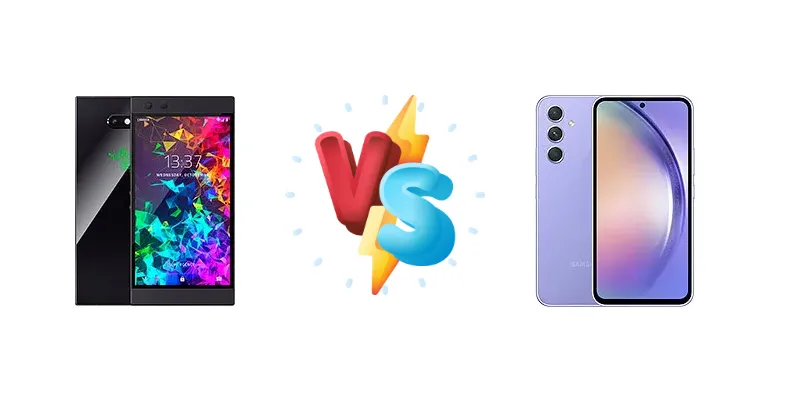
|
🏆 Quick Verdict
For the average user, the Samsung Galaxy A54 is the better choice. Its significantly superior battery life (119h endurance vs 70h) and more efficient Exynos 1380 chipset provide a smoother, longer-lasting experience. While the Razer Phone 2 offers a higher contrast ratio in sunlight, the A54’s overall package is more compelling in 2024.
| PHONES | ||
|---|---|---|
| Phone Names | Razer Phone 2 | Samsung Galaxy A54 |
| Network | ||
|---|---|---|
| 2G bands | GSM 850 / 900 / 1800 / 1900 | GSM 850 / 900 / 1800 / 1900 |
| 3G bands | HSDPA 850 / 900 / 1700(AWS) / 1800 / 1900 / 2100 | HSDPA 850 / 900 / 1700(AWS) / 1900 / 2100 |
| 4G bands | 1, 2, 3, 4, 5, 7, 8, 12, 13, 14, 17, 18, 19, 20, 26, 28, 29, 30, 32, 38, 39, 40, 41, 48, 66, 71 | 1, 2, 3, 4, 5, 7, 8, 12, 17, 20, 26, 28, 32, 38, 40, 41, 66 - International |
| 5G bands | - | 1, 3, 7, 8, 20, 28, 38, 40, 41, 77, 78 SA/NSA/Sub6 - International |
| Speed | HSPA 42.2/5.76 Mbps, LTE (5CA) Cat18 1200/150 Mbps | HSPA, LTE, 5G |
| Technology | GSM / CDMA / HSPA / LTE | GSM / HSPA / LTE / 5G |
| CDMA 800 & TD-SCDMA | 25, 41, 66, 71 SA/NSA/Sub6/mmWave - USA | |
| Launch | ||
|---|---|---|
| Announced | 2018, October. Released 2018, October | 2023, March 15 |
| Status | Discontinued | Available. Released 2023, March 24 |
| Body | ||
|---|---|---|
| Build | Glass front (Gorilla Glass 5), aluminum back, aluminum frame | Glass front (Gorilla Glass 5), glass back (Gorilla Glass 5), plastic frame |
| Dimensions | 158.5 x 79 x 8.5 mm (6.24 x 3.11 x 0.33 in) | 158.2 x 76.7 x 8.2 mm (6.23 x 3.02 x 0.32 in) |
| SIM | Nano-SIM | · Nano-SIM + eSIM· Nano-SIM + Nano-SIM |
| Weight | 220 g (7.76 oz) | 202 g (7.13 oz) |
| IP67 dust/water resistant (up to 1m for 30 mins) RGB Illuminated Razer Chroma Logo on the back | IP67 dust/water resistant (up to 1m for 30 min) | |
| Display | ||
|---|---|---|
| Protection | Corning Gorilla Glass 5, oleophobic coating | Corning Gorilla Glass 5 |
| Resolution | 1440 x 2560 pixels, 16:9 ratio (~513 ppi density) | 1080 x 2340 pixels, 19.5:9 ratio (~403 ppi density) |
| Size | 5.72 inches, 90.2 cm2 (~72.0% screen-to-body ratio) | 6.4 inches, 100.5 cm2 (~82.9% screen-to-body ratio) |
| Type | IGZO IPS LCD, 120Hz, 580 nits (typ) | Super AMOLED, 120Hz, HDR10+, 1000 nits (HBM) |
| Wide Colour Gamut | - | |
| Platform | ||
|---|---|---|
| CPU | Octa-core (4x2.8 GHz Kryo 385 Gold & 4x1.7 GHz Kryo 385 Silver) | Octa-core (4x2.4 GHz Cortex-A78 & 4x2.0 GHz Cortex-A55) |
| Chipset | Qualcomm SDM845 Snapdragon 845 (10 nm) | Exynos 1380 (5 nm) |
| GPU | Adreno 630 | Mali-G68 MP5 |
| OS | Android 8.1 (Oreo), upgradable to Android 9.0 (Pie) | Android 13, up to 4 major Android upgrades, One UI 7 |
| Memory | ||
|---|---|---|
| Card slot | microSDXC (dedicated slot) | microSDXC (uses shared SIM slot) |
| Internal | 64GB 8GB RAM | 128GB 4GB RAM, 128GB 6GB RAM, 128GB 8GB RAM, 256GB 6GB RAM, 256GB 8GB RAM |
| UFS 2.1 | - | |
| Main Camera | ||
|---|---|---|
| Dual | 12 MP, f/1.8, 25mm (wide), 1/2.55", 1.4µm, dual pixel PDAF, OIS 12 MP, f/2.6, 1/3.1", 1.0µm, 2x optical zoom | - |
| Features | Dual-LED dual-tone flash, panorama, HDR | LED flash, panorama, HDR |
| Single | - | 32 MP, f/2.2, 26mm (wide), 1/2.8", 0.8µm |
| Triple | - | 50 MP, f/1.8, 23mm (wide), 1/1.56", 1.0µm, PDAF, OIS 12 MP, f/2.2, 13mm, 123˚ (ultrawide), 1/3.X", 1.12µm 5 MP (macro) |
| Video | 4K@30/60fps, 1080p@30/30/60/120fps, stereo sound rec. | 4K@30fps, 1080p@30/60fps, 720p@480fps, gyro-EIS |
| Selfie camera | ||
|---|---|---|
| Single | 8 MP, f/2.0 | 32 MP, f/2.2, 26mm (wide), 1/2.8", 0.8µm |
| Video | 1080p@30/60fps | 4K@30fps, 1080p@30/60fps |
| Sound | ||
|---|---|---|
| 3.5mm jack | No | No |
| 35mm jack | No | No |
| Loudspeaker | Yes, with Dolby Atmos stereo speakers (THX-certified amplifiers) | Yes, with stereo speakers |
| 24-bit/192kHz audio | - | |
| Comms | ||
|---|---|---|
| Bluetooth | 5.0, A2DP, LE | 5.3, A2DP, LE |
| NFC | Yes | Yes (market/region dependent) |
| Positioning | GPS | GPS, GLONASS, GALILEO, BDS |
| Radio | No | No |
| USB | USB Type-C | USB Type-C 2.0, OTG |
| WLAN | Wi-Fi 802.11 a/b/g/n/ac, dual-band, Wi-Fi Direct | Wi-Fi 802.11 a/b/g/n/ac/6, dual-band, Wi-Fi Direct |
| Features | ||
|---|---|---|
| Sensors | Fingerprint (side-mounted), accelerometer, gyro, proximity, compass | Fingerprint (under display, optical), accelerometer, gyro, compass, barometer (USA only) |
| - | Virtual proximity sensing | |
| Battery | ||
|---|---|---|
| Charging | 18W wired, QC4 15W wireless | 25W wired |
| Type | Li-Po 4000 mAh, non-removable | 5000 mAh |
| Misc | ||
|---|---|---|
| Colors | Mirror back, Rugged satin | Lime, Graphite, Violet, White |
| Models | - | SM-A546V, SM-A546U, SM-A546U1, SM-A546B, SM-A546B/DS, SM-A546E, SM-A546E/DS, SM-A5460, SM-A546M, SM-A546M/DS, SM-A546W |
| Price | About 850 EUR | € 210.00 / $ 119.11 / £ 169.95 / ₹ 28,999 |
| SAR | - | 0.81 W/kg (head) 0.67 W/kg (body) |
| SAR EU | - | 0.69 W/kg (head) 1.34 W/kg (body) |
| Tests | ||
|---|---|---|
| Audio quality | Noise -93.4dB / Crosstalk -92.8dB | - |
| Battery life | Endurance rating 70h | Endurance rating 119h |
| Camera | Photo / Video | Photo / Video |
| Display | Contrast ratio: 948 (nominal), 2.932 (sunlight) | Contrast ratio: Infinite (nominal) |
| Loudspeaker | Voice 78dB / Noise 78dB / Ring 86dB | -26.6 LUFS (Good) |
| Performance | AnTuTu: 286076 (v7) GeekBench: 9110 (v4.4) GFXBench: 22fps (ES 3.1 onscreen) | AnTuTu: 506678 (v9) GeekBench: 2703 (v5.1), 2797 (v6) GFXBench: 25fps (ES 3.1 onscreen) |
Razer Phone 2
- High contrast ratio for outdoor visibility
- Potentially lower price point (due to age)
- Gaming-focused design (though dated)
- Significantly shorter battery life
- Older chipset and software support
- Less efficient power consumption
Samsung Galaxy A54
- Excellent battery life (119h endurance)
- More efficient Exynos 1380 chipset
- Modern camera system and image processing
- Guaranteed software updates
- May lack the dedicated gaming features of the Razer Phone 2
- Potentially higher price than a used Razer Phone 2
Display Comparison
The Razer Phone 2 boasts a high contrast ratio of 948 (nominal) and an impressive 2.932 in sunlight, suggesting excellent outdoor visibility. However, the Samsung Galaxy A54 counters with a measured peak brightness of 980 nits, likely providing a brighter overall image in most conditions. While the Razer Phone 2’s refresh rate is likely 120Hz (based on its gaming focus), the A54’s display technology isn’t specified, but Samsung’s Super AMOLED panels are known for vibrant colors and efficient power consumption. The A54’s 'Infinite' contrast ratio suggests a true black level, a common trait of OLED displays, which the Razer Phone 2 likely lacks.
Camera Comparison
Both phones feature photo and video capabilities, but details are limited. The Razer Phone 2’s camera system was never its strong suit, focusing more on video recording. The Galaxy A54 likely benefits from Samsung’s advanced image processing algorithms and a more modern sensor. Without specific sensor size or aperture information for the Razer Phone 2, it’s difficult to make a direct comparison, but the A54’s camera is expected to deliver superior image quality, especially in low-light conditions. The inclusion of OIS (Optical Image Stabilization) in the A54 is also a significant advantage.
Performance
The Qualcomm Snapdragon 845 in the Razer Phone 2, built on a 10nm process, was a flagship chip in its time, featuring an octa-core CPU with Kryo cores clocked up to 2.8 GHz. However, the Samsung Galaxy A54’s Exynos 1380, fabricated on a more efficient 5nm node, offers improved power efficiency and potentially comparable real-world performance. The 5nm process allows for a higher transistor density, leading to better thermal management and reduced throttling during sustained workloads. While the Snapdragon 845’s raw CPU clock speed is higher, the Exynos 1380’s architecture and process node give it an edge in sustained performance and battery life.
Battery Life
The Samsung Galaxy A54 dominates in battery life, with an endurance rating of 119 hours compared to the Razer Phone 2’s 70 hours. This translates to significantly longer usage between charges. While the Razer Phone 2 supports 18W wired charging with QC4 and 15W wireless charging, the A54 offers 25W wired charging, enabling faster top-ups. The Exynos 1380’s 5nm efficiency plays a crucial role in the A54’s extended battery life, offsetting the potential impact of a smaller battery capacity (not specified in the data).
Buying Guide
Buy the Razer Phone 2 if you prioritize a high-refresh-rate display and are willing to accept compromises in battery life and software support for a potentially lower price. It's a niche choice for those who specifically want a gaming-focused experience and don't mind an older device. Buy the Samsung Galaxy A54 if you value all-day battery life, a modern camera system, and guaranteed software updates. It’s the more practical and versatile option for everyday use.