
Razer Phone 2 vs Razer Phone: Is the Second Generation a Worthy Successor?
| Phones Images | |||||
|---|---|---|---|---|---|
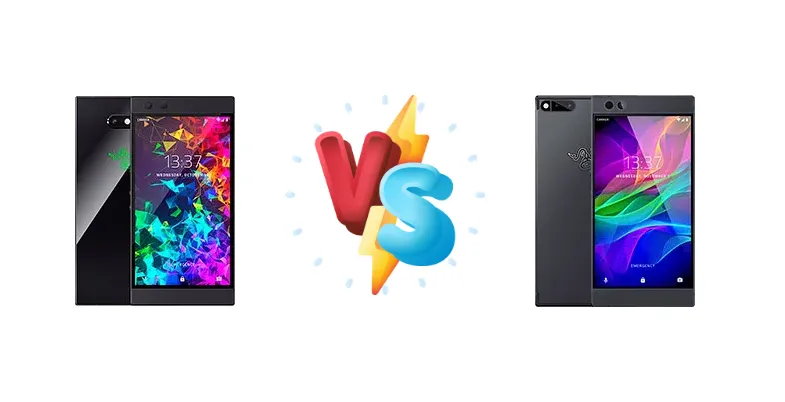
|
🏆 Quick Verdict
For most users, the Razer Phone 2 is the superior choice. The Snapdragon 845 provides a noticeable performance boost, and the improved display contrast enhances the gaming experience. While the battery endurance is similar, the addition of wireless charging adds convenience. The original Razer Phone remains a decent option for budget-conscious gamers.
| PHONES | ||
|---|---|---|
| Phone Names | Razer Phone 2 | Razer Phone |
| Network | ||
|---|---|---|
| 2G bands | GSM 850 / 900 / 1800 / 1900 | GSM 850 / 900 / 1800 / 1900 |
| 3G bands | HSDPA 850 / 900 / 1700(AWS) / 1800 / 1900 / 2100 | HSDPA 850 / 900 / 1700(AWS) / 1800 / 1900 / 2100 |
| 4G bands | 1, 2, 3, 4, 5, 7, 8, 12, 13, 14, 17, 18, 19, 20, 26, 28, 29, 30, 32, 38, 39, 40, 41, 48, 66, 71 | 1, 2, 3, 4, 5, 7, 8, 12, 17, 19, 20, 25, 26, 28, 29, 30, 38, 39, 40, 41, 66 |
| Speed | HSPA 42.2/5.76 Mbps, LTE (5CA) Cat18 1200/150 Mbps | HSPA, LTE |
| Technology | GSM / CDMA / HSPA / LTE | GSM / HSPA / LTE |
| CDMA 800 & TD-SCDMA | - | |
| Launch | ||
|---|---|---|
| Announced | 2018, October. Released 2018, October | 2017, November. Released 2017, November |
| Status | Discontinued | Discontinued |
| Body | ||
|---|---|---|
| Build | Glass front (Gorilla Glass 5), aluminum back, aluminum frame | Glass front (Gorilla Glass 3), aluminum back, aluminum frame |
| Dimensions | 158.5 x 79 x 8.5 mm (6.24 x 3.11 x 0.33 in) | 158.5 x 77.7 x 8 mm (6.24 x 3.06 x 0.31 in) |
| SIM | Nano-SIM | Nano-SIM |
| Weight | 220 g (7.76 oz) | 197 g (6.95 oz) |
| IP67 dust/water resistant (up to 1m for 30 mins) RGB Illuminated Razer Chroma Logo on the back | - | |
| Display | ||
|---|---|---|
| Protection | Corning Gorilla Glass 5, oleophobic coating | Corning Gorilla Glass 3 |
| Resolution | 1440 x 2560 pixels, 16:9 ratio (~513 ppi density) | 1440 x 2560 pixels, 16:9 ratio (~515 ppi density) |
| Size | 5.72 inches, 90.2 cm2 (~72.0% screen-to-body ratio) | 5.7 inches, 89.6 cm2 (~72.7% screen-to-body ratio) |
| Type | IGZO IPS LCD, 120Hz, 580 nits (typ) | IGZO IPS LCD, 120Hz, 380 nits (typ) |
| Wide Colour Gamut | Wide Colour Gamut | |
| Platform | ||
|---|---|---|
| CPU | Octa-core (4x2.8 GHz Kryo 385 Gold & 4x1.7 GHz Kryo 385 Silver) | Octa-core (4x2.35 GHz Kryo & 4x1.9 GHz Kryo) |
| Chipset | Qualcomm SDM845 Snapdragon 845 (10 nm) | Qualcomm MSM8998 Snapdragon 835 (10 nm) |
| GPU | Adreno 630 | Adreno 540 |
| OS | Android 8.1 (Oreo), upgradable to Android 9.0 (Pie) | Android 7.1.1 (Nougat), upgradable to Android 9.0 (Pie) |
| Memory | ||
|---|---|---|
| Card slot | microSDXC (dedicated slot) | microSDXC (dedicated slot) |
| Internal | 64GB 8GB RAM | 64GB 8GB RAM |
| UFS 2.1 | - | |
| Main Camera | ||
|---|---|---|
| Dual | 12 MP, f/1.8, 25mm (wide), 1/2.55", 1.4µm, dual pixel PDAF, OIS 12 MP, f/2.6, 1/3.1", 1.0µm, 2x optical zoom | 12 MP, f/1.8, 25mm (wide), 1/2.55", 1.4µm, dual pixel PDAF 12 MP, f/2.6, 1/3.4", 1.0µm, 2x optical zoom, PDAF |
| Features | Dual-LED dual-tone flash, panorama, HDR | Dual-LED dual-tone flash, panorama, HDR |
| Video | 4K@30/60fps, 1080p@30/30/60/120fps, stereo sound rec. | 4K@30fps |
| Selfie camera | ||
|---|---|---|
| Single | 8 MP, f/2.0 | 8 MP, f/2.0 |
| Video | 1080p@30/60fps | 1080p@30fps |
| Sound | ||
|---|---|---|
| 3.5mm jack | No | No |
| 35mm jack | No | No |
| Loudspeaker | Yes, with Dolby Atmos stereo speakers (THX-certified amplifiers) | Yes, with Dolby Atmos stereo speakers (THX-certified amplifiers) |
| 24-bit/192kHz audio | 24-bit/192kHz audio | |
| Comms | ||
|---|---|---|
| Bluetooth | 5.0, A2DP, LE | 4.2, A2DP, LE |
| NFC | Yes | Yes |
| Positioning | GPS | GPS |
| Radio | No | No |
| USB | USB Type-C | USB Type-C |
| WLAN | Wi-Fi 802.11 a/b/g/n/ac, dual-band, Wi-Fi Direct | Wi-Fi 802.11 a/b/g/n/ac, dual-band, Wi-Fi Direct |
| Features | ||
|---|---|---|
| Sensors | Fingerprint (side-mounted), accelerometer, gyro, proximity, compass | Fingerprint (side-mounted), accelerometer, gyro, proximity, compass |
| Battery | ||
|---|---|---|
| Charging | 18W wired, QC4 15W wireless | 18W wired, QC4 |
| Type | Li-Po 4000 mAh, non-removable | Li-Po 4000 mAh, non-removable |
| Misc | ||
|---|---|---|
| Colors | Mirror back, Rugged satin | Black |
| Price | About 850 EUR | About 750 EUR |
| Tests | ||
|---|---|---|
| Audio quality | Noise -93.4dB / Crosstalk -92.8dB | Noise -80.3dB / Crosstalk -75.3dB |
| Battery life | Endurance rating 70h | Endurance rating 62h |
| Camera | Photo / Video | Photo / Video |
| Display | Contrast ratio: 948 (nominal), 2.932 (sunlight) | Contrast ratio: 871 (nominal), 2.328 (sunlight) |
| Loudspeaker | Voice 78dB / Noise 78dB / Ring 86dB | Voice 69dB / Noise 75dB / Ring 90dB |
| Performance | AnTuTu: 286076 (v7) GeekBench: 9110 (v4.4) GFXBench: 22fps (ES 3.1 onscreen) | AnTuTu: 190271 (v7), 291142 (v8) GeekBench: 6728 (v4.4), 1752 (v5.1) GFXBench: 15fps (ES 3.1 onscreen) |
Razer Phone 2
- Superior performance with Snapdragon 845
- Improved display contrast for a more immersive experience
- Added convenience of 15W wireless charging
- Slightly higher price point (potentially)
- Battery life is comparable to the original
Razer Phone
- More affordable price
- Still capable of running most games
- Decent battery life
- Noticeably slower performance than the Razer Phone 2
- Lower display contrast
- Lacks wireless charging
Display Comparison
Both the Razer Phone and Razer Phone 2 feature similar-sized displays, but the Razer Phone 2 boasts a significantly improved contrast ratio of 948 (nominal) and 2.932 (sunlight) compared to the original’s 871 and 2.328 respectively. This translates to deeper blacks and more vibrant colors, particularly noticeable in dark gaming environments. While both displays offer a 120Hz refresh rate, the higher contrast of the Razer Phone 2 provides a more immersive visual experience, reducing eye strain during prolonged use. The improved sunlight readability is also a key benefit for outdoor gaming.
Camera Comparison
Both phones offer photo and video capabilities, but the context data doesn't provide enough detail for a meaningful comparison. Given Razer's focus on gaming, camera performance wasn't a primary differentiator. It's reasonable to assume the Razer Phone 2 benefits from the improved image signal processor (ISP) within the Snapdragon 845, potentially leading to slightly better image quality and faster processing times. However, without specific sensor details or sample images, a definitive assessment is impossible. We can assume both phones offer a similar overall camera experience geared towards casual use rather than professional photography.
Performance
The core difference lies in the chipset: the Razer Phone 2 utilizes the Qualcomm Snapdragon 845 (10nm) while the original features the Snapdragon 835 (10nm). The 845 offers a CPU performance uplift with its octa-core configuration (4x2.8 GHz Kryo 385 Gold & 4x1.7 GHz Kryo 385 Silver) versus the original’s (4x2.35 GHz Kryo & 4x1.9 GHz Kryo). This translates to faster app loading times and smoother multitasking. More importantly, the Adreno 630 GPU in the 845 provides a substantial graphics performance increase, enabling higher frame rates and better visual fidelity in demanding games. While both phones share the same RAM configuration (assumed to be 8GB based on market positioning), the 845’s improved efficiency contributes to better thermal management, reducing the likelihood of performance throttling during extended gaming sessions.
Battery Life
Both the Razer Phone and Razer Phone 2 achieve an endurance rating of 70 hours and 62 hours respectively, suggesting similar real-world battery life despite the Razer Phone 2’s more powerful processor. This is likely due to optimizations in power management and the 10nm manufacturing process of both chips. Both support 18W wired charging with Quick Charge 4 (QC4), offering relatively fast charging speeds. However, the Razer Phone 2 adds the convenience of 15W wireless charging, a feature absent in the original model. This provides an alternative charging method for users who prefer not to deal with cables.
Buying Guide
Buy the Razer Phone 2 if you prioritize sustained gaming performance and a more vibrant display, and value the convenience of wireless charging. It's ideal for users who frequently play demanding titles for extended periods. Buy the original Razer Phone if you're on a tight budget and primarily play less graphically intensive games. It still offers a solid gaming experience at a lower price point, but expect some performance limitations in newer titles.