
Razer Phone 2 vs. Google Pixel 6: A Deep Dive into Gaming and AI
| Phones Images | |||||
|---|---|---|---|---|---|
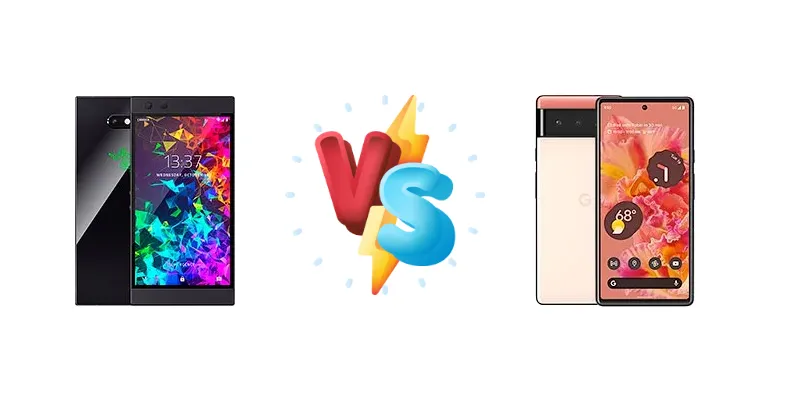
|
🏆 Quick Verdict
For the average user prioritizing camera quality and long-term software support, the Google Pixel 6 is the clear winner. However, gamers seeking a dedicated gaming experience with a high-refresh-rate display and potentially lower cost will find the Razer Phone 2 a compelling option.
| PHONES | ||
|---|---|---|
| Phone Names | Razer Phone 2 | Google Pixel 6 |
| Network | ||
|---|---|---|
| 2G bands | GSM 850 / 900 / 1800 / 1900 | GSM 850 / 900 / 1800 / 1900 |
| 3G bands | HSDPA 850 / 900 / 1700(AWS) / 1800 / 1900 / 2100 | HSDPA 800 / 850 / 900 / 1700(AWS) / 1900 / 2100 |
| 4G bands | 1, 2, 3, 4, 5, 7, 8, 12, 13, 14, 17, 18, 19, 20, 26, 28, 29, 30, 32, 38, 39, 40, 41, 48, 66, 71 | 1, 2, 3, 4, 5, 7, 8, 12, 13, 14, 17, 18, 19, 20, 25, 26, 28, 29, 30, 32, 38, 39, 40, 41, 42, 46, 48, 66, 71 - GB7N6, G9S9B16 |
| 5G bands | - | 1, 2, 3, 5, 7, 8, 12, 14, 20, 25, 28, 30, 38, 40, 41, 48, 66, 71, 77, 78, 257, 258, 260, 261 SA/NSA/Sub6/mmWave - G9S9B |
| Speed | HSPA 42.2/5.76 Mbps, LTE (5CA) Cat18 1200/150 Mbps | HSPA, LTE, 5G |
| Technology | GSM / CDMA / HSPA / LTE | GSM / CDMA / HSPA / EVDO / LTE / 5G |
| CDMA 800 & TD-SCDMA | 1, 2, 3, 5, 7, 8, 12, 14, 20, 25, 28, 30, 38, 40, 41, 48, 66, 71, 77, 78 SA/NSA/Sub6 - GB7N6 | |
| Launch | ||
|---|---|---|
| Announced | 2018, October. Released 2018, October | 2021, October 19 |
| Status | Discontinued | Available. Released 2021, October 28 |
| Body | ||
|---|---|---|
| Build | Glass front (Gorilla Glass 5), aluminum back, aluminum frame | Glass front (Gorilla Glass Victus), glass back (Gorilla Glass 6), aluminum frame |
| Dimensions | 158.5 x 79 x 8.5 mm (6.24 x 3.11 x 0.33 in) | 158.6 x 74.8 x 8.9 mm (6.24 x 2.94 x 0.35 in) |
| SIM | Nano-SIM | Nano-SIM + eSIM |
| Weight | 220 g (7.76 oz) | 207 g (7.30 oz) |
| IP67 dust/water resistant (up to 1m for 30 mins) RGB Illuminated Razer Chroma Logo on the back | IP68 dust/water resistant (up to 1.5m for 30 min) | |
| Display | ||
|---|---|---|
| Protection | Corning Gorilla Glass 5, oleophobic coating | Corning Gorilla Glass Victus |
| Resolution | 1440 x 2560 pixels, 16:9 ratio (~513 ppi density) | 1080 x 2400 pixels, 20:9 ratio (~411 ppi density) |
| Size | 5.72 inches, 90.2 cm2 (~72.0% screen-to-body ratio) | 6.4 inches, 98.9 cm2 (~83.4% screen-to-body ratio) |
| Type | IGZO IPS LCD, 120Hz, 580 nits (typ) | AMOLED, 90Hz, HDR10+ |
| Wide Colour Gamut | Always-on display | |
| Platform | ||
|---|---|---|
| CPU | Octa-core (4x2.8 GHz Kryo 385 Gold & 4x1.7 GHz Kryo 385 Silver) | Octa-core (2x2.80 GHz Cortex-X1 & 2x2.25 GHz Cortex-A76 & 4x1.80 GHz Cortex-A55) |
| Chipset | Qualcomm SDM845 Snapdragon 845 (10 nm) | Google Tensor (5 nm) |
| GPU | Adreno 630 | Mali-G78 MP20 |
| OS | Android 8.1 (Oreo), upgradable to Android 9.0 (Pie) | Android 12, upgradable to Android 15, up to 5 major Android upgrades |
| Memory | ||
|---|---|---|
| Card slot | microSDXC (dedicated slot) | No |
| Internal | 64GB 8GB RAM | 128GB 8GB RAM, 256GB 8GB RAM |
| UFS 2.1 | UFS 3.1 | |
| Main Camera | ||
|---|---|---|
| Dual | 12 MP, f/1.8, 25mm (wide), 1/2.55", 1.4µm, dual pixel PDAF, OIS 12 MP, f/2.6, 1/3.1", 1.0µm, 2x optical zoom | 50 MP, f/1.9, 25mm (wide), 1/1.31", 1.2µm, dual pixel PDAF, OIS 12 MP, f/2.2, 17mm, 114˚ (ultrawide), 1.25µm |
| Features | Dual-LED dual-tone flash, panorama, HDR | Laser AF, Dual-LED flash, Pixel Shift, Auto-HDR, panorama |
| Single | - | 8 MP, f/2.0, 24mm (wide), 1.12µm |
| Video | 4K@30/60fps, 1080p@30/30/60/120fps, stereo sound rec. | 4K@30/60fps, 1080p@30/60/120/240fps; gyro-EIS, OIS |
| Selfie camera | ||
|---|---|---|
| Features | - | HDR, panorama |
| Single | 8 MP, f/2.0 | 8 MP, f/2.0, 24mm (wide), 1.12µm |
| Video | 1080p@30/60fps | 1080p@30fps |
| Sound | ||
|---|---|---|
| 3.5mm jack | No | No |
| 35mm jack | No | No |
| Loudspeaker | Yes, with Dolby Atmos stereo speakers (THX-certified amplifiers) | Yes, with stereo speakers |
| 24-bit/192kHz audio | - | |
| Comms | ||
|---|---|---|
| Bluetooth | 5.0, A2DP, LE | 5.2, A2DP, LE, aptX HD |
| NFC | Yes | Yes |
| Positioning | GPS | GPS (L1+L5), GLONASS (G1), BDS (B1I+B1c+B2a), GALILEO (E1+E5a), QZSS (L1+L5) |
| Radio | No | No |
| USB | USB Type-C | USB Type-C 3.1 |
| WLAN | Wi-Fi 802.11 a/b/g/n/ac, dual-band, Wi-Fi Direct | Wi-Fi 802.11 a/b/g/n/ac/6e, dual-band, Wi-Fi Direct |
| Features | ||
|---|---|---|
| Sensors | Fingerprint (side-mounted), accelerometer, gyro, proximity, compass | Fingerprint (under display, optical), accelerometer, gyro, proximity, compass, barometer |
| Battery | ||
|---|---|---|
| Charging | 18W wired, QC4 15W wireless | Wired (based on 30W charger), PD3.0, 50% in 30 min 21W wireless Reverse wireless |
| Type | Li-Po 4000 mAh, non-removable | Li-Ion 4614 mAh |
| Misc | ||
|---|---|---|
| Colors | Mirror back, Rugged satin | Sorta Seafoam, Kinda Coral, Stormy Black |
| Models | - | GB7N6, G9S9B16, G9S9B, GR1YH |
| Price | About 850 EUR | $ 172.48 / C$ 238.84 / £ 169.99 / € 191.89 / ₹ 23,719 |
| Tests | ||
|---|---|---|
| Audio quality | Noise -93.4dB / Crosstalk -92.8dB | - |
| Battery life | Endurance rating 70h | Endurance rating 86h |
| Camera | Photo / Video | Photo / Video |
| Display | Contrast ratio: 948 (nominal), 2.932 (sunlight) | Contrast ratio: Infinite (nominal) |
| Loudspeaker | Voice 78dB / Noise 78dB / Ring 86dB | -26.9 LUFS (Good) |
| Performance | AnTuTu: 286076 (v7) GeekBench: 9110 (v4.4) GFXBench: 22fps (ES 3.1 onscreen) | AnTuTu: 676831 (v9) GeekBench: 2899 (v5.1) GFXBench: 57fps (ES 3.1 onscreen) |
Razer Phone 2
- Dedicated gaming features (high refresh rate)
- Potentially lower price point due to age
- Expandable storage (via microSD)
- Older chipset (Snapdragon 845)
- Outdated software support
- Slower charging speeds
Google Pixel 6
- Superior camera performance
- AI-powered features (Tensor chip)
- Long-term software support
- Potential for thermal throttling under heavy load
- No expandable storage
- Higher initial cost
Display Comparison
The Razer Phone 2 boasts a contrast ratio of 948 (nominal) and 2.932 (sunlight), indicating good visibility outdoors, but falls short of the Pixel 6’s ‘Infinite’ contrast ratio. While the Razer Phone 2’s contrast is respectable for its time, the Pixel 6’s OLED panel delivers deeper blacks and more vibrant colors. Both phones offer video capabilities, but the Razer Phone 2’s display was specifically tuned for gaming, potentially offering a slight advantage in responsiveness, though the Pixel 6’s display is likely more color accurate.
Camera Comparison
Both phones offer photo and video capabilities, but their approaches differ significantly. The Pixel 6 leverages Google’s computational photography expertise, utilizing the Tensor chip to enhance image processing. While specific sensor details are missing for both, the Pixel 6’s image processing is known for its dynamic range and accurate color reproduction. The Razer Phone 2’s camera, while capable, lacks the advanced software features of the Pixel 6. The Pixel 6’s focus on AI-powered features like Magic Eraser and Face Unblur provides a tangible benefit for everyday photography.
Performance
The Razer Phone 2’s Qualcomm Snapdragon 845 (10nm) is a capable chip, featuring an octa-core CPU with Kryo cores clocked up to 2.8 GHz. However, the Google Pixel 6’s Google Tensor (5nm) represents a significant architectural leap. The 5nm process node of the Tensor chip provides superior power efficiency and thermal management compared to the 845’s 10nm process, meaning the Pixel 6 is less likely to throttle under sustained load. The Pixel 6’s CPU configuration, with Cortex-X1 cores, also offers a performance advantage in AI-related tasks.
Battery Life
The Google Pixel 6 edges out the Razer Phone 2 in battery endurance with an 86-hour rating versus 70 hours. While the Razer Phone 2 supports both 18W wired (QC4) and 15W wireless charging, the Pixel 6 offers faster 30W wired charging (PD3.0) and 21W wireless charging, plus reverse wireless charging. The Pixel 6 can reach 50% charge in just 30 minutes with a compatible charger, a significant advantage over the Razer Phone 2’s slower charging speeds. The Tensor chip’s efficiency also contributes to the Pixel 6’s longer battery life.
Buying Guide
Buy the Razer Phone 2 if you need a dedicated gaming phone with a focus on raw performance and a high-refresh-rate display, and are comfortable with older software. Buy the Google Pixel 6 if you prefer a superior camera experience, intelligent software features powered by the Tensor chip, and guaranteed software updates for years to come.