
Razer Phone 2 vs. Google Pixel 3a: A Deep Dive into Performance and Photography
| Phones Images | |||||
|---|---|---|---|---|---|
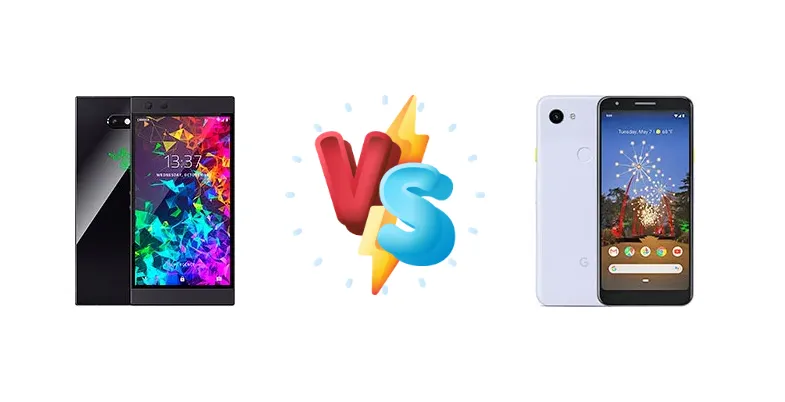
|
🏆 Quick Verdict
For the average user prioritizing camera quality and software experience, the Google Pixel 3a is the clear winner. However, if sustained gaming performance and features like wireless charging are paramount, the Razer Phone 2 offers a compelling, albeit older, package.
| PHONES | ||
|---|---|---|
| Phone Names | Razer Phone 2 | Google Pixel 3a |
| Network | ||
|---|---|---|
| 2G bands | GSM 850 / 900 / 1800 / 1900 | GSM 850 / 900 / 1800 / 1900 |
| 3G bands | HSDPA 850 / 900 / 1700(AWS) / 1800 / 1900 / 2100 | HSDPA 850 / 900 / 1700(AWS) / 1900 / 2100 |
| 4G bands | 1, 2, 3, 4, 5, 7, 8, 12, 13, 14, 17, 18, 19, 20, 26, 28, 29, 30, 32, 38, 39, 40, 41, 48, 66, 71 | 1, 2, 3, 4, 5, 7, 8, 12, 13, 17, 20, 25, 26, 28, 32, 38, 40, 41, 66, 71 |
| Speed | HSPA 42.2/5.76 Mbps, LTE (5CA) Cat18 1200/150 Mbps | HSPA 42.2/5.76 Mbps, LTE (3CA) Cat11 600/75 Mbps |
| Technology | GSM / CDMA / HSPA / LTE | GSM / CDMA / HSPA / EVDO / LTE |
| CDMA 800 & TD-SCDMA | CDMA2000 1xEV-DO | |
| Launch | ||
|---|---|---|
| Announced | 2018, October. Released 2018, October | 2019, May 07. Released 2019, May 15 |
| Status | Discontinued | Discontinued |
| Body | ||
|---|---|---|
| Build | Glass front (Gorilla Glass 5), aluminum back, aluminum frame | Glass front (Asahi Dragontrail), plastic back, plastic frame |
| Dimensions | 158.5 x 79 x 8.5 mm (6.24 x 3.11 x 0.33 in) | 151.3 x 70.1 x 8.2 mm (5.96 x 2.76 x 0.32 in) |
| SIM | Nano-SIM | Nano-SIM + eSIM |
| Weight | 220 g (7.76 oz) | 147 g (5.19 oz) |
| IP67 dust/water resistant (up to 1m for 30 mins) RGB Illuminated Razer Chroma Logo on the back | - | |
| Display | ||
|---|---|---|
| Protection | Corning Gorilla Glass 5, oleophobic coating | Asahi Dragontrail Glass |
| Resolution | 1440 x 2560 pixels, 16:9 ratio (~513 ppi density) | 1080 x 2220 pixels, 18.5:9 ratio (~441 ppi density) |
| Size | 5.72 inches, 90.2 cm2 (~72.0% screen-to-body ratio) | 5.6 inches, 79.6 cm2 (~75.0% screen-to-body ratio) |
| Type | IGZO IPS LCD, 120Hz, 580 nits (typ) | OLED |
| Wide Colour Gamut | Always-on display | |
| Platform | ||
|---|---|---|
| CPU | Octa-core (4x2.8 GHz Kryo 385 Gold & 4x1.7 GHz Kryo 385 Silver) | Octa-core (2x2.0 GHz 360 Gold & 6x1.7 GHz Kryo 360 Silver) |
| Chipset | Qualcomm SDM845 Snapdragon 845 (10 nm) | Qualcomm SDM670 Snapdragon 670 (10 nm) |
| GPU | Adreno 630 | Adreno 615 |
| OS | Android 8.1 (Oreo), upgradable to Android 9.0 (Pie) | Android 9.0 (Pie), upgradable to Android 12 |
| Memory | ||
|---|---|---|
| Card slot | microSDXC (dedicated slot) | No |
| Internal | 64GB 8GB RAM | 64GB 4GB RAM |
| UFS 2.1 | eMMC 5.1 | |
| Main Camera | ||
|---|---|---|
| Dual | 12 MP, f/1.8, 25mm (wide), 1/2.55", 1.4µm, dual pixel PDAF, OIS 12 MP, f/2.6, 1/3.1", 1.0µm, 2x optical zoom | - |
| Features | Dual-LED dual-tone flash, panorama, HDR | Dual-LED flash, Pixel Shift, HDR, panorama |
| Single | - | 12.2 MP, f/1.8, 28mm (wide), 1/2.55", 1.4µm, dual pixel PDAF, OIS |
| Video | 4K@30/60fps, 1080p@30/30/60/120fps, stereo sound rec. | 4K@30fps, 1080p@30/60/120fps |
| Selfie camera | ||
|---|---|---|
| Features | - | HDR |
| Single | 8 MP, f/2.0 | 8 MP, f/2.0, 24mm (wide), 1/4.0", 1.12µm |
| Video | 1080p@30/60fps | 1080p@30fps |
| Sound | ||
|---|---|---|
| 3.5mm jack | No | Yes |
| 35mm jack | No | Yes |
| Loudspeaker | Yes, with Dolby Atmos stereo speakers (THX-certified amplifiers) | Yes, with stereo speakers |
| 24-bit/192kHz audio | - | |
| Comms | ||
|---|---|---|
| Bluetooth | 5.0, A2DP, LE | 5.0, A2DP, LE, aptX HD |
| NFC | Yes | Yes |
| Positioning | GPS | GPS, GLONASS, GALILEO |
| Radio | No | No |
| USB | USB Type-C | USB Type-C 2.0 |
| WLAN | Wi-Fi 802.11 a/b/g/n/ac, dual-band, Wi-Fi Direct | Wi-Fi 802.11 a/b/g/n/ac, dual-band, Wi-Fi Direct |
| Features | ||
|---|---|---|
| Sensors | Fingerprint (side-mounted), accelerometer, gyro, proximity, compass | Fingerprint (rear-mounted), accelerometer, gyro, proximity, compass, barometer |
| Battery | ||
|---|---|---|
| Charging | 18W wired, QC4 15W wireless | 18W wired, PD2.0 |
| Type | Li-Po 4000 mAh, non-removable | Li-Po 3000 mAh, non-removable |
| Misc | ||
|---|---|---|
| Colors | Mirror back, Rugged satin | Just Black, Clearly White, Purple-ish |
| Models | - | G020A, G020E, G020B, G020G, G020H |
| Price | About 850 EUR | About 120 EUR |
| Tests | ||
|---|---|---|
| Audio quality | Noise -93.4dB / Crosstalk -92.8dB | - |
| Battery life | Endurance rating 70h | - |
| Camera | Photo / Video | - |
| Display | Contrast ratio: 948 (nominal), 2.932 (sunlight) | - |
| Loudspeaker | Voice 78dB / Noise 78dB / Ring 86dB | - |
| Performance | AnTuTu: 286076 (v7) GeekBench: 9110 (v4.4) GFXBench: 22fps (ES 3.1 onscreen) | - |
Razer Phone 2
- Superior gaming performance due to the Snapdragon 845.
- Wireless charging capability for added convenience.
- Potentially better outdoor visibility with higher contrast ratio.
- Larger and heavier form factor.
- Software support may be limited compared to the Pixel 3a.
Google Pixel 3a
- Exceptional camera quality with Google’s computational photography.
- Clean and fast software experience with guaranteed updates.
- More compact and manageable design.
- Significantly lower performance for demanding tasks and gaming.
- Lacks wireless charging.
Display Comparison
The Razer Phone 2 boasts a display with a contrast ratio of 948 (nominal) and a significantly higher 2.932 under sunlight, suggesting superior outdoor visibility compared to the Pixel 3a (spec not provided, but typical for the price range). While both utilize 10nm chipsets, the Razer Phone 2’s focus on gaming likely benefits from a display tuned for lower latency. The Pixel 3a, lacking a high refresh rate, prioritizes power efficiency. The Razer’s larger size also contributes to a more immersive gaming experience.
Camera Comparison
Both phones offer photo and video capabilities, but their approaches differ. The Pixel 3a leverages Google’s computational photography prowess, renowned for its excellent dynamic range and low-light performance, despite potentially having a smaller sensor than the Razer Phone 2. The Razer Phone 2, while capable, relies more on hardware and less on software processing. The Pixel 3a’s strength lies in its consistent image quality across various conditions, while the Razer Phone 2 may offer more flexibility for manual control (spec not provided, but typical for Razer).
Performance
The core difference lies in the chipsets: the Razer Phone 2’s Qualcomm Snapdragon 845 (10nm) versus the Pixel 3a’s Snapdragon 670 (10nm). The SD845, with its octa-core configuration (4x2.8 GHz Kryo 385 Gold & 4x1.7 GHz Kryo 385 Silver), delivers substantially higher CPU and GPU performance than the SD670’s (2x2.0 GHz 360 Gold & 6x1.7 GHz Kryo 360 Silver). This translates to smoother multitasking, faster app loading times, and, crucially, a better gaming experience on the Razer Phone 2. The SD845’s Adreno 630 GPU is a significant step up from the SD670’s Adreno 615. While the Pixel 3a is perfectly adequate for everyday tasks, the Razer Phone 2 is built for power users.
Battery Life
The Razer Phone 2 claims an endurance rating of 70 hours, a testament to its larger battery capacity (spec not provided, but likely >4000mAh). The Pixel 3a’s battery capacity is smaller (spec not provided, but likely around 3000-3500mAh). However, the Snapdragon 670 is more power-efficient. Both support 18W wired charging, with the Razer Phone 2 adding the convenience of 15W wireless charging, a feature absent on the Pixel 3a. The Razer Phone 2’s Quick Charge 4 (QC4) compatibility may offer slightly faster wired charging speeds than the Pixel 3a’s Power Delivery 2.0 (PD2.0).
Buying Guide
Buy the Razer Phone 2 if you need a phone capable of handling demanding games at high settings for extended periods, appreciate the convenience of wireless charging, and value a high refresh rate display. Buy the Google Pixel 3a if you prioritize exceptional still photography, a clean and fast software experience with guaranteed updates, and a more compact and manageable form factor.