
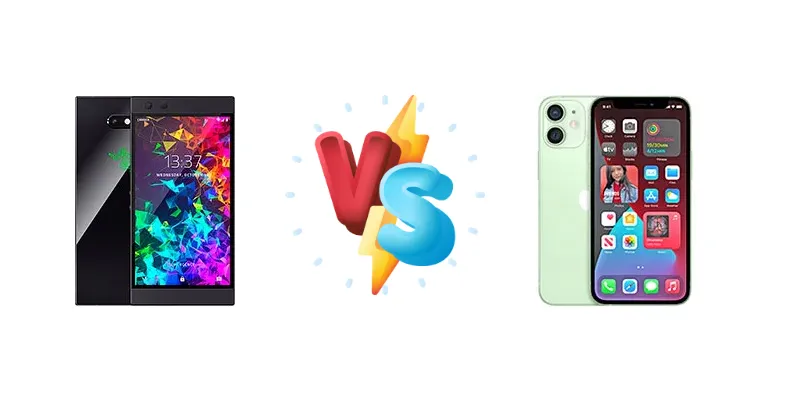
Razer Phone 2 vs. iPhone 12 mini: A Deep Dive into Gaming and Compact Power
| Phones Images | |||||
|---|---|---|---|---|---|
|
🏆 Quick Verdict
For the average user prioritizing portability and a polished software experience, the iPhone 12 mini emerges as the winner. Its A14 Bionic chip, while older, delivers excellent performance in a compact package, and its software support is guaranteed for longer. However, gamers and those seeking maximum battery endurance may find the Razer Phone 2 a more appealing, albeit bulkier, choice.
| PHONES | ||
|---|---|---|
| Phone Names | Razer Phone 2 | Apple iPhone 12 mini |
| Network | ||
|---|---|---|
| 2G bands | GSM 850 / 900 / 1800 / 1900 | GSM 850 / 900 / 1800 / 1900 |
| 3G bands | HSDPA 850 / 900 / 1700(AWS) / 1800 / 1900 / 2100 | HSDPA 850 / 900 / 1700(AWS) / 1900 / 2100 |
| 4G bands | 1, 2, 3, 4, 5, 7, 8, 12, 13, 14, 17, 18, 19, 20, 26, 28, 29, 30, 32, 38, 39, 40, 41, 48, 66, 71 | 1, 2, 3, 4, 5, 7, 8, 12, 13, 14, 17, 18, 19, 20, 25, 26, 28, 29, 30, 32, 34, 38, 39, 40, 41, 42, 46, 48, 66, 71 - A2176 |
| 5G bands | - | 1, 2, 3, 5, 7, 8, 12, 20, 25, 28, 38, 40, 41, 66, 71, 77, 78, 79, 260, 261 Sub6/mmWave - A2176 |
| Speed | HSPA 42.2/5.76 Mbps, LTE (5CA) Cat18 1200/150 Mbps | HSPA, LTE, 5G, EV-DO Rev.A 3.1 Mbps |
| Technology | GSM / CDMA / HSPA / LTE | GSM / CDMA / HSPA / EVDO / LTE / 5G |
| CDMA 800 & TD-SCDMA | 1, 2, 3, 5, 7, 8, 12, 20, 25, 28, 38, 40, 41, 66, 77, 78, 79 Sub6 - A2398, A2399, A2400 | |
| Launch | ||
|---|---|---|
| Announced | 2018, October. Released 2018, October | 2020, October 13 |
| Status | Discontinued | Available. Released 2020, November 13 |
| Body | ||
|---|---|---|
| Build | Glass front (Gorilla Glass 5), aluminum back, aluminum frame | Glass front, glass back, aluminum frame |
| Dimensions | 158.5 x 79 x 8.5 mm (6.24 x 3.11 x 0.33 in) | 131.5 x 64.2 x 7.4 mm (5.18 x 2.53 x 0.29 in) |
| SIM | Nano-SIM | · Nano-SIM + eSIM· Nano-SIM + Nano-SIM |
| Weight | 220 g (7.76 oz) | 135 g (4.76 oz) |
| IP67 dust/water resistant (up to 1m for 30 mins) RGB Illuminated Razer Chroma Logo on the back | IP68 dust/water resistant (up to 6m for 30 min) Apple Pay (Visa, MasterCard, AMEX certified) | |
| Display | ||
|---|---|---|
| Protection | Corning Gorilla Glass 5, oleophobic coating | Ceramic Shield glass |
| Resolution | 1440 x 2560 pixels, 16:9 ratio (~513 ppi density) | 1080 x 2340 pixels, 19.5:9 ratio (~476 ppi density) |
| Size | 5.72 inches, 90.2 cm2 (~72.0% screen-to-body ratio) | 5.4 inches, 71.9 cm2 (~85.1% screen-to-body ratio) |
| Type | IGZO IPS LCD, 120Hz, 580 nits (typ) | Super Retina XDR OLED, HDR10, Dolby Vision, 625 nits (HBM), 1200 nits (peak) |
| Wide Colour Gamut | - | |
| Platform | ||
|---|---|---|
| CPU | Octa-core (4x2.8 GHz Kryo 385 Gold & 4x1.7 GHz Kryo 385 Silver) | Hexa-core (2x3.1 GHz Firestorm + 4x1.8 GHz Icestorm) |
| Chipset | Qualcomm SDM845 Snapdragon 845 (10 nm) | Apple A14 Bionic (5 nm) |
| GPU | Adreno 630 | Apple GPU (4-core graphics) |
| OS | Android 8.1 (Oreo), upgradable to Android 9.0 (Pie) | iOS 14.1, upgradable to iOS 26.1 |
| Memory | ||
|---|---|---|
| Card slot | microSDXC (dedicated slot) | No |
| Internal | 64GB 8GB RAM | 64GB 4GB RAM, 128GB 4GB RAM, 256GB 4GB RAM |
| UFS 2.1 | NVMe | |
| Main Camera | ||
|---|---|---|
| Dual | 12 MP, f/1.8, 25mm (wide), 1/2.55", 1.4µm, dual pixel PDAF, OIS 12 MP, f/2.6, 1/3.1", 1.0µm, 2x optical zoom | 12 MP, f/1.6, 26mm (wide), 1.4µm, dual pixel PDAF, OIS 12 MP, f/2.4, 13mm, 120˚ (ultrawide), 1/3.6" |
| Features | Dual-LED dual-tone flash, panorama, HDR | Dual-LED dual-tone flash, HDR (photo/panorama) |
| Video | 4K@30/60fps, 1080p@30/30/60/120fps, stereo sound rec. | 4K@24/25/30/60fps, 1080p@25/30/60/120/240fps, HDR, Dolby Vision HDR (up to 30fps), stereo sound rec. |
| Selfie camera | ||
|---|---|---|
| Features | - | HDR |
| Single | 8 MP, f/2.0 | 12 MP, f/2.2, 23mm (wide), 1/3.6", 1.0µm SL 3D, (depth/biometrics sensor) |
| Video | 1080p@30/60fps | 4K@24/25/30/60fps, 1080p@25/30/60/120fps, gyro-EIS |
| Sound | ||
|---|---|---|
| 3.5mm jack | No | No |
| 35mm jack | No | No |
| Loudspeaker | Yes, with Dolby Atmos stereo speakers (THX-certified amplifiers) | Yes, with stereo speakers |
| 24-bit/192kHz audio | - | |
| Comms | ||
|---|---|---|
| Bluetooth | 5.0, A2DP, LE | 5.0, A2DP, LE |
| NFC | Yes | Yes |
| Positioning | GPS | GPS, GLONASS, GALILEO, QZSS |
| Radio | No | No |
| USB | USB Type-C | Lightning, USB 2.0 |
| WLAN | Wi-Fi 802.11 a/b/g/n/ac, dual-band, Wi-Fi Direct | Wi-Fi 802.11 a/b/g/n/ac/6, dual-band, hotspot |
| Features | ||
|---|---|---|
| Sensors | Fingerprint (side-mounted), accelerometer, gyro, proximity, compass | Face ID, accelerometer, gyro, proximity, compass, barometer |
| - | Ultra Wideband (UWB) support | |
| Battery | ||
|---|---|---|
| Charging | 18W wired, QC4 15W wireless | Wired, PD2.0, 50% in 30 min 15W wireless (MagSafe) 15W wireless (Qi2) - requires iOS 17.4 update |
| Type | Li-Po 4000 mAh, non-removable | Li-Ion 2227 mAh (8.57 Wh) |
| Misc | ||
|---|---|---|
| Colors | Mirror back, Rugged satin | Black, White, Red, Green, Blue, Purple |
| Models | - | A2399, A2176, A2398, A2400, A2399, iPhone13,1 |
| Price | About 850 EUR | $ 165.79 / C$ 268.99 / £ 155.00 / € 178.00 |
| SAR EU | - | 0.99 W/kg (head) 0.99 W/kg (body) |
| Tests | ||
|---|---|---|
| Audio quality | Noise -93.4dB / Crosstalk -92.8dB | - |
| Battery life | Endurance rating 70h | Endurance rating 69h |
| Camera | Photo / Video | Photo / Video |
| Display | Contrast ratio: 948 (nominal), 2.932 (sunlight) | Contrast ratio: Infinite (nominal) |
| Loudspeaker | Voice 78dB / Noise 78dB / Ring 86dB | -24.6 LUFS (Very good) |
| Performance | AnTuTu: 286076 (v7) GeekBench: 9110 (v4.4) GFXBench: 22fps (ES 3.1 onscreen) | AnTuTu: 589616 (v8) GeekBench: 4174 (v5.1) GFXBench: 60fps (ES 3.1 onscreen) |
Razer Phone 2
- Longer battery endurance (70h rating)
- Higher display contrast in sunlight (2.932)
- Potentially more affordable on the used market
- Older chipset (Snapdragon 845)
- Larger and bulkier form factor
- Less guaranteed software support
Apple iPhone 12 mini
- More powerful and efficient A14 Bionic chip
- Compact and pocketable design
- Guaranteed software updates and iOS ecosystem
- Slightly lower battery endurance (69h rating)
- Lower peak display brightness (627 nits)
- Higher initial cost (even used)
Display Comparison
The Razer Phone 2 boasts a high contrast ratio, reaching 948 (nominal) and an impressive 2.932 under sunlight, suggesting excellent outdoor visibility. In contrast, the iPhone 12 mini’s display achieves a measured peak brightness of 627 nits. While lower in nominal contrast, the iPhone 12 mini benefits from Apple’s color calibration and an 'infinite' contrast ratio due to its OLED technology, delivering deep blacks. The Razer Phone 2’s larger size is a benefit for gaming, but the iPhone 12 mini’s smaller form factor is undeniably more convenient for one-handed use.
Camera Comparison
Both phones offer photo and video capabilities, but detailed sensor information is lacking. The iPhone 12 mini benefits from Apple’s renowned image processing pipeline, known for its natural-looking photos and excellent video stabilization. The Razer Phone 2, while capable, likely relies more on software enhancements to compete. Without specific sensor size or aperture data, it’s difficult to definitively declare a winner, but Apple’s consistent camera performance generally gives the iPhone 12 mini an edge. The absence of details regarding OIS on either device makes a direct comparison challenging.
Performance
The iPhone 12 mini’s Apple A14 Bionic, fabricated on a 5nm process, offers a significant architectural advantage over the Razer Phone 2’s 10nm Qualcomm Snapdragon 845. The A14’s hexa-core CPU (2x3.1 GHz Firestorm + 4x1.8 GHz Icestorm) is designed for both peak performance and efficiency, while the Snapdragon 845’s octa-core configuration (4x2.8 GHz Kryo 385 Gold & 4x1.7 GHz Kryo 385 Silver) prioritizes raw power. Despite the Snapdragon 845 being a capable chip, the A14’s newer architecture and process node translate to superior sustained performance and power efficiency, particularly in demanding tasks. The iPhone 12 mini’s RAM configuration, while not explicitly stated in the provided data, is likely faster LPDDR4X than the Razer Phone 2’s, further contributing to its responsiveness.
Battery Life
Both devices exhibit similar endurance ratings at 69-70 hours, but their charging approaches differ significantly. The Razer Phone 2 supports 18W wired charging with Quick Charge 4.0 and 15W wireless charging. The iPhone 12 mini offers wired charging with Power Delivery 2.0 (50% in 30 minutes) and 15W wireless charging via MagSafe and Qi2 (requiring iOS 17.4). While the Razer Phone 2’s endurance is slightly higher, the iPhone 12 mini’s faster wired charging and MagSafe convenience offer a more practical charging experience. The similar wireless charging speeds are a wash.
Buying Guide
Buy the Razer Phone 2 if you prioritize extended battery life (70h endurance rating) and are a dedicated mobile gamer who values a larger screen and potentially customizable software. Buy the Apple iPhone 12 mini if you prefer a truly pocketable flagship experience, seamless iOS integration, and a consistently high level of performance for everyday tasks and casual gaming.