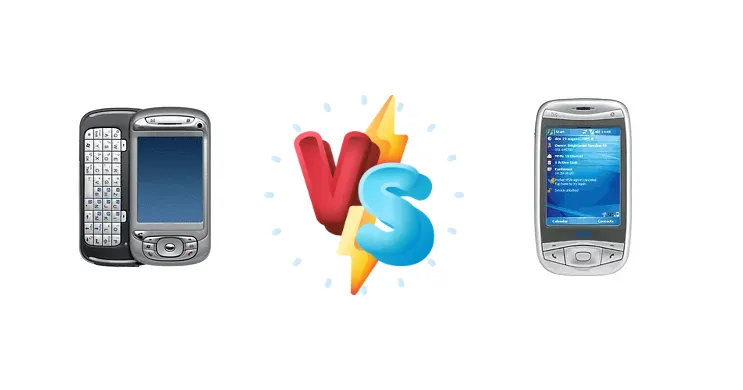
The Qtek 9600 and 9100 represent pivotal moments in the early smartphone era, both running Windows Mobile but diverging significantly in their core hardware. This comparison dissects the architectural differences between the Samsung-powered 9600 and the TI OMAP 850-based 9100, revealing how these choices impacted real-world performance and user experience.
🏆 Quick Verdict
For users prioritizing responsiveness and the potential for smoother multitasking, the Qtek 9600 emerges as the better choice. Its 400 MHz Samsung processor, while still modest by today’s standards, offers a 100% clock speed advantage over the 9100’s 200 MHz ARM926EJ-S, translating to a noticeably snappier experience.
| Network |
|---|
| 2G bands | GSM 850 / 900 / 1800 / 1900 | GSM 850 / 900 / 1800 / 1900 |
| 3G bands | UMTS 850 / 1900 / 2100 | - |
| EDGE | - | Class 10 |
| GPRS | - | Class 10 |
| Speed | Yes, 384 kbps | - |
| Technology | GSM / UMTS | GSM |
| Launch |
|---|
| Announced | 2006, June | 2005, Q3 |
| Status | Discontinued | Discontinued |
| Body |
|---|
| Dimensions | 113 x 58 x 22 mm (4.45 x 2.28 x 0.87 in) | 109 x 58 x 23 mm (4.29 x 2.28 x 0.91 in) |
| Keyboard | QWERTY | QWERTY |
| SIM | Mini-SIM | Mini-SIM |
| Weight | 176 g (6.21 oz) | 160 g (5.64 oz) |
| Display |
|---|
| Resolution | 240 x 320 pixels, 4:3 ratio (~143 ppi density) | 240 x 320 pixels, 4:3 ratio (~143 ppi density) |
| Size | 2.8 inches, 42 x 57 mm, 24.3 cm2 (~37.0% screen-to-body ratio) | 2.8 inches, 42 x 57 mm, 24.3 cm2 (~38.4% screen-to-body ratio) |
| Type | TFT resistive touchscreen, 65K colors | TFT resistive touchscreen, 65K colors |
| | Handwriting recognition
| - |
| Platform |
|---|
| CPU | 400 MHz Samsung | 200 MHz ARM926EJ-S |
| Chipset | - | TI OMAP 850 |
| OS | Microsoft Windows Mobile 5.0 PocketPC | Microsoft Windows Mobile 5.0 PocketPC |
| Memory |
|---|
| Card slot | microSD (dedicated slot) | miniSD |
| Internal | 64MB RAM, 128MB ROM | 64MB RAM, 128MB ROM |
| Main Camera |
|---|
| Features | LED flash | LED flash |
| Single | 2 MP | 1.3 MP |
| Video | Yes | Yes |
| Selfie camera |
|---|
| Single | QCIF videocall camera | - |
| | - | No |
| Sound |
|---|
| 3.5mm jack | No | No |
| 35mm jack | No | No |
| Alert types | Vibration; Downloadable polyphonic, MP3 ringtones | Vibration; Downloadable polyphonic, MP3 ringtones |
| Loudspeaker | Yes | Yes |
| Comms |
|---|
| Bluetooth | 2.0 | 2.0 |
| Infrared port | Yes | Yes |
| Positioning | No | No |
| Radio | No | No |
| USB | 1.1 | Proprietary |
| WLAN | Wi-Fi 802.11b/g | Wi-Fi 802.11b/g |
| Features |
|---|
| Browser | WAP 2.0/xHTML, HTML (PocketIE) | WAP 2.0/xHTML, HTML (PocketIE) |
| | Pocket Office
Voice memo
MP3/AAC player | Microsoft ActiveSync
Pocket Office
MP3/AAC player
Predictive text input |
| Battery |
|---|
| Stand-by | Up to 300 h | Up to 200 h |
| Talk time | Up to 5 h | Up to 4 h |
| Type | Removable Li-Po 1350 mAh battery | Removable Li-Po 1250 mAh battery |
| Misc |
|---|
| Colors | Silver | Stylish black |
Qtek 9600
- Faster 400 MHz processor for improved responsiveness
- Potentially smoother multitasking capabilities
- Faster application loading times
- Likely shorter battery life due to higher power consumption
- Potentially higher operating temperature
Qtek 9100
- Potentially longer battery life due to lower power consumption
- TI OMAP 850 includes a DSP for audio processing
- May run cooler under sustained load
- Slower 200 MHz processor resulting in sluggish performance
- Noticeably slower application loading times
- Less responsive user interface
Display Comparison
Information regarding display specifications (resolution, size, panel type) is unavailable. However, both devices likely utilized resistive touchscreens common to the era, impacting usability. The focus here is on processing power, as display quality was not a primary differentiator in this market segment.
Camera Comparison
Camera specifications are not provided. Given the era, both devices likely featured basic VGA or 1.3MP cameras primarily for capturing simple snapshots. Image processing capabilities would have been limited by the processor’s capabilities, making the 9600’s faster CPU potentially beneficial for quicker image capture and processing, though the difference would be minimal.
Performance
The core difference lies in the processors. The Qtek 9600’s 400 MHz Samsung CPU represents a significant leap over the Qtek 9100’s 200 MHz ARM926EJ-S. The ARM926EJ-S, while efficient, was designed for simpler tasks. The 9600’s higher clock speed allows for faster application loading and smoother operation of Windows Mobile’s interface. The TI OMAP 850 in the 9100 includes an integrated DSP, potentially offering advantages in audio processing, but this doesn’t offset the raw CPU performance deficit. The 9600’s processor is likely built on a larger process node, potentially impacting thermal efficiency, but the lower overall workload mitigates this concern.
Battery Life
Battery capacity data is unavailable. However, the 9100’s lower clock speed suggests it would likely achieve longer battery life under typical usage. The 9600’s faster processor will consume more power, potentially requiring more frequent charging. The trade-off is performance versus longevity.
Buying Guide
Buy the Qtek 9600 if you need a device capable of handling basic Windows Mobile tasks with greater speed and responsiveness, even if it means potentially sacrificing battery life due to the higher clock speed. Buy the Qtek 9100 if you prioritize potentially longer battery life and are willing to accept a slower, more deliberate pace for application loading and system navigation. The 9100 is best suited for users who primarily make calls and send messages.
Frequently Asked Questions
❓ Will the Qtek 9600 struggle with demanding Windows Mobile applications?
While the 400 MHz processor is an improvement, the Qtek 9600 will still struggle with resource-intensive applications. Windows Mobile was not optimized for high performance, and even 400 MHz is relatively slow by modern standards. Expect some lag and delays when running multiple applications simultaneously.
❓ Is the TI OMAP 850’s DSP in the Qtek 9100 noticeable in everyday use?
The benefits of the OMAP 850’s DSP are likely subtle. It may offer slightly improved audio quality during calls or when playing media, but this difference would be difficult to discern without a direct comparison. The DSP does not compensate for the significantly slower CPU.
❓ Which device is better for basic tasks like calling and texting?
The Qtek 9100 is perfectly adequate for basic tasks like calling and texting. Its lower power consumption will result in longer battery life, making it a practical choice for users who primarily use their phone for communication.